
题目列表(包括答案和解析)
情景反应,根据对话内容从对话后所给的选项中选择正确答案.
补全对话.
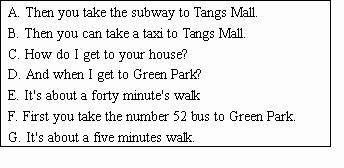
A: Can you come to my party tomorrow, Ed?
B: Yes, I can. Thanks. __________________ (1)
A: That's easy. _________________ (2)That's about half an hour.
B: Okay. ________________ (3)
A: ________________ (4)That takes about ten minutes.
B: Okay. First the bus and then the subway to Tangs Mall.
A: Yeah, then you walk up North Street to number 15. _________ (5)
B: Okay, thanks. That sounds easy.

情景反应,根据对话内容从对话后所给的选项中选择正确答案.
补全对话.
A: Can you come to my party tomorrow, Ed?
B: Yes, I can. Thanks. __________________ (1)
A: That's easy. _________________ (2)That's about half an hour.
B: Okay. ________________ (3)
A: ________________ (4)That takes about ten minutes.
B: Okay. First the bus and then the subway to Tangs Mall.
A: Yeah, then you walk up North Street to number 15. _________ (5)
B: Okay, thanks. That sounds easy.
Every morning, the newspaper chief editor(主编) holds a meeting with the reporters. They discuss the main events(事件) of the day. Reporters are then sent to cover the events.
As soon as the reporters know what to write about, they get down to work. They telephone people and fix a time for a face-to-face interview with them. Sometimes they do telephone interviews. Checking information is very important. They go to the newspaper's own library to look up any information that they need. This is called “doing one's homework”.
At the same time, the picture editor decides which photographs will be used for the next day's paper. All the people who work on a newspaper must be able to work fast. Reporters have to stop working on one story and start working at once on the important new one. They must find out the new information as quickly as possible. Later in the day, everything is put together at the news desk. Reporters return, type their stories into the computer and hand them to the editor.
The chief editor decides which will be the most important story on the front page. Sometimes this will have to be changed if something more important happens late in the day. Other editors read the stories which the reporters have written and make any necessary changes.
Finally, there is no more time left for adding new stories, and the time for printing(印刷) the newspaper has come. This is done on fast-moving printing machines. The newspapers are then delivered(发送) by truck, plane or rail. Speed is important. People want to buy the latest newspaper; nobody wants to buy yesterday's.
【小题1】What is the work in a newspaper office like?
| A.Interesting and confusing | B.Important and patient. |
| C.Particular and necessary. | D.Fast and busy. |
| A.c-b-a-d-e | B.c-d-e-a-b | C.c-b-d-a-e | D.c-a-d-b-e |
| A.the importance of the events |
| B.how well the stories are written |
| C.the knowledge of the chief editor |
| D.whether they are the latest |
| A.help the chief editor with the morning discussion |
| B.decide when and how the papers can be printed |
| C.read the stories and make necessary changes |
| D.get together information from reporters and photographers |
| A.How a newspaper is produced | B.How newspapers are delivered |
| C.What kind of papers readers like | D.Whose work is more important |
阅读与回答问题
Let children learn to judge their own work.A child learning to talk does not learn by being correct-ed all the time:if corrected too much, he will stop talking.He noticed a thousand times a day the difference between the language he uses and the language those around him use.Bit by bit, he makes the necessary changes to make his language like other people's.In the same way, children learn to do all the other things without being taught to walk, run, ride a bicycle.But in school we never give a child to find out his mistakes and correct them for himself.We do it all for him.We act as if we thought that he would never notice a mistake unless it was pointed out to him, or correct it unless he was made to.Let him work out, with the help of other children if he wants, what this word says, what the answer is to that problem, whether this is a good way of saying or doing this or not.
If it is a matter of right answers, as it may be in maths or science, give him the answer book.Let him correct his own papers.Why should our teachers waste time on much routine(日常的)work?Our job should be to help the child when he tells us that he can't find the way to get the right answer.Let the children learn what all educated person must some day learn, how to measure their own under-standing, how to know what they know or do not know.
1.Why shouldn't we continuously correct a child's mistakes while he is talking?
_____________________________________________
2.How does the writer think children usually learn to walk, run, climb, and so on?
_____________________________________________
3.The writer doesn't think teachers in school ever give a child a chance to find out his mistakes or correct them for himself, does he?
_____________________________________________
4.What should teacher's job be according to the passage?
_____________________________________________
5.What does the writer suggest teachers to do?
_____________________________________________
阅读理解
The thin monk stood there in his purple robes, grinning at me. Then I recognized him. I couldn't believe my eyes! “Ben!” I said. “What are you…I mean…why…?”
Ben said nothing, but quickly put his finger to his lips to tell me be quiet. Then he led me to a car that was waiting outside the airport. We got in, spoke to the driver in Nepali, and we drove off.
“Would you mind telling me what's going on?” I asked. At the same time, I noticed that we were driving out of the city towards the mountains. “And where are we going?” I said.
“I'm sorry, Ed,” said Ben. “I know this must seem very strange. Let me explain. For the past few months I have been traveling around Nepali disguised as a monk. I speak Nepali fluently, and when I'm dressed like this no one can tell that I'm a foreigner.”
“Yes,” I said. “But why do you need to travel in disguise. Who are you chasing or hiding from?” “Art thieves.” said Ben. “International criminals who steal ancient works of art from poor countries like Nepali, and then sell them to rich collectors.” He pulled something out of his monk's robs. “Look at this: a gold statue of the Buddha. It's almost one thousand and five hundred years old. Foreign collectors would pay one million dollars for a piece like this. It was in a Buddhist monastery in a place called Mastong. Then two months ago, it disappeared. I found it last week in a box that fell out of the back of a lorry. The lorry was full of stolen objects that were about to be smuggled out of the country.”
“Why don't you tell the police,” I asked.
“You'll meet the boss in a minute,” said Ben. “She'll explain the rest.”
We were driving through the back streets of the old city, passed buildings with beautifully carved wooden windows. But the streets were dirty, and the air was heavy with smog. I had heard about Kathmandu's pollution problem, but this was worse than I had expected. “Ugh!” I exclaimed. “This is awful! I can hardly breathe!”
1.When “I” recognized the thin monk, “I” was ________.
[ ]
2.When he met “I”, Ben was ________.
[ ]
A.amazed to see “me”
B.talking to the driver of his car
C.worried that people might hear their conversation
D.waiting outside the airport
3.Ben was wearing monk's clothes ________.
[ ]
A.because they were more comfortable for traveling
B.so that people could not tell that he was a foreigner
C.to help him hide from the police
D.because he thought they seemed strange to others.
4.Ben is chasing ________.
[ ]
A.people who steal old works of art
B.foreigner art collectors
C.a gold statue of the Buddha
D.Buddhist monks
5.The word “This” in the passage refers to ________.
[ ]
湖北省互联网违法和不良信息举报平台 | 网上有害信息举报专区 | 电信诈骗举报专区 | 涉历史虚无主义有害信息举报专区 | 涉企侵权举报专区
违法和不良信息举报电话:027-86699610 举报邮箱:58377363@163.com