
题目列表(包括答案和解析)
There are many things we need to know, but we do not learn them at school. For example, if we want to use our money wisely, we need to shop carefully. We need to know how to compare(比较) the prices of the things in different shops. We also need to know how to make the best choice when we shop .
Knowing how to make such choices is a life skill, and we need to practice it in our daily life.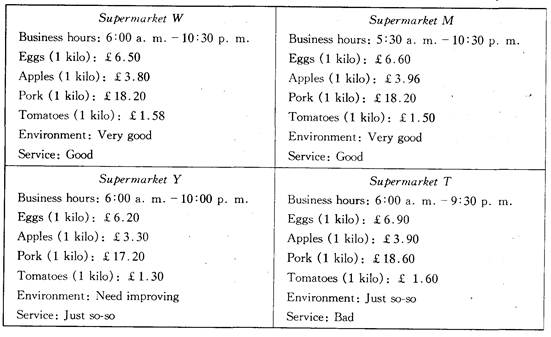
【小题1】Which supermarket has the longest Business hours?
| A.Supermarket M. | B.Supermarket T. |
| C.Supermarket Y. | D.Supermarket W. |
| A.Supermarket W. | B.Supermarket T. |
| C.Supermarket M. | D.Supermarket Y. |
| A.The environment. | B.The Business hours. |
| C.The Price. | D.The Service. |
It is common to believe that learning just takes place in school, but much of human learning happens outside the classroom, even from birth and people continue to learn throughout their lives.
Even before they enter school, young children learn to walk, to talk, and to use their hands to use toys, food, and other objects. They use all of their senses to learn about the sights, sounds, tastes, and smells in their environments. They learn how to communicate with their parents, grandparents, siblings, friends, and other people important to their world. When they enter school, children learn subjects like reading, writing, and maths. They also continue to learn a lot outside the classroom. They learn which behaviors are likely to be rewarded and which are likely to be punished. They learn social skills for communicating with other children. After they finish school, people must learn to deal with many changes that affect their lives, such as getting married, raising children, and finding and keeping a job.
Because learning continues throughout our lives and influences almost everything we do, the study of learning is important in many different fields. Teachers need to understand the best ways to educate children. Scientists, social workers and other human service workers need to understand how certain experiences change people’s behaviors.
Learning is closely related (相关的) to memory, which is the storage(储存) of information in the brain (大脑). Scientists who study memory are interested in how the brain stores knowledge, where this storage takes place, and how the brain later offers knowledge when we need it. However, scientists who study learning are more interested in behavior and how behavior changes as a result of a person’s experiences. ?
【小题1】The underlined word “siblings” in Paragraph 2 probably means _________.
| A.teachers | B.classmates | C.doctors | D.brothers or sisters |
| A.After they go into society. | B.Before they enter school. |
| C.When they are at school. | D.Before they are born. |
| A.As a matter of fact, learning begins at a person’s birth and last the whole life. |
| B.Teachers need to understand the best ways to educate their students. |
| C.People need to understand how certain experiences change their behaviors. |
| D.Social workers need to study how experiences affect people’s thoughts. |
Swimming is very popular in summer. People like swimming in summer because water 【小题1】m______ people feel cool. If you like swimming and swim in a wrong place, it may not be safe(安全的). Last summer, more than ten people died 【小题2】w______ they were 【小题3】e_______ themselves in the water, and 【小题4】m______ of them were students. But some people are 【小题5】s_____ not careful in swimming. They often think they swim so well that【小题6】n_____ can happen to them in water. Summer is here again , if you go swimming in summer, don’t forget that better swimmers have died in 【小题7】w______. They 【小题8】d______ only because they were not 【小题9】c______, not because they could not swim. So don’t get into water when you go swimming 【小题10】y______, go with your teachers or your parents. If there are “No 【小题11】S______” sign, don’t get into water, either. If you 【小题12】r______ these, swimming will be safer.
 Recent research from
the Pew Internet Project suggests that 90% of Americans aged from 12 to 17 use
the Internet, and 51% of those teens use social networks. However, there are
many possible problems with social networking
sites and the teenagers who use them.
Recent research from
the Pew Internet Project suggests that 90% of Americans aged from 12 to 17 use
the Internet, and 51% of those teens use social networks. However, there are
many possible problems with social networking
sites and the teenagers who use them.
Apart from the social advantages, social networking sites can be used to record school research, develop artistic talents and experiment with other forms of subject creation. They provide a way to communicate with others who share the same interests and to get helpful advice on ongoing projects.
Along with these advantages come some dangers. For example, most social networking sites are open to all, especially MySpace, which is the most popular social network among teens in America. It means that they could be put in unpleasant and frightening situations.
A greater danger is that teens may become objects of the people with secret purposes. The secrecy of some social networking sites makes it easy for dangerous people to find young teens and invite them into dangerous conversations. It’s easy for them to pretend as teens and draw children into dangerous real-world communication as well. Then further hurt might be on its way.
Another danger is identity stealing, which can happen when teens share too much information about their names, dates of birth and locations.
Therefore, it’s very important to make sure teens are safe when they use social networks.
Many of the same rules that work for online chat work for these sites:
※ Don’t use your real name.
※ Don’t give out personal information to people you don’t know. A last name and a town
are enough for a bad guy to find where you are.
※ Don’t believe that people are who they say to be.
※ Immediately end any communication that makes you uncomfortable and report it to a
parent.
Only if you are sure of your safety, can you enjoy the fun brought by social networking. Besides, trying to deal with all problems on your own can lead to terrible results. Remember, asking your parents or school officials for help doesn’t mean you are unable to do anything but wiser than many others.
1.How many dangers of using social networks are mentioned in the passage?
A. 2. B. 3. C. 4. D. 5.
2.The writer takes MySpace as an example to show that ________.
A. students could be put into unreal situations on the Internet
B. teenagers are facing unknown dangers on the social networks
C. Internet provides more social websites to American teenagers
D. social networks are very popular among teenagers in America
3.We can infer from the passage that ________.
A. the dangers are similar when chatting online and surfing social networks
B. more than half American teenagers aged from 12 to 17 use social networks
C. teens who ask for help are wiser when meeting problems on social networks
D. there are more disadvantages than advantages for teens to use social networks
湖北省互联网违法和不良信息举报平台 | 网上有害信息举报专区 | 电信诈骗举报专区 | 涉历史虚无主义有害信息举报专区 | 涉企侵权举报专区
违法和不良信息举报电话:027-86699610 举报邮箱:58377363@163.com