
题目列表(包括答案和解析)
Monday morning is an important time at our school. All of the students go to the playground. We listen to music, and we 16 the national flag go up.
Usually, one student gives a talk on Monday mornings. One Monday last year, a boy gave the talk. He was 17 and excited! When I saw him, I wanted to have a try, too.
Can I really do it?
Last week, our teacher said our class should give the talk. My teacher 18 me, “I know you want to have a try. Next Monday, you can give the talk. Go and write something down. 19 for it, I’m sure you’ll do well.”
“Thank you,” I answered. It was such a great 20 for me! When I got home, I was excited. I wrote two pages for the talk. I read them again and again. When I read, I asked my parents 21 . I wanted to make my teacher happy.
Monday morning came. I began to feel 22 . When did I last give a talk to 23 many people? Never! This was my first time. Could I really 24 it ? Maybe I couldn’t finish the talk.
When I got to school, we all went out to playground. I 25 in front of everyone. I opened my mouth, but I couldn’t say anything.
“Take it easy,” I said to 26 . “Don’t be nervous. You can do it.”
Just then, I looked down at everyone. I saw about 1,000 eyes. They were all looking at me ! I couldn’t 27 stand up.
I looked at their eyes more carefully. Their eyes were saying, “You can do it! Don’t be afraid, just talk!”
I 28 a big breath. Then I began to talk. It wasn’t hard. It was easy.
I don’t know 29 I finished my talk. But I did it. I felt so good that day. I showed myself 30 everyone what I can do.
1.A. watch B. see C. notice D. look at
2.A. surprising B. proud C. amazed D. careful
3.A. told B. asked for C. said to D. showed
4.A. Look out B. Come on C. Take care D. Get ready
5.A. chance B. news C. time D. message
6.A. to listen to B. to listen C. listen to D. listen
7.A. excited B. happy C. nervous D. surprised
8.A. after B. such C. before D. so
9.A. do B. speak C. talk D. take
10.A. stand B. stood C. was standing D. have stood
11.A. me B. my class C. myself D. my parents
12.A. be able to B. hardly C. ever D. even
13.A. took B. held C. put D. left
14.A. when B. how C. why D. whether
15.A. so B. but C. to D. for
| 小题1: |
|
| 小题2: |
|
| 小题3: |
|
| 小题4: |
|
| 小题5: |
|
| 小题6: |
|
| 小题7: |
|
| 小题8: |
|
| 小题9: |
|
| 小题10: |
|
Life in Britain
Homes and families: Many British people live in houses, not flats. Most houses have gardens.
Daily life: Most office workers start work at about nine in the morning, and finish at about five or six in the afternoon. Most people don’t go home for lunch. They just have a quick meal.
School life : Children start school at about 9 a.m. and finish at about 3:30 p.m. Most children have lunch at school. All children go to school when they are six or seven.
Shops Most shops open at about 9 a.m. and close at 6 p.m. Usually they don’t close for lunch.
1 The buildings that British people live in are ______
A. gardens B. houses C. rooms D. flats
2 Most children have lunch _______
A. at school. B. at home. C. in the shop. D. in the garden.
3 How old do the children start to go to school in Britain? ______
A. Four. B. Four or five. C. Twelve or thirteen. D. Six or seven.
4 Can you buy things in the shops at lunch time ?
A. Yes. They don’t close for lunch. B. No. Shops open at 1 p.m.
C. Yes. But there is no people in the shop. D. No. They close for lunch.
5 What do the most office workers do at about nine in the morning?
A. Have breakfast. B. Go to school. C. Drink coffee. D. Start work.
Life in Britain
Homes and families: Many British people live in houses, not flats. Most houses have gardens.
Daily life: Most office workers start work at about nine in the morning, and finish at about five or six in the afternoon. Most people don’t go home for lunch. They just have a quick meal.
School life : Children start school at about 9 a.m. and finish at about 3:30 p.m. Most children have lunch at school. All children go to school when they are six or seven.
Shops Most shops open at about 9 a.m. and close at 6 p.m. Usually they don’t close for lunch.
1 The buildings that British people live in are ______
A. gardens B. houses C. rooms D. flats
2 Most children have lunch _______
A. at school. B. at home. C. in the shop. D. in the garden.
3 How old do the children start to go to school in Britain? ______
A. Four. B. Four or five. C. Twelve or thirteen. D. Six or seven.
4 Can you buy things in the shops at lunch time ?
A. Yes. They don’t close for lunch. B. No. Shops open at 1 p.m.
C. Yes. But there is no people in the shop. D. No. They close for lunch.
5 What do the most office workers do at about nine in the morning?
A. Have breakfast. B. Go to school. C. Drink coffee. D. Start work.
听力选择(共20小题,计20分)
Ⅰ.录音中有五个句子,每个句子听一遍,然后从每小题ABC中选出适合每个句子的答语。
1.A.Size 10
B.Number 10
C.Ten dollars
2.A.Five dollars.
B.You can’t buy it.
C.Guess.
3.A.Yes, but you can’t buy it.
B.Yes, it was sold out.
C.Sorry, it was sold out.
4.A.It’s interesting, and I will read it again.
B.It is so interesting that I have read it twice.
C.It is so interesting that I haven’t read it.
5.A.Either I or she.
B.Either he or I.
C.Either of them.
Ⅱ.录音中有五组对话和五个问题,听对话和问题一遍,然后从每小题ABC中选出能回答每个问题的正确答案。
6.What is Julia’s sister?
A.A singer
B.A player
C.A nurse
7.What will Mary do this Sunday?
A.Study for the test.
B.Go to play table tennis.
C.Go to visit her friends.
8.Why is Katie moving?
A.She needs a small house.
B.She needs a beautiful house.
C.She needs a big house.
9.Why is Jim late again?
A.His bike is broken on his way to school.
B.The traffic is too heavy.
C.He gets up late in the morning.
10.How does Anna usually go to school?
A.She drives her car.
B.She takes a bus.
C.She rides her bike.
Ⅲ.录音中有一大段对话和五个问题,听对话和问题两遍,然后从每小题ABC中选出能回答每个问题的人正确答案。
11.Where does the conversation take place(发生)?
A.In a shop.
B.In an office.
C.At school.
12.What is the man customer doing?
A.He is buying a shirt.
B.He is buying a pair of shoes.
C.He is posting a letter.
13.How much is the short blue one?
A.Thirty pounds.
B.Fifteen pounds fifty.
C.Fifteen.
14.What is his size?
A.42.
B.38.
C.40.
15.Why does this salesgirl say “Just a moment”?
A.She is going to talk with the manager.
B.She is going to get a bigger shirt for the man.
C.She doesn’t want to help the man.
Ⅳ.短文理解。根据你听到的短文内容和五个问题,从ABC中选出与你所听到的短文内容相符的答案。短文读两遍。
16.Linda wrote to Lois on _________.
A.Dec.13
B.Sept.30
C.Nov.13
17.Lois receives the letter _________.
A.a few days ago
B.two days ago
C.a few weeks ago
18.Lois is now _________.
A.in New York
B.with her aunt
C.in Chicago
19.The main idea of the passage is _________.
A.Lois’ aunt will come for Christmas
B.
Lois can’t join Linda for ChristmasC.Lois hopes that Linda will come to visit her some day.
20.It is suggested in the passage that _________.
A.Lois is very grateful to Linda for her invitation.
B.Linda has not been living in New York for long
C.Lois hopes Linda can come to Chicago for Christmas
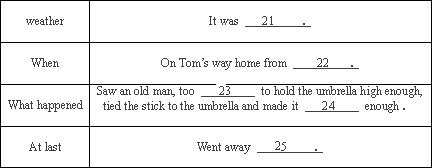
Ⅴ.听短文填空。根据你所听到的对话内容和表格中的提示,讲所听到的主要信息填入表格中相应的位置上。对话读两遍。(5分)
湖北省互联网违法和不良信息举报平台 | 网上有害信息举报专区 | 电信诈骗举报专区 | 涉历史虚无主义有害信息举报专区 | 涉企侵权举报专区
违法和不良信息举报电话:027-86699610 举报邮箱:58377363@163.com