
题目列表(包括答案和解析)
书面表达
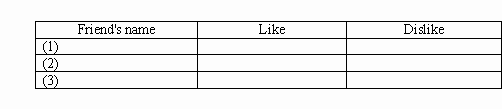
Ask three of your friends the questions “What do you like?” and “What do you not like?” Write their answers in the form below. Then make a report to you class.
1) Fill in the form
2) Report
(1) ________ likes ________,but he/she doesn't like ________.
(2) ________ likes ________,but he/she doesn't like ________.
(3) ________ likes ________,but he/she doesn't like ________.
学习语言的关键在于应用。请你根据提示词语及句型,踊跃参加以下活动吧!相信你一定是佼佼者!
A.Who is Dr. Know?
Choose a problem from the list below. Ask your classmates for advice. Who gives the best advice is “Dr. Know”.
提示词语及句型:
1)Problems: toothache, stressed out, hungry, backache, cold, sorethroat, tired, headache, thirsty
2)What's the matter?
You should (shouldn't)…
3)lie down, go to bed, see a dentist, listen to music, go out, drink, eat, have a rest, exercise…
B.Who is the healthiest?
Make a survey about what some of your classmates do and how often they do on weekends. Tell it to your classmates. Take a vote:
Who is the healthiest?
提示词语及句型:
1)always, usually, often, sometimes, hardly ever, never, watch TV, read books, exercise, shop, surf the Internet, play football
2)What do you usually do on weekends?
How often do you watch TV?
C.Vacation Dreams
Imagine your dream vacation. On a piece of paper, write what you are doing for vacation, when you are going and how long you are staying there. Put your paper in a bag, then take another paper from the bag. Find the students who has your paper.
提示词语及句型:
1)go camping, go bike riding, go sightseeing, take walks, visit, on Monday, tomorrow, the day after tomorrow, on the 12th, next week, for a week, for three days
2)Where are you doing for vacation?
What are you doing for vacation?
When are you going?
How long are you staying there?
D.Find someone who…
Ask three of your classmates questions. Write their answers in the table below. The first student to fill in all the blanks wins.
提示词语及句型:
1)walk to, ride my bike, take the bus (train, subway), get to school
2)How do you get to school?
How long does it take?
How far is it from…to…?

E.Plan a party
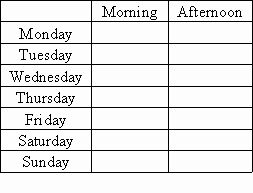
Write everything you have to do next week, and fill in the table below. Choose a day and time to have a party. Then invite classmates to your party.
提示词语及句型:
1)study, have a lesson, visit, help, play football, go to the movies, watch TV
2)Can you come to my party?
I have to…
What are you doing on Tuesday?
F.The same and different
Write your name on a piece of paper and put it in a bag. Take a paper from the bag to find a partner. You have three minutes to make a list of things that are the same and different between you and your partner. The pair with the most items wins.
提示词语及句型:
1)tall, quiet, athletic, serious, intellectual, thin, funny
2)He is taller than me.
We are both girls.

In the Caucasus region(高加索地区), nearly 50 out of every 100,000 people live to celebrate their 100th birthday, and many don’t stop at 100! By comparison, in America only 3 people in 100,000 reach 100. But these Caucasus people aren’t alone. The Pakistani Hunzas, who live high in the Himalaya Mountains, and the Vilcabambans of the Andes Mountains in Ecuador seem to share the secret of long life too.
These peoples remain healthy in body and spirit despite the passage of time. While many older persons in industrial societies become weak and ill in their 60s and 70s, some Caucasus people aged 110-140, work in the fields beside their great-great-grandchildren. Even the idea of aging is foreign to them. When asked, “At what age does youth end?” most of these old people had no answer. Several replied, “Well, perhaps at age 80.” The very youngest estimate was age 60.
What accounts for this ability to survive (live) to such old age, and to survive so well? First of all, hard physical work is a way of life for all of these long-lived peoples. They began their long days of physical labor as children and never seem to stop. For example, Mr. Rustam is 142 years of age. He remembers his life experience: the Crimean War of 1854; the Turkish War of 1878; the Bolshevik Revolution in 1917. His wife is 116 years old. They have been married for 90 years. Mr. Rustam has no plan of retiring from his life as a farmer. “Why? What else would I do?” he asks. Oh, he’s slowed down a bit. Now he might quit (stop working) for the day after 6 hours in the field instead of 10.
All these people get healthful rewards from the environment in which they work. They all come from mountainous regions. They live and work at elevations(海拔)of 5,000 to 12, 000 feet(1,660 to 4,000meters) above sea level. The air has less oxygen and is pollution-free. This reduced oxygen environment makes the heart and blood vessel(血管)system stronger.
Another factor(因素)that may lead to the good health of these people is their isolation. To a great extent, they are separated from the pressure(压力)and worries of industrial society.
Inherited(遗传的) factors also play some role. Most of the longest-lived peoples had parents and grandparents who also reached very old age. Good family genes may, therefore, be one factor in living longer.
Finally, although these three groups don’t eat exactly the same foods, their diets are similar. All of them eat little animal meat. Their diets are full of fresh fruits, vegetables, nuts, grains, cheese and milk. They never eat more food than their bodies need.
It is clear that isolation from urban pressure and pollution, clean mountain air, daily hard work, moderate diets, good genes, and a youthful approach to life all lead to the health and remarkable long life of all these people.
1. What is the main idea of this article?
A.Cause and effect of long-lived life.
B.People in the world enjoying a longer life.
C.Factors leading to the health and long life of people.
D.A description of several societies where people living a long life.
2. “The idea of aging is foreign to them” means that _________.
A.they don’t care much about their age
B.they have no idea of how old they are
C.they won’t say anything about their age until they are asked to
D.the idea of getting old has never come into their mind
3. How do you think the writer feels about these long-lived people?
A.He is much impressed with them.
B.He doesn’t care a bit about them.
C.He hopes that they will live a still longer life.
D.He doesn’t think their life is full of pressure and worries.
In the Caucasus region(高加索地区), nearly 50 out of every 100,000 people live to celebrate their 100th birthday, and many don’t stop at 100! By comparison, in America only 3 people in 100,000 reach 100. But these Caucasus people aren’t alone. The Pakistani Hunzas, who live high in the Himalaya Mountains, and the Vilcabambans of the Andes Mountains in Ecuador seem to share the secret of long life too.
These peoples remain healthy in body and spirit despite the passage of time. While many older persons in industrial societies become weak and ill in their 60s and 70s, some Caucasus people aged 110-140, work in the fields beside their great-great-grandchildren. Even the idea of aging is foreign to them. When asked, “At what age does youth end?” most of these old people had no answer. Several replied, “Well, perhaps at age 80.” The very youngest estimate was age 60.
What accounts for this ability to survive (live) to such old age, and to survive so well? First of all, hard physical work is a way of life for all of these long-lived peoples. They began their long days of physical labor as children and never seem to stop. For example, Mr. Rustam is 142 years of age. He remembers his life experience: the Crimean War of 1854; the Turkish War of 1878; the Bolshevik Revolution in 1917. His wife is 116 years old. They have been married for 90 years. Mr. Rustam has no plan of retiring from his life as a farmer. “Why? What else would I do?” he asks. Oh, he’s slowed down a bit. Now he might quit (stop working) for the day after 6 hours in the field instead of 10.
All these people get healthful rewards from the environment in which they work. They all come from mountainous regions. They live and work at elevations(海拔)of 5,000 to 12, 000 feet(1,660 to 4,000meters) above sea level. The air has less oxygen and is pollution-free. This reduced oxygen environment makes the heart and blood vessel(血管)system stronger.
Another factor(因素)that may lead to the good health of these people is their isolation. To a great extent, they are separated from the pressure(压力)and worries of industrial society.
Inherited(遗传的) factors also play some role. Most of the longest-lived peoples had parents and grandparents who also reached very old age. Good family genes may, therefore, be one factor in living longer.
Finally, although these three groups don’t eat exactly the same foods, their diets are similar. All of them eat little animal meat. Their diets are full of fresh fruits, vegetables, nuts, grains, cheese and milk. They never eat more food than their bodies need.
It is clear that isolation from urban pressure and pollution, clean mountain air, daily hard work, moderate diets, good genes, and a youthful approach to life all lead to the health and remarkable long life of all these people.
【小题1】 What is the main idea of this article?
| A.Cause and effect of long-lived life. |
| B.People in the world enjoying a longer life. |
| C.Factors leading to the health and long life of people. |
| D.A description of several societies where people living a long life. |
| A.they don’t care much about their age |
| B.they have no idea of how old they are |
| C.they won’t say anything about their age until they are asked to |
| D.the idea of getting old has never come into their mind |
| A.He is much impressed with them. |
| B.He doesn’t care a bit about them. |
| C.He hopes that they will live a still longer life. |
| D.He doesn’t think their life is full of pressure and worries. |
Grace is nine years old. She has a bad cold and coughs all the time. One day, she went to see a doctor. The doctor gave her some cough medicine.
There are some words on the bottle of the medicine.
|
Shake the bottle well before taking the medicine. |
||
|
Take the medicine 3 times a day after meals. |
||
|
Dose(剂量) for each time: |
||
|
Age |
Over 15 |
2 teaspoons(茶匙) |
|
8-14 |
1 teaspoon |
|
|
4-7 |
1/2 teaspoon |
|
|
*It doesn't work for the children below the age of 3. *Be sure the cap on the bottle is nice and tight(紧的)after taking the medicine. *Keep it away from sunlight. *Use before Dec.2009. |
1.How much medicine should Grace take a day?
A.Half a teaspoon. B.At teaspoon.
C.Two teaspoons. D.Three teaspoons.
2.What should Grace do at first when she wants to the medicine?
A.Wash the bottle. B.Shake the bottle.
C.Keep the bottle cool. D.Keep the bottle hot.
3.After Grace takes the medicine, she should ____.
A.throw the cap away
B.put the bottle in a place with sunlight
C.put a nice cap on the bottle
D.put the cap back on the bottle and tighten it
4.Can a two-year-old child take the medicine?
A.No, he can't.
B.Yes, but only 1/3 teaspoon each time.
C.Yes, but he has to ask the doctor
D.Yes, but only 1/2 teaspoon each time.
5.Which of the following is TRUE?
A.If someone has a stomachache, he can also take the medicine.
B.If Grace's father has a cold, he should take the medicine 2 teaspoons a day.
C.After getting up, Grace should take the medicine at once.
D.Grace can't use the medicine after DEC.2009.
湖北省互联网违法和不良信息举报平台 | 网上有害信息举报专区 | 电信诈骗举报专区 | 涉历史虚无主义有害信息举报专区 | 涉企侵权举报专区
违法和不良信息举报电话:027-86699610 举报邮箱:58377363@163.com