
A: do you want? B: I'd like some fruit. A. What B. Where C. How D. How much 查看更多


题目列表(包括答案和解析)

阅读下面短文,掌握大意,从每小题所给的A、B、C、D四个选项中选出一个最佳选项。
For the first time, Zhang Shengyu, a student at Laiyang Middle School in Shandong, didn’t ask her mother to buy _____ a new schoolbag or any new pens for the beginning of the school term. “My old schoolbag can still be used, so there is no need to buy a new one,” Zhang Shengyu said. “I’ve _____ to be thrift* from now on.”
As the ____ of the family’s attention, many of the one-child do not know about the hardships* of life. They sometimes have ____idea of the value* of things. Many students would _____pens and erasers that haven’t been used up and buy new ones. Some students like to have a competition with each other to see whose clothes and school things are ______.
The Ministry of Education _____a notice on its website on Jan 20. It called on students to form good _____ such as stopping wasting food. Many schools think teaching the value of money to be an important ______ and encourage their students to be thrifty.
Teachers at Yu Cai Middle School in Wenzhou gave a speech _______ the food on the first day back to school this year. “When we came back from the holiday, we found a slogan “Empty Plates” on _______ table in the dining room. It tells us that it’s______ OK to waste. In the past, I ordered three dishes for each meal, but now I only order two. ______ I want to try three, I will ask for a smaller one”. Wang Tong said.
Students at No 44 Middle School of Shijiazhuang, Hebei planted many fruit trees in their school. Through taking care of the trees, the students learned ______to cherish* things.
At Tie Yi Middle School in Xi’an, students organized a group to collect used pen refills* and use them for crafts*. “What we students do are small things, ________I think with everyone’s work, we can make a difference,” said Li Dongdong,, a 16-year-old student at the school.
小题1:
A.meB.himC.herD.you
小题2:
A.believedB.decidedC.hoped D.told
小题3:
A.centerB.actionC.dream D.corner
小题4:
A.any B.someC.noD.an
小题5:
A.throw awayB.take awayC.put awayD.keep away
小题6:
A.more expensiveB.cheaper
C.more comfortableD.more colorful
小题7:
A.explainedB.showedC.collectedD.saw
小题8:
A.waysB.habitsC.hobbiesD.duty
小题9:
A.lessonB.orderC.subject D.experience
小题10:
A.aboutB.ofC.toD.with
小题11:
A.allB.someC.bothD.each
小题12:
A.alwaysB.usualC.sometimes D.never
小题13:
A.BecauseB.When C.UnlessD.If
小题14:
A.howB.whenC.whatD.where
小题15:
A.andB.butC.soD.or

查看答案和解析>>

阅读理解

阅读下面文章,根据文章内容,从每小题所给的A、B、C、D四个选项中选出能回答所提问题或完成所给句子的最佳答案。

  It was so dark outside the car window that is was hard to see anything.

  “Can I have a carrot, Mum?” Riley asked.

  “I don't have any carrots,” her mum said.“How about an apple?”

  “No,” said Riley.“It has to be a carrot.”

  “Why do you want a carrot?” asked her mum.

  “You always say carrots help your eyes,” said Riley.“If I eat one now, it might help me see in the dark.”

  Would eating a carrot really help Riley? What is special about carrots? A clue to what makes a carrot special is its color.Carrots are orange because they store beta-carotene(胡萝卜素).Beta-carotene is a way to talk about Vitamin A(维生素A).Your eyes need Vitamin A.It helps them work.

  When light hits your eye, very small parts inside turn the light into messages.The messages go to your brain(脑),and then you know what you're looking at.Your eye can only turn light into messages when it has a special chemical(化学物质).That's where Vitamin A comes in.Your eyes use Vitamin A to make the special chemical.Every time your eye changes light to messages, a little bit of the chemical is used up.By the end of the day, you've looked at hundreds of things.That uses up a lot of the chemical.Your eyes need to make more.

  What should you eat if you don't like carrots? Don't worry.Other fruits and vegetables have Vitamin A too.The secret is in their color.Most orange or red fruits store some beta-carotene, or Vitamin A.Sweet potatoes, red peppers, mangoes(芒果)are a few that have the same orange secret.Can you think of any more?

(1)

Riley wanted a carrot because she thought ________.

[  ]

A.

she liked it

B.

she was thirsty

C.

it could help her see in the dark

D.

it was sweet and delicious

(2)

The word “clue” here in Chinese means ________.

[  ]

A.

告知

B.

线路

C.

方法

D.

线索

(3)

How can Vitamin A help your eyes work?

[  ]

A.

The special chemical can stop your eyes from using up Vitamin A.

B.

Vitamin A can stop your eyes from using up the special chemical.

C.

The special chemical is used to make Vitamin A the light is turned

into messages with.

D.

Vitamin A is used to make the special chemical the light is turned

into messages with.

(4)

Which one is NOT TRUE according to the above passage?

[  ]

A.

Carrots are orange because they store beta-carotene.

B.

Any food which is orange or red must have some Vitamin A.

C.

Most fruits that are orange or red store some beta-carotene or

Vitamin A.

D.

Sweet potatoes, red peppers, and mangoes have the same orange secret.

(5)

The passage mainly tells us that ________.

[  ]

A.

we can't see clearly in the dark unless we eat any carrots every day

B.

we can't see clearly unless we eat any orange or red food every day

C.

we should eat some food with Vitamin A so that we can see clearly

D.

we should eat some fruit with beta-carotene so that we can see in the dark

查看答案和解析>>

阅读理解。
     Mrs. Smith has a shop in the town. There are all kinds of fruit in her shop. She's friendly to the
customers and never, fools (愚弄) anyone. So the customers like to buy fruit in her shop and she
gets more and more money.     
     One day, the apples she sold were all fresh and nice. She remembered her son Steve like. them best, 
so she brought some home for her son. After lunch, she went out and left the apples on the table. That 
afternoon Steve came back from school , he felt very hungry. He looked tor something to eat and found
 some apples on the table. "Great ! They are my favorite," he cried and ate a lot. Mrs. Smith got home 
after she closed her fruit shop. When she saw Steve, she asked him,"Did you have the apples?" Her son 
answered, "Yes, And I ate lots of them." "Did you wash them?" "Oh, I forgot. (忘记) I was too hungry. 
What should I do?"     
     A few minutes later, Mrs. Smith found her son kept on drinking water.     
    "Are you thirsty? Why are you drinking so much water?" asked the mother.
    "No, Mom," answered the boy, "I want to wash the apples in my stomach (胃) with the water."
1. What shop does Mrs. Smith have?     
A clothes shop.     
B. A food shop.     
C. A fruit shop.
D. A bookshop.
2.What's Steve's favorite fruit?
A. Oranges.      
B. Pears.
C. Bananas.      
D. Apples.
3. Where did Steve find the fruit?     
A. On the table.     
B. In the basket.     
C. In the kitchen.
D. In his bedroom.
4. Why did Steve keep on drinking water?     
A. Because he was very thirsty.
B. Because he wanted to wash the apples in his stomach.     
C. Because he liked drinking water. 
D. Because he was very hungry.
5. Could he wash the apples in his stomach with the water?
A. Yes, he could.     
B. No, he couldn't.      
C. Sorry, I don't know.     
D. Yes, I think so.

查看答案和解析>>

Amy was a dear little girl, but she was too ready to waste time in getting ready to do her tasks, instead of doing them at once as she ought to.

In the village in which she lived, Mr. Thornton kept a store where he sold fruit of all kinds, including berries in their season. One day he said to Amy, whose parents were quite poor, “Would you like to earn some money?”

“Oh, yes, ” replied she, “for I want some new shoes, and papa has no money to buy them with.”

“Well, Amy,” said Mr. Thornton, “I noticed some fine, ripe blackberries in Mr. Green’s field today, and he said that anybody was welcome to them. I will pay you thirteen cents a quart(度量单位) for all you will pick for me.”

Amy was delighted at the thought of earning some money; so she ran home to get a basket, intending to go immediately to pick the berries.

Then she thought she would like to know how much money she would get if she picked five quarts. With the help of her slate(书写板) and pencil, she found out that she would get sixty-five cents.

“But supposing I should pick a dozen quarts,” thought she, “how much should I earn then?” “Dear me!” she said, after figuring(测算) a while, “I should earn a dollar and fifty-six cents.”

Amy then found out what Mr. Thornton would pay her for fifty, a hundred, and two hundred quarts. It took her some time to do this, and then it was so near dinner time that she had to stay at home until afternoon.

As soon as dinner was over, she took her basket and hurried to the field. Some boys had been there before dinner, and all the ripe berries were picked. She could not find enough to fill a quarter of a quart.

As Amy went home, she thought of what her teacher had often told her---“Do your task at once; then think about it,” for “One doer is worth a hundred dreamers.”

56. How many times did Amy figure with her slate?

A. 3.              B. 4.              C. 5.            D. 6.

57. The underlined sentence may mean “______”.

A. she got ready to waste some time to do her tasks

B. she thought it was a waste of time to do her tasks

C. she liked to waste time when should do her tasks immediately

D. she was not ready to get her tasks ready, and it’s a waste of time

58. What can we infer from the story?

A. Amy’s family was very poor.

B. Amy was good at counting with a slate.

C. Mr. Thornton was the richest person in the village.

D. Amy would learn a better lesson from this affair than from school.       

59. The best title of the passage may be “_____”.

A. The Money Amy Did Not Earn       

B. The Girl Did Not Like To Waste Time  

C. Amy, A Good Student To her Teachers

D. A Poor Girl Wanted To Earn Some Money

查看答案和解析>>

听力部分(25分)

Ⅰ.听句子,选出句子中包含的信息。每个句子读两遍。(共5小题,每题1分)

1.A.biking

B.hiking

C.hanging

2.A.on Saturdays

B.on Sundays

C.on sunny days

3.A.bus station

B.subway station

C.train station

4.A.Kay wants to be a doctor.

B.Kay is ill.

C.Kay is a bad girl.

5.A.My friend and I are old.

B.My friend is younger than me.

C.My friend is older than me.

Ⅱ.听句子,选出正确的答语。每个句子读两遍。(共5小题,每题1分)

6.A.Three or four times a week.

B.This Sunday.

C.He wants to buy some fruit.

7.A.I am going on vacation.

B.To Tibet.

C.By bike.

8.A.For ten minutes.

B.By bike.

C.Ten minutes’ walk.

9.A.All right.Let’s go.

B.That’s all right.

C.How about you?

10.A.Sorry, I am late.

B.Yes, I’d love to.

C.I think I can’t.

Ⅲ.听对话及问题,选择正确的答案。对话及问题读两遍。(共5小题,每题1分)

11.What does Cindy have to do On Sunday afternoon?

A.

B.

C.

12.How is John going to school today?

A.

B.

C.

13.What does Lucy do on weekends?

A.

B.
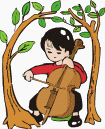
C.

14.What does the woman want the man to get her?

A.A stamp

B.A cup of coffee

C.A letter

15.When is the man leaving Pairs?

A.May 1st

B.May 3rd

C.May 4th

Ⅳ.听对话,根据对话内容选择正确答案。 对话及问题读两遍。(共5小题,每题1分)

请听第一段对话,回答第16-17小题。

16.What sport does Michael like best?

A.Volleyball

B.Baseball

C.Basketball

17.How often does he play it?

A.Once a week

B.Twice a week

C.Every day

请听第二段对话,回答第18-20小题。

18.Why is David going to England?

A.To study

B.To travel

C.To visit friends

19.Where is David mainly(主要)staying in England?

A.In Liverpool

B.In London

C.In Manchester

20.How long is David staying in England?

A.2 weeks

B.4 weeks

C.6 weeks

Ⅴ.听电话录音,根据录音内容补全表格。内容读两遍。(共5小题,每题1分)
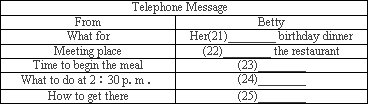
查看答案和解析>>


同步练习册答案