
题目列表(包括答案和解析)
阅读理解
Every object has weight. But the center of its weight is not always in the middle of the object, If the top of an object is heavier than its bottom, it will fall over easily. We say that its center of gravity
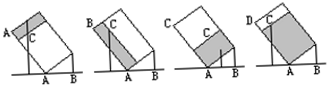
(引力)is high. But if the bottom is heavier, it won't fall easily. Then we say that its center of gravity is low.Look at the first picture, lifts empty box must fall over, bemuse its center of gravity (C) is not above the line of its bottom (AB).
Now look at the second picture. There is some heavy iron at the bottom of this box. It will not fall, because its center of gravity is above its bottom.
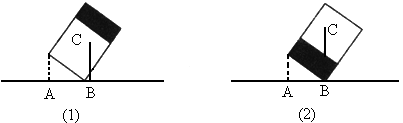
(1) Please point out which box will not fall?
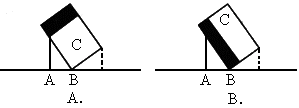
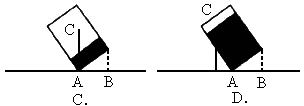
(2) From the passage, we can infer that the Leaning Tower of Pisa does not fall is because_______.
[
]A
.the top of the tower is heavier than its bottomB
.the bottom of the tower is not heavier than its topC
.its center of the gravity is still above the line of its bottomD
.its center of the gravity is not above the line of its bottom(3) If an object has a low center of gravity, _______.
[
]|
A .it won't fall |
B .it won't fall easily |
|
C .it is certain to fall over |
D .its top must be heavier |
(4) Which of the following is TRUE according to the passage?
[
]A
.The center of the weight is always in the middle of the objectB
.The center of the weight is always on the objectC
.The center of gravity is not always in the middle of the objectD
.The center of the gravity is always high(5) The passage is mainly about _______.
[
]|
A .why things fall over |
B .a low center of gravity |
|
C .a high center of gravity |
D .that everything has weight |
Every object has weight. But the center of its weight is not always in the middle of the object. If the top of an object is heavier than its bottom, it will fall over easily. We say that its center of gravity is high. But if the bottom is heavier, it won’t fall easily. Then we say that its center of gravity is low.
Look at the first picture. This empty box must fall over, because its center of gravity (C) is not above the line of its bottom (AB).
Now look at the second picture. There is some heavy iron in the bottom of this box. It will not fall, because its center of gravity is above its bottom.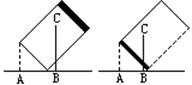
【小题1】If the bottom of an object is ______ its top, it will fall over easily.
| A.lighter than | B.heavier than | C.no heavier than | D.as heavy as |
| A.why things fall over | B.a low center of gravity |
| C.a high center of gravity | D.that everything has weight |
Every object has weight. But the center of its weight is not always in the middle of the object. If the top of an object is heavier than its bottom, it will fall over easily. We say that its center of gravity is high. But if the bottom is heavier, it won’t fall easily. Then we say that its center of gravity is low.
Look at the first picture. This empty box must fall over, because its center of gravity (C) is not above the line of its bottom (AB).
Now look at the second picture. There is some heavy iron in the bottom of this box. It will not fall, because its center of gravity is above its bottom.

1.If the bottom of an object is ______ its top, it will fall over easily.
A. lighter than B. heavier than C. no heavier than D. as heavy as
2.Please point out which box will not fall.

3.The main idea of the passage is _________.
A. why things fall over B. a low center of gravity
C. a high center of gravity D. that everything has weight
“Mum, I want to make you a bet,” I said. “If I go a whole year without TV, will you give me a hundred dollars?”
“Well, if you can 1 do it, …”
“Of course I can,” I replied, trying to convince 2 .
In fact, all this started from my 3 of a picture in the newspaper. I couldn’t bear to look at that boy. He said that he had 4 one year without TV for a hundred dollars, 5 me with mocking eyes. It seemed he was saying, “I did it, 6 you can’t!”. I glared at the boy’s face.
That year I did a lot of things. For example, my father taught me to 7 , which became my favorite sport. 8 winter afternoons snowball wars with my neighbors offered daily drama. I went on bike trips with my friends and swam as much as a fish.
It was unbelievable how much 9 I had without TV. I learned so many new games. I guess the 10 thing I learnt, though, was self-motivation(上进心).
I started to do my homework. I went from a D student to an A student within a couple of 11 .
I used to 12 reading if there were no 13 , but now I began to read and enjoy it. I could arrange off all the pictures just the way I wanted them—my own little TV, right 14 my head!
I’m surprised what I did. I got a lot more from the 15 than just the 100 dollars!
| 【小题1】 |
|
| 【小题2】 |
|
| 【小题3】 |
|
| 【小题4】 |
|
| 【小题5】 |
|
| 【小题6】 |
|
| 【小题7】 |
|
| 【小题8】 |
|
| 【小题9】 |
|
| 【小题10】 |
|
| 【小题11】 |
|
| 【小题12】 |
|
| 【小题13】 |
|
| 【小题14】 |
|
| 【小题15】 |
|
| |||||||||||||||||||||||||||||||||||||||||||||||||||||||||||||||||||||||||
湖北省互联网违法和不良信息举报平台 | 网上有害信息举报专区 | 电信诈骗举报专区 | 涉历史虚无主义有害信息举报专区 | 涉企侵权举报专区
违法和不良信息举报电话:027-86699610 举报邮箱:58377363@163.com