
题目列表(包括答案和解析)
When it rains, do your shoes get wet? Of course they do! But you can buy these pretty red and white “Umbrella for Shoes”. They keep the rain off wet.
Who sweeps the floor at your home? Do you do it yourself? Perhaps your mother does it. Well, now you just need a cat. Get a cat and buy these four “Dusters (抹布)for Cats ”.
You talk too long on the phone, don’t you? Most teenagers do! Save time – buy the “Telephone Dumb–bell (哑铃)”! It weighs five kilos. Then your calls will be less than five minutes.
Do your friends sometimes come up behind you and make you jump? Do cars come around the corner when you try to cross the road? Well, you can solve that problem with these modern “Forward – backward Glasses.” Look forward with the right eye and back with the left.
【小题1】Which of the following pictures is the right order to match the text?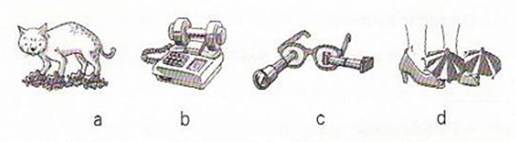
| A.d; a; b; c | B.b; a; c; d | C.d; a; c; b | D.b; d; a; c |
| A.do some housework | B.keep the rain off |
| C.speak on the phone | D.look for something |
| A.drawings | B.inventions | C.animals | D.shoes |
In the West, some people believe that personality can be predicted according to the time of the year the person was bor. From China comes the belief that the year of birth influences one’s personality. In the past century, a new belief ahs arisen: the idea that personality is related to one’s ABO blood type. People with blood type A, for example, are considered more likely to be serious, hard-working, and quiet, while people with blood type O are likely to be popular and outgoing, yet often unable to finish what they start. Though this belief continues to be strong, some people question whether it is true.
The blood-type personality theory(理论) started in Japan in 1927 when Furukawa Takehi noticed personality similarities and differences among his workers. This idea soon went out of fashion, but was brought back by a Japanese television host named Toshitaka Nomi in the 1970s. The belief is still strong in Japan and is increasingly popular in neighboring countries. Some young Koreans have taken to the theory. A recent study showed 76 percent of Koreans aged between13 and 64 believing in the blood-type personality connection. Though most Asians might believe in the blood-type theory, for many it seems harmless and not something to be taken too seriously.
Is the belief true? The scientists in Asia largely dismiss the belief as a modern-day superstition(迷信). Most studies have failed to find any strong connection between blood and personality. Generally, scientists warn against making predictions or important decisions based on this questionable theory.
1.The writer uses blood type A and O as an example to explain ________.
A. the difference between to two blood types
B. the relationship between the two blood types
C. the influence of blood type on one’s behavior
D. the connection between personality and blood type
2. What does the underlined sentence in Paragraph 2 mean?
A. It was lightly believed. B. It was brought to them.
C. They liked and accepted it. D. They stole the idea from others
3.Which of the following is true according to the passage?
A. Most scientists in Asia don’t believe in the theory.
B. The blood-type theory began in Japan in the 1970s.
C. The blood-type personality theory is about blood type.
D. People don’t change their personality to match the theory.
4.What is the best title for the passage?
A. Is the blood-type theory poplar? B. Is the personality changeable?
C. Is it in your blood? D. Is it in you mind?
用所给词的适当形式填空
【小题1】It takes twenty minutes __________ (get) to the nearest town by car from here.
【小题2】Why don’t you _________(play) foot ball with us?
【小题3】There are lots of interesting things __________(see) in the Palace Museum.
【小题4】He seldom____________(eat) rice dumplings.
【小题5】----Where is Helen? ----She ______________(prepare) food for her friends.
【小题6】There __________ (be) a football match the day after tomorrow.
【小题7】Turn left at the __________ (nine) turning.
【小题8】Who teaches ___________(we) English.
【小题9】We look forward to ____________ (visit) your school in Shanghai.
【小题10】The UK is a __________(west) country.
【小题11】Would you like __________(help) us do some cleaning?
【小题12】My brother sometimes _____________ (watch) a film with me at the cinema.
【小题13】We _____________ (be) there at 9 a.m. tomorrow.
【小题14】What about __________ (take) another route?
【小题15】How ___________(wonder) these Chinese paintings are!
阅读下列短文,根据短文中的信息完成文后表格。(每空一词)
A 10-year-old boy decided to learn judo though he had lost his left arm in a car accident. The boy was doing well, so he couldn’t understand why, after three months of training, the master had taught him only one move.
“ Master,” the boy finally asked, “shouldn’t I be learning more moves?” “ This is the only move you know, but this is the only move you’ll ever need to know,” the teacher answered.
Several months later, the teacher took the boy to his first competition. Surprising himself, the boy easily won his first two matches. The third match proved to be more difficult, but after some time, his opponent (对手) became impatient and charged; the boy skillfully used his one move to win the match. Still amazed by his success, the boy was now in the final.
This time, his opponent was bigger, stronger, and more experienced. Soon after the match started, the boy seemed to lose. Thinking that the boy might get hurt, the judge called a time-out. He was going to stop the match when the teacher appeared. “ No,” the teacher said, “Let him continue.” A short time after the match carried on, his opponent made a careless mistake. At once, the boy used his move to pin (压住) him. The boy won the match and the competition.
On the way home, the boy asked the teacher what was really in his mind. “ Why could I win the competition with only one move?” The teacher answered. “ First, you’ve mastered one of the most difficult throws in judo. Second, your opponent can only attack your left arm to win you.”
根据短文内容完成下面的表格,每空一词。
|
Title: One’s weakness can become his 1. _▲_ |
||
|
A boy had lost left arm, 2. _▲_ he decided to learn judo |
||
|
After three months of training, the master taught him only one move. |
||
|
His first 3. _▲_ |
First three matches |
He won.[来源:ZXXK] |
|
Final |
His opponent was bigger, 4. _▲_ and more 5. _▲_ . At the 6. _▲_, the boy seemed to lose the match. The judge was 7. _▲_ that the boy might get hurt and called a time-out. His opponent made a mistake. The boy used his move and pinned him. He became the 8. _▲_ of the match. |
|
|
9. _▲_ |
1. He had almost mastered one of the most difficult throws in all of judo. 2. The opponent can win the match by 10. _▲_ your left arm. |
| A.the difference between to two blood types |
| B.the relationship between the two blood types |
| C.the influence of blood type on one’s behavior |
| D.the connection between personality and blood type |
| A.It was lightly believed. | B.It was brought to them. |
| C.They liked and accepted it. | D.They stole the idea from others |
| A.Most scientists in Asia don’t believe in the theory. |
| B.The blood-type theory began in Japan in the 1970s. |
| C.The blood-type personality theory is about blood type. |
| D.People don’t change their personality to match the theory. |
| A.Is the blood-type theory poplar? | B.Is the personality changeable? |
| C.Is it in your blood? | D.Is it in you mind? |
湖北省互联网违法和不良信息举报平台 | 网上有害信息举报专区 | 电信诈骗举报专区 | 涉历史虚无主义有害信息举报专区 | 涉企侵权举报专区
违法和不良信息举报电话:027-86699610 举报邮箱:58377363@163.com