题目列表(包括答案和解析)
In most languages, a greeting is usually followed by “small talk”. Small talk means the little things we talk about at the start of a conversation.
In English-speaking countries people often make small talk about the weather: “Nice day, isn’t it?” “Terrible weather, isn’t it?” But there is something special about small talk. It must be about something which both people have the same opinion about. The purpose of small talk is to let both people agree on something. This makes meeting people easier and more comfortable. People usually agree about the weather, so it is a safe topic for small talk. But people often disagree about religion or politics so these are not suitable topics for small talk in English. The topics for small talk also depend on where the conversation is taking place. At football matches, people make small talk about the game they are watching: “Great game, isn’t it?” At bus stops, people may comment about the transport system: “The bus service is terrible, isn’t it?”
Greetings and small talk are an important part of conversation in any language. The way people great each and the things they talk about, however, may be different from one language to another. This shows that there is much more to learn when we learn a language than just the vocabulary and the grammar of the language. We also have to learn the social behavior of the people who speak it.
【小题1】Small talk ___.
| A.is a kind of conversation with short words |
| B.is a greeting when people meet each other |
| C.is to let people disagree about something |
| D.is something we talk about to start a conversation |
| A.the weather | B.politics | C.Games | D.languages |
| A.we should learn about the transport system of the country |
| B.we should only master the grammar and vocabulary |
| C.we should know the culture about the country |
| D.we should grasp the importance of the language |
| A.ask a question | B.have a conversation |
| C.greet each other | D.begin a small talk |
| A.different language has different grammar |
| B.small talk is an important part in a language |
| C.small talk depends on the purpose of the conversation |
| D.in English-speaking countries we should talk about the weather. |
阅读下面语言材料,根据要求作答。根据短文内容,判断文后句子的正确(T)与错误(F)
“How are you?” is a nice question. It’s a friendly way that people in the U.S.A greet each other. But “How are you?” is also a very unusual question. It’s a question that often doesn’t need an answer. The person who asks“ How are you?” hopes to hear the answer “Fine”, even if the person’s friend isn’t fine. The reason is that “How are you?” isn’t really a question and “Fine” isn’t really an answer. They are simply other ways of saying “Hello” or “Hi”.
Sometimes, people also don’t say exactly what they mean. For example, when someone Asks “Do you agree?”, the other person might think, “No, I disagree. I think you’re Wrong...”But it isn’t very polite to disagree so strongly, so the other person might say “I’m not sure.” It’s a nicer way to say that you don’t agree with someone.
People also don’t say exactly what they are thinking when they finish talking with other people. For example, many talks over the phone finish when one person say “I’ve to go now.” Often, the person who wants to hang up gives an excuse: “Someone’s at the door.”“Something is burning on the stove.” The excuses might be real, or not. Perhaps the person who wants to hang up simply doesn’t want to talk any more, but it isn’t polite to say that. The excuse is more polite, and it doesn’t hurt the other person.
Whether they are greeting each other, talking about an idea, or finishing a talk, people don’t say exactly that they are thinking. It’s an important way that people try to be nice to each other, and it’s part of the game of language.
【小题1】“How are you?” is another way of saying "Hello." or" Hi."
【小题2】It is polite to say" No. I disagree I think you are wrong, "if you don’t agree with others.
【小题3】When someone says "I have to go now "On the phone.it means he wants to go on talking.
【小题4】"Someone is at the door." may be an excuse for finishing a phone.
【小题5】Sometimes people don’t say exactly what they are thinking about just because they try to be nice to each other.
A greeting is a way of saying "Hello" to someone. People in different countries greet each other in different ways. Here are some.
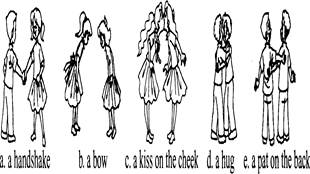
World Greetings
|
Philippine |
The everyday greeting for friends is a handshake for both men and women. Men sometimes pat each other on the back. |
|
Japan |
When people meet for the first time, they usually bow. In business, people also shake hands. In formal situations, people often exchange business cards. When you give a business card, give it with two hands. This is polite. Special note: In Japan, a smile can have different meanings. It usually means that the person is happy, or that the person thinks something is funny. But it can also mean that the person is embarrassed. |
|
New Zealand |
Usually, both men and women shake hands when they meet someone for the first time. Fun fact: If you see two people pressing their noses together, they are probably Maori. The Maori are the native people of New Zealand. This is their traditional greeting. |
|
Brazil |
Men often shake hands when they meet for the first time. When women meet, they kiss each other on the cheek. Women also kiss male friends to say hello. When you shake hands, look at the person in the eyes. This shows interest and friendliness. |
1.In this passage, which of the following is NOT mentioned?
A.Kisses. B.Hugs. C.Bows. D.Handshakes.
2.Of the five pictures above (a, b, c, d and e), which is the same way to greet each other in the four countries?
A.a B.b C.c D.d
3.Which of the following is TRUE according to the passage?
A.Both men and women shake hands in Brazil when they meet.
B.Japanese won't smile until they feel very happy.
C.The Maori often press their noses together to greet each other.
D.In Philippine, people shake hands only when they meet for the first time.
|
|
Friday January 28.2011 |
|
China's world number seven Li Na became the first Chinese tennis player to reach a Grand Slam final at this year's Australian Open. "It was the first match easy or tough? Nothing between." said Li, who has defeated Zahlavpva Strycova on her way to the Australian Open final. |
|
|
|
Tuesday March 5\2011 |
|
Besides China, more than 70 countries have offered Japan help after the earthquake. Two US search and rescue teams, with 144 stuff and 12 dogs, have begun work; The southern Afghan city of Kandahar announced it would donate (捐赠) $50.000 to die "brothers and sisters" of Japan |
|
|
|
Thursday May 19,2011 |
|
Canada pop star Justin. Bieber got a hugely disappointing greeting when he arrived in Hong Kon8 on Wednesday. Just seven fans showed up at the city's airport to greet Bieber. Bieber's concert—one of the last shows in his "My World" tour—is on Friday in Hong Kong, |
|
|
|
Monday May 30. 2011 |
|
A serious drought aloft] the Yang River has affected over 34 million people, leaving farmers and livestocks (牲畜) without water. Over 4.23 million people are having difficulty finding enough drinking water, |while more than 5 million need help to tight against the drought. |
1. Li Na__,
A. is one of the top table tennis players in the world
B. is the first player to reach a Grand Slam final
C. didn't say anything about the match
D. beat Zahlavpva Strycova on her way to the Australian Open final
2. Two search and rescue teams from_______ have begun work in Japan,
A. Australia B. the US C. the UK D. Afghanistan
3.Justin Bieber might feel_______ when he arrived at Hong Kong airport.
A. disappointed B. happy C. excited D. bored
4.When a drought happens, people are short of________.
A. money B. oil C . food D. water
5.Which of the following is NOT mentioned in the news''
A. An Afghan city of Kandahar will donate $50,000 to Japan.
B. More than 4.23 million people find it difficult to get enough drinking water,
C. All the Chinese were proud of Li Na after she won the match.
D. The concert Bieber will have in Hong Kong is one of his last shows in his "My World'' tour.
湖北省互联网违法和不良信息举报平台 | 网上有害信息举报专区 | 电信诈骗举报专区 | 涉历史虚无主义有害信息举报专区 | 涉企侵权举报专区
违法和不良信息举报电话:027-86699610 举报邮箱:58377363@163.com