
some ways you look the same. A.On B.In C.At D.For 查看更多


题目列表(包括答案和解析)

Think stars don’t move? Think again! When you look at the sky at night, the stars may appear to stay in the same place. But stars are always on the move—they are just so far away that the movement is hard to see.
But some stars move in ways that appear to be strange to be real. In 2005, astronomer Warren Brown found one of these space oddities(奇特). It was located on the outer edge of the Milky Way, the galaxy(星系) we live in. The star was speeding away like nothing he’d ever seen. “It seemed unbelievable. No star in the galaxy has a speed like that,” Brown remembers. “I thought, oh my goodness, I have something kind of special here.”
No one had ever seen a star like this one. What does a scientist do when the results don’t make sense?
Brown didn’t give up. Instead, he kept looking. And he kept finding more of these strange and speedy stars, called hypervelocity stars. Hyper means “above” and velocity has to do with speed. He and his team just found six more of these “above speed” stars, bringing to the total of 16. And, he says, he’s found even more, and is just waiting for the scientific community to confirm them.
【小题1】In 2005, astronomer Warren Brown found___________.

A.a star was speeding away very fast.
B.a stars was moving away very slowly.
C.some stars were not real.
D.some stars were not in the Milky Way.
【小题2】Which of the following is TRUE?
A.Stars never move at all.
B.No star in the galaxy has a fast speed.
C.It’s hard to see the stars moving.
D.Brown has never seen something special.
【小题3】The underlined word “hypervelocity” in the last paragraph probably means”_____”.
A.匀速的B.超速的C.超重的D.超常的
【小题4】The writer writes this passage to tell us____________.
A.something about an astronomer.
B.where the Milky Way is
C.something about the speedy stars.
D.how scientists do their research

查看答案和解析>>

Think stars don’t move? Think again! When you look at the sky at night, the stars may appear to stay in the same place. But stars are always on the move—they are just so far away that the movement is hard to see.
But some stars move in ways that appear to be strange to be real. In 2005, astronomer Warren Brown found one of these space oddities(奇特). It was located on the outer edge of the Milky Way, the galaxy(星系) we live in. The star was speeding away like nothing he’d ever seen. “It seemed unbelievable. No star in the galaxy has a speed like that,” Brown remembers. “I thought, oh my goodness, I have something kind of special here.”
No one had ever seen a star like this one. What does a scientist do when the results don’t make sense?
Brown didn’t give up. Instead, he kept looking. And he kept finding more of these strange and speedy stars, called hypervelocity stars. Hyper means “above” and velocity has to do with speed. He and his team just found six more of these “above speed” stars, bringing to the total of 16. And, he says, he’s found even more, and is just waiting for the scientific community to confirm them.
小题1:In 2005, astronomer Warren Brown found___________.
A.a star was speeding away very fast.
B.a stars was moving away very slowly.
C.some stars were not real.
D.some stars were not in the Milky Way.
小题2:Which of the following is TRUE?
A.Stars never move at all.
B.No star in the galaxy has a fast speed.
C.It’s hard to see the stars moving.
D.Brown has never seen something special.
小题3:The underlined word “hypervelocity” in the last paragraph probably means”_____”.
A.匀速的B.超速的C.超重的D.超常的
小题4:The writer writes this passage to tell us____________.
A.something about an astronomer.
B.where the Milky Way is
C.something about the speedy stars.
D.how scientists do their research

查看答案和解析>>

Think stars don’t move? Think again! When you look at the sky at night, the stars may appear to stay in the same place. But stars are always on the move—they are just so far away that the movement is hard to see.
But some stars move in ways that appear to be strange to be real. In 2005, astronomer Warren Brown found one of these space oddities(奇特). It was located on the outer edge of the Milky Way, the galaxy(星系) we live in. The star was speeding away like nothing he’d ever seen. “It seemed unbelievable. No star in the galaxy has a speed like that,” Brown remembers. “I thought, oh my goodness, I have something kind of special here.”
No one had ever seen a star like this one. What does a scientist do when the results don’t make sense?
Brown didn’t give up. Instead, he kept looking. And he kept finding more of these strange and speedy stars, called hypervelocity stars. Hyper means “above” and velocity has to do with speed. He and his team just found six more of these “above speed” stars, bringing to the total of 16. And, he says, he’s found even more, and is just waiting for the scientific community to confirm them.

  1. 1.

    In 2005, astronomer Warren Brown found___________.

    1. A.
      a star was speeding away very fast.
    2. B.
      a stars was moving away very slowly.
    3. C.
      some stars were not real.
    4. D.
      some stars were not in the Milky Way.
  2. 2.

    Which of the following is TRUE?

    1. A.
      Stars never move at all.
    2. B.
      No star in the galaxy has a fast speed.
    3. C.
      It’s hard to see the stars moving.
    4. D.
      Brown has never seen something special.
  3. 3.

    The underlined word “hypervelocity” in the last paragraph probably means”_____”.

    1. A.
      匀速的
    2. B.
      超速的
    3. C.
      超重的
    4. D.
      超常的
  4. 4.

    The writer writes this passage to tell us____________.

    1. A.
      something about an astronomer.
    2. B.
      where the Milky Way is
    3. C.
      something about the speedy stars.
    4. D.
      how scientists do their research

查看答案和解析>>

阅读理解

  Think stars don't move? Think again! When you look at the sky at night, the stars may appear to stay in the same place.But stars are always on the move-they are just so far away that the movement is hard to see.

  But some stars move in ways that appear to be strange to be real.In 2005, astronomer Warren Brown found one of these space oddities(奇特).It was located on the outer edge of the Milky Way, the galaxy(星系)we live in.The star was speeding away like nothing he'd ever seen.“It seemed unbelievable.No star in the galaxy has a speed like that,” Brown remembers.“I thought, oh my goodness, I have something kind of special here.”

  No one had ever seen a star like this one.What does a scientist do when the results don't make sense?

  Brown didn't give up.Instead, he kept looking.And he kept finding more of these strange and speedy stars, called hypervelocity stars.Hyper means “above” and velocity has to do with speed.He and his team just found six more of these “above speed” stars, bringing to the total of 16.And, he says, he's found even more, and is just waiting for the scientific community to confirm them.

(1)

In 2005, astronomer Warren Brown found ________.

[  ]

A.

a star was speeding away very fast.

B.

a stars was moving away very slowly.

C.

some stars were not real.

D.

some stars were not in the Milky Way.

(2)

Which of the following is TRUE?

[  ]

A.

Stars never move at all.

B.

No star in the galaxy has a fast speed.

C.

It's hard to see the stars moving.

D.

Brown has never seen something special.

(3)

The underlined word “hypervelocity” in the last paragraph probably means”________”.

[  ]

A.

匀速的

B.

超速的

C.

超重的

D.

超常的

(4)

The writer writes this passage to tell us ________.

[  ]

A.

something about an astronomer.

B.

where the Milky Way is

C.

something about the speedy stars.

D.

how scientists do their research

查看答案和解析>>

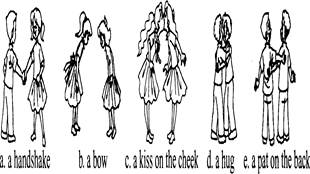
A greeting is a way of saying "Hello" to someone. People in different countries greet each other in different ways. Here are some.
World Greetings

Philippine

The everyday greeting for friends is a handshake for both men and women. Men some­times pat each other on the back.

Japan

When people meet for the first time, they usually bow. In business, people also shake hands.

In formal situations, people often exchange business cards. When you give a business card, give it with two hands. This is polite.

Special note: In Japan, a smile can have different meanings. It usually means that the person is happy, or that the person thinks something is funny. But it can also mean that the person is embarrassed.

New Zealand

Usually, both men and women shake hands when they meet someone for the first time.

Fun fact: If you see two people pressing their noses together, they are probably Maori. The Maori are the native people of New Zealand. This is their traditional greeting.

Brazil

Men often shake hands when they meet for the first time.

When women meet, they kiss each other on the cheek. Women also kiss male friends to say hello.

When you shake hands, look at the person in the eyes. This shows interest and friendliness.

1.In this passage, which of the following is NOT mentioned?

A.Kisses.            B.Hugs.             C.Bows.            D.Handshakes.

2.Of the five pictures above (a, b, c, d and e), which is the same way to greet each other in the four countries?

A.a                B.b                C.c                D.d

3.Which of the following is TRUE according to the passage?

A.Both men and women shake hands in Brazil when they meet.

B.Japanese won't smile until they feel very happy.

C.The Maori often press their noses together to greet each other.

D.In Philippine, people shake hands only when they meet for the first time.


查看答案和解析>>


同步练习册答案