题目列表(包括答案和解析)
| |||||||||||||||||||||||||||||||||||||||||||||||||||||||||||||||||||||||||
A greeting is a way of saying "Hello" to someone. People in different countries greet each other in different ways. Here are some.
World Greetings
|
Philippine |
The everyday greeting for friends is a handshake for both men and women. Men sometimes pat each other on the back. |
|
Japan |
When people meet for the first time, they usually bow. In business, people also shake hands. In formal situations, people often exchange business cards. When you give a business card, give it with two hands. This is polite. Special note: In Japan, a smile can have different meanings. It usually means that the person is happy, or that the person thinks something is funny. But it can also mean that the person is embarrassed. |
|
New Zealand |
Usually, both men and women shake hands when they meet someone for the first time. Fun fact: If you see two people pressing their noses together, they are probably Maori. The Maori are the native people of New Zealand. This is their traditional greeting. |
|
Brazil |
Men often shake hands when they meet for the first time. When women meet, they kiss each other on the cheek. Women also kiss male friends to say hello. When you shake hands, look at the person in the eyes. This shows interest and friendliness. |
1.In this passage, which of the following is NOT mentioned?
A.Kisses. B.Hugs. C.Bows. D.Handshakes.
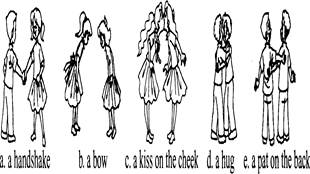
2.Of the five pictures above (a, b, c, d and e), which is the same way to greet each other in the four countries?
A.a B.b C.c D.d
3.Which of the following is TRUE according to the passage?
A.Both men and women shake hands in Brazil when they meet.
B.Japanese won't smile until they feel very happy.
C.The Maori often press their noses together to greet each other.
D.In Philippine, people shake hands only when they meet for the first time.
A greeting is a way of saying "Hello" to someone. People in different countries greet each other in different ways. Here are some.

World Greetings
| Philippine | The everyday greeting for friends is a handshake for both men and women. Men sometimes pat each other on the back. |
| Japan | When people meet for the first time, they usually bow. In business, people also shake hands. In formal situations, people often exchange business cards. When you give a business card, give it with two hands This is polite. Special note: In Japan, a smile can have different meanings. It usually means that the person is happy, or that the person thinks something is funny. But it can also mean that the person is embarrassed. |
| New Zealand | Usually, both men and women shake hands when they meet someone for the first time. Fun fact: If you see two people pressing their noses together, they are probably Maori. The Maori are the native people of New Zealand. This is their traditional greeting. |
| Brazil | Men often shake hands when they meet for the first time. When women meet, they kiss each other on the cheek. Women also kiss male friends to say hello. When you shake hands, look at the person in the eyes. This shows interest and friendliness. |
51. In which country do men sometimes pat each other on the back?
A. Philippine. B. Brazil. C. Japan. D. New Zealand.
52. In this passage, which of the following is NOT mentioned?
A. Kisses. B. Hugs. C. Bows. D. Handshakes.
53. Of the five pictures above (a, b, c, d and e) , which is the same way to greet each other in the four countries?
A. a B. b C. c D. d
54. Which of the following is true, according to the passage?
A. Both men and women shake hands in Brazil when they meet.
B. Japanese won't smile until they feel very happy.
C. The Maori often press their noses together to greet each other.
D. In Philippine, people shake hands only when they meet for the first time.
55. What does the writer mainly want to tell us in the passage?
A. Different ways of greetings. B. Four countries.
C. Some fun facts. D. Some special notes.
| 阅读理解。 | ||||||||
| ?A greeting is a way of saying "Hello" to someone. People in different countries greet each other in different ways. Here are some.      a. a handshake b. a bow c. a kiss on the cheek d. a hug e. a pat on the back World Greetings
| ||||||||
| 1. In which country do men sometimes pat each other on the back? | ||||||||
|
[ ] | ||||||||
| A. Philippines B. Brazil C. Japan D. New Zealand | ||||||||
| 2. In this passage, which of the following is NOT mentioned (提及)? | ||||||||
|
[ ] | ||||||||
| A. Kisses B. Hugs C. Bows D. Handshakes | ||||||||
| 3. Of the five pictures above (a, b, c, d and e), which is the same way to greet each other in the four countries? | ||||||||
|
[ ] | ||||||||
| A. a B. b C. c D. d | ||||||||
| 4. Which of the following is TRUE according to the passage? | ||||||||
|
[ ] | ||||||||
| A. Both men and women shake hands in Brazil when they meet. ? B. Japanese won't smile until they feel very happy. ? C. The Maori often press their noses together to greet each other. ? D. In Philippines, people shake hands only when they meet for the first time. | ||||||||
| 5. What does the writer mainly want to tell us in the passage? | ||||||||
|
[ ] | ||||||||
| A. Different ways of greetings. B. Four countries. ? C. Some fun facts. D. Some special notes. |
用方框中所给单词的适当形式填空,使短文通顺、正确、连贯(每个单词限用一次)
|
Perhaps you've experienced the following situation: You meet an English speaker and begin with what you think is a standard greeting, "How do you do?" Then in ___61___, you hear exactly the same words. You don't know what to say next.
Actually, the exact same greeting is a standard reply to "How do you do?" Don't be nervous, you can __62____ nod and say "fine," and start a new ___63___.
However, next time you watch a Hollywood movie, or ___64___you have the chance to go to an English speaking country, you may be surprised to find that people seldom greet each other ___65___ this sentence. Actually, this expression is very formal (正式的). Many people avoid using such language in everyday life.
Instead of using “how do you do?”, younger people these days use ____66__ own expressions. To people you meet for the first time, you can say: "Nice to meet you." At other__67____, “How's it going?”, “What's up?”, “How are you?” are other casual expressions you can use when talking to friends or ____68__ people.
To reply to ___69___ informal greetings, you can just say "Fine", or "Oh, not so bad". If you are in a good mood, you could even give your friend a "high five". Simply, raise your hand and clap (轻拍) your ___70___ palm in the air.
湖北省互联网违法和不良信息举报平台 | 网上有害信息举报专区 | 电信诈骗举报专区 | 涉历史虚无主义有害信息举报专区 | 涉企侵权举报专区
违法和不良信息举报电话:027-86699610 举报邮箱:58377363@163.com