题目列表(包括答案和解析)
Maybe you know that the letter “V” stands for victory in western countries. But do you know the history of the sign?
During World War Ⅱ, Europe was occupied (占领) by the Germans. A lot of people got away to Britain. Among them was one Belgian (比利时人) named Victor Valveli. He was very patriotic (爱国的) . And every day, he used short-wave radio to broadcast to the Belgian people, calling on them to resist (抵抗) the German occupiers (侵略者). On the last day of 1940, he asked his country men to write the letter “V” wherever they could to show their decision to win the final victory. In a few days, the letter “V” appeared everywhere, even in the German barracks (营房) and the living quarters of Nazi officers (纳粹军官).
Later, the letter “V” spread to the other occupied countries in Europe. Because it was simple and meaningful, it soon became very popular. When friends met, they stretched out their middle and index finger (食指) to greet each other.
At that time, in many restaurants, knives and forks were places in such a way as to form a “V”. And in some clock, factories clocks were purposely (故意地) stopped at 11:05 to show the sign of “V”.
(1) From the passage, we know that during World War Ⅱ ________.
[ ]
A.Britain was occupied but Belgium (比利时) was not
B.both Britain and Belgium were occupied
C.neither Britain nor Belgium was occupied
D.Britain was not occupied but Belgium was
(2) In the 1940's, the letter “V” first appeared in ________.
[ ]
(3) The underlined word “greet” in the third paragraph means ________.
[ ]
(4) From the passage we can infer (推断) that ________.
[ ]
A.some customs date from culture (文化)
B.some customs date from wars
C.some customs date back to the past history
D.some customs have been formed since the Second World War
(5) From the passage, we know the letter “V” means ________.
[ ]
| |||||||||||||||||||||||||||||||||||||||||||||||||||||||||||||||
任务型阅读
Mr Mason is standing in front of a car.He is looking at it.It is a beautiful car and it is very big.Mr Mason likes big cars.A policeman is standing behind Mr Mason.He is looking at the car, too.He is writing in a notebook.Now he is giving a piece of paper to Mr Mason.
Policeman:Excuse me, sir.
Mr Mason:Yes?
Policeman:This is for you.
Mr Mason:What is it?
Policeman:It's a ticket.
Mr Mason:A ticket?
Policeman:Can you see the sign?
Mr Mason:Yes.
Policeman:It says ‘NO PARKING’.You can't park your car in the street.
Mr Mason:This isn't my car.
根据上面的内容完成下面的句子,每空一词:
1.The policeman is standing 1 Mr Mason.
2.This policeman gives Mr Mason a 2 .
3.Mr Mason says that car isn't 3 .
4.‘NO PARKING’ means you can't 4 your car here.
5.The car is in the 5 .
根据情景会话,选择正确图片
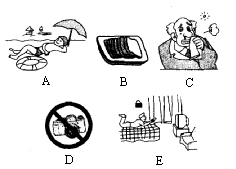
1.A:Mum, Can I watch TV? ( )
B:No, but you may do it after you finish your homework.
2.A:What's the matter? ( )
B:I've had a cold for three days.
3.A:What are you going to do tomorrow? ( )
B:I'd like to swim with my classmates.
4.A:What can I do for you? ( )
B:I'd like some bread.
5.A:What's the meaning of the sign? ( )
B:It means “No photos!”
 in museums. It
means _______.
in museums. It
means _______.
A. NO PHOTOS B. NO FISHING
C. NO SMOKING D. NO SWIMMING
湖北省互联网违法和不良信息举报平台 | 网上有害信息举报专区 | 电信诈骗举报专区 | 涉历史虚无主义有害信息举报专区 | 涉企侵权举报专区
违法和不良信息举报电话:027-86699610 举报邮箱:58377363@163.com