
题目列表(包括答案和解析)
We live in a noisy world. Young and old alike are
troubled by sounds over which we may have lit tle
or no control: car and house alarms, motorcycles, loudspeakers, even movie
previews.
tle
or no control: car and house alarms, motorcycles, loudspeakers, even movie
previews.
We attend rock concerts, weddings, parties and sports
events at which the music is so loud that you can hardly hear the person
sitting next to you. At home, televisions, stereos and computer games are o ften
turned up so loud that listeners cannot hear a doorbell or a telephone.
ften
turned up so loud that listeners cannot hear a doorbell or a telephone.
As if environmental noise were not enough, now we sur round
children with n
round
children with n oisy
toys and personal listening devices that can permanently damage their hearing.
A series of studies conducted in 2002 indicated that even moderate (缓和的) background
noise can interfere with how they learn language. In fact, children in
classrooms on the noisy side of a school had lower reading scores
oisy
toys and personal listening devices that can permanently damage their hearing.
A series of studies conducted in 2002 indicated that even moderate (缓和的) background
noise can interfere with how they learn language. In fact, children in
classrooms on the noisy side of a school had lower reading scores than those whose classes were on the quiet side.
Noise-induced (噪音诱发的) hearing
loss can come about in two ways: from a brief exposure to a very loud noise or
from consistent exposure to moderate-level
noise. Thus, there is much concern about the lasting effects of MP3 players
that are turned up loud enough to block out surrounding sound, like street
noise. An MP3 player at maximum volume produces about 105 decibels(分贝)— 100 times as severe as 85 decibels, where hearing
damage begins.
So, before buying noise-making toys, parents would do
well to listen to how loud they are. If the item comes with
a volume control, monitor its use to make sure it is kept near the lowest
level. Consider returning gifts that make loud noises, or disable the
noise-making function.
Children who play computer games and stereo equipment should be warned
to keep the volume down. Most iPads have a control that allows parents to set a
maximum volume.
Avoid taking children to loud action movies. If you do go and the sound seems deafening, ask the management to turn down the volume or insist on your money back.
The League for the Hard of Hearing urges parents to encourage participation in quiet activities, like reading, doing puzzles, making things with construction toys, playing educational computer games, drawing and painting, and visiting libraries and museums.
|
Noise And Children’s Hearing |
|
|
Fact about noise |
We live in a world of noise which 1. people and is free of 2. . |
|
The 3. that noise causes |
We find it hard to hear others in a noisy 4. . |
|
Noisy toys and personal listening devices can permanently 5. children’s hearing. |
|
|
Two 6. of noise-induced hearing loss |
People are 7. to loud
noise for short time or to moderate-level noise fo |
|
Advice for parents |
They should pay attention to how 8. the noise-making toys are and the returning gifts. |
|
They shouldn’t 9. their children to loud action movies. |
|
|
|
Students who say they never or hardly ever used dictionaries often speak English well but usually write poorly, because they make many mistakes.
The students who use dictionaries most do not learn especially well either. The ones who look up every new word do not read fast. Therefore they do not have time to read much. Those who use small two-language dictionaries have the worst problems. Their dictionaries often give only one or two words as a translation of English. But one English word often has many translations in a foreign language and one foreign word has many translations in English.
The most successful students are those who use large college edition dictionaries with about 100,000 words but do not use them too often. When they are reading, these students first try to get the general idea and understand new words from the context
(上下文).Then they reread and use the dictionary to look up only key words that they do not understand. They use dictionaries more for writing. If they are not sure how to spell a word, or divide it into syllables (音节), they always use a dictionary. Also, if they think a noun might have an unusual plural form or a verb might have an unusual past form, they cheek these in dictionary.Choose the best answer.
(1) The writer tends to
(倾向)think that ________.A
.choose a good dictionary, and you'll succeed in learning EnglishB
.dictionaries are not very necessary to the students who learn EnglishC
.it is very important for students to use good dictionaries properlyD
.using dictionaries very often can't help to improve writing(2) Judging from the passage, which of the following is wrong?
A
.Dictionaries have little effect on learning to speak English.B
.No matter what new words you meet while reading, never use dictionaries.C
.Small two-language dictionaries have serious defects(缺陷).D
.Reading something for the first time, you'd better not use dictionaries.(3) The article mainly tells us _________.
A
.that students shouldn't use small two-language dictionariesB
.what were the defects of small two-language dictionariesC
.why students should use large college edition dictionariesD
.what dictionary students should choose and how to use it(4) The function
(作用)of the first sentence in the third paragraph is _______.A
.to form a connection link between the preceding and the followingB
.to raise the main point of the third paragraphC
.to end the subject talked about in the first two paragraphsD
.to change the subject to talk about something else(5) Which is not mentioned
(提到)in this article?A
.How to make good use of a dictionary.B
.When to use a dictionary.C
.How to improve spoken English.D
.How to practise reading fast.1
Good evening, ladies and gentlemen. Welcome to the nine o’clock Mystery Hour. Today we’ll show you two British stories. We hope you’ll enjoy them.
About 900 years ago two green children arrived in a small village in south England. Their eyes and skin were green and they spoke a strange language. They were very tired and weak, so the people of the village looked after them. The boy died a year later, but the girl grew strong and lived the rest of her life there. And her skin color turned back to normal day by day. Scientists say that sometimes of people don’t have enough food to eat for a long time, their skin goes very pale and can turn green.
Loch Ness is the largest lake in Scotland. It’s a very deep and cold lake. For hundreds of years, people have talked about a monster(怪物) called Nessie which lives in the lake. About seventy years ago, two people saw something moving in the lake. They said that the animal was playing and rolling around in the water. Since then many people say they have seen the monster. Their descriptions are always the same. It looks like a dinosaur, with a very long neck and a small head. It has a big bump(肿块)on its back. People have tried to photograph the animal, but the pictures have not been very clear. Scientists don’t know whether there is a monster or not. Some say it may be a whale or a very large fish. Some think it’s a snake. Others say there’s nothing at all— nothing but people’s imagination. Maybe we’ll never know what’s in Loch Ness.
1.What kind of story is talked about in this program?
A. Romantic stories. B. Mysteries. C. Horror stories. D. Comedies.
2.Where did the stories happen?


A. B. C. D.
3.Which sentence is TRUE about the two green children?
A. They both enjoyed a long and happy life.
B. The girl’s eyes and skin were green all her life.
C. At first they spoke the same language as people in the small village did.
D. Maybe they hadn’t eaten enough for long before they reached the village.
4.What does Nessie look like according to some witnesses?
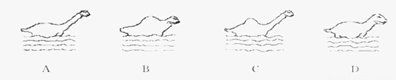
5.What can we learn from the second story?
A. Scientists are still not sure whether there is a monster or not in Loch Ness.
B. Loch Ness is very deep and warm lake in Scotland.
C. People have taken very clear pictures of Nessie.
D. In fact Nessie is a whale or a snake.
|
PEN PAL WANTED I’m Li Jiacheng. My English name is Jim. I’m a 14-year-old boy. I live in the city of Chengdu in China. I speak Chinese and I can speak a little Japanese. I have a small family, my father, my mother and I. I’m lonely(孤单的). I enjoy playing basketball and I like Japanese very much, (A) but I can’t speak it well. So (B)I want a pen pal to help me with my Japanese. Please write to me if(假如) you want. |
1.根据这封信完成下面这张身份卡片。(4分)
|
Chinese Name: __________ English Name: __________ Age: __________ Country: __________ Language: __________ Family: father and mother Address: __________ Favorite Sport: __________ Favorite Subject: __________ |
2.把划线句子A改为同义句。(2分)
. . . but my spoken(口头的)English __________ __________ .
3.把划线句子B翻译成汉语。(4分)
____________________________________________________________________
Did you notice the number on the book in a library? That number is part of the system used by libraries to organize their collections of books. And it’s used in many countries. The number on each book tells you exactly what kind of book it is. This system is also useful for knowing where to go in the library to find a book.
In this system, there are ten large groups of books. Each of these groups has its own number, such as 100, 200, etc. So, for example, any books about language will have a number 400. On the other hand, any books about history will have a number 900. So, a number in the hundreds place tells you what general group a book is in. If you find a book that has a number in the 500s, you know it is a book about science.
However, science is a big group, so the tens place is used to make a more detailed set of science books. For example, math books are included in the group of science books. Math books all have numbers between 510 and 519. Books about the history of Africa have numbers between 960 and 969.
The system uses the ones place to give a more exact limit for the subject of a book. A book on the history of South Africa will have the number 968.
As you can see, it is a simple system to use as long as you understand what the numbers mean. With this system, the library can keep its books well organized, and people can easily find the book that they want.
1.The reading is about .
A. libraries
B. working in a library
C. how numbers are organized
D. how books are organized in libraries
2.The number system is NOT used to .
A. find where a book is
B. tell you the title of a book
C. tell you what kind of book a book is
D. organize the collections of books in libraries
3.According to the reading, which sentence is TRUE?
A. The number on a book can’t be bigger than 900.
B. There are ten big groups for books in this system.
C. History books can have any number between 500 and 900.
D. This system uses both numbers and letters for some books.
4.A book about math can be found in the same group of books as .
A. reference books B. school books C. science books D. art books
5.Which two numbers would indicate a book about language and a book about science?
A. 439 and 493 B. 439 and 568 C. 530 and 560 D. 563 and 436
湖北省互联网违法和不良信息举报平台 | 网上有害信息举报专区 | 电信诈骗举报专区 | 涉历史虚无主义有害信息举报专区 | 涉企侵权举报专区
违法和不良信息举报电话:027-86699610 举报邮箱:58377363@163.com They
They 