
题目列表(包括答案和解析)
Everybody can suffer from stress(压力). No matter what your age is, you can feel stressed out by things that are happening in your life. Teenagers, however, have many more opportunities(机会) to get stressed than people in any other age group. Being a teenager is hard. You are not a child any more, but you are not an adult, even though you have to deal with some very grown-up problems and decisions. Families can be one of the biggest causes of stress, such as problems with parents arguing at home, or problems with brothers and sisters. Teenagers also have a lot of stress from school, either from their teachers or from their friends. Some teenagers also feel stressed about choosing their education after high school. Getting a place at university(大学) can be very difficult and some cannot afford to go to university. The stress about getting a job when finishing school is hard for some teenagers. There are so many young people finishing school and not enough jobs for them. Sadly, there is nothing we can do to remove these causes of stress from the 1ives of teenagers, but you can learn the best way to deal with it. Talking to people is one of the best ways to deal with stress. It may sound simple(简单), but it is true. A problem shared is a problem halved(减半).
根据短文内容判断正误,正确的写(A)、错误的写(B)。
1.Being a teenager is often difficult because adults often make them feel stressed.
2.Families can add to the stress a teenager might experience by asking them to go to university.
3.When many teenagers finish school ,they may worry about becoming an adult.
4.Finding a job after finishing school can be difficult because there is a lot of competition for jobs.
5.There are many things we can do to deal with stress.
Mrs Elise was my teacher in the fourth grade. One day at lunch time, I was getting ready to eat my tuna fish (金枪鱼) sandwich and suddenly Mrs Elise asked me if she could buy my sandwich from me. She explained that I could use the money to buy a hot hunch from the cafeteria (食堂).
I was excited. I never bought my lunch at the cafeteria. It was too expensive for my family, and I always carried my lunch and took the bag back home to use it again the next day. So you could understand my happiness when I had the chance to buy a hot lunch.
When we finished lunch that day, Mrs Elise took me aside and said she wanted to explain why she had bought my sandwich. I really didn’t care why, but it gave me a few minutes of her special attention, so I was quiet as she explained. She told me that she was a Catholic(天主教徒) and Catholics didn’t eat red meat on Fridays, they ate fish on Fridays.
Oh, I couldn’t wait to get home and tell my mother that from then on I wanted a tuna fish sandwich on Fridays. After my mother understood why, she gladly made tuna fish sandwiches for me on Fridays. She even made it with brown bread because she knew Mrs Elise liked brown bread. From then on, every Friday I could get in line with other kids for a hot lunch. I didn’t care how many of the kids complained about cafeteria food. It tasted divine to me!
I realize now that Mrs Elise could have made herself tuna fish sandwiches on Fridays. But she bought mine because she saw a little girl who was excited at the simple act of having a hot lunch.
I will never forget Mrs Elise for her pity for me and generosity (慷慨) and what I should do is to follow her example.
1. From this passage we know_______.
A.Mrs Elise was the best friend of the writer
B.the writer came from a poor family
C.many or the writer’s classmates liked cafeteria food
D.the writer like to eat tuna fish sandwiches on Fridays
2. Mrs Elise bought the writer’s sandwiches because_______.
A.she was tired of cafeteria food
B.she hated getting in line with kids
C.she liked the tuna fish sand writer’s made by the writer’s mother
D.she wanted to show care to the writer
3. The underlined word“divine”means“_____”.
A.perfect B.sweet C.unpleasant D.bad
4. Which of the following can we learn from this passage?
A.It is hard to please all.
B.Better to give than to receive.
C.Love makes the world go around.
D.The more you offer, the more you get.
Mrs Elise was my teacher in the fourth grade. One day at lunch time, I was getting ready to eat my tuna fish (金枪鱼) sandwich and suddenly Mrs Elise asked me if she could buy my sandwich from me. She explained that I could use the money to buy a hot hunch from the cafeteria (食堂).
I was excited. I never bought my lunch at the cafeteria. It was too expensive for my family, and I always carried my lunch and took the bag back home to use it again the next day. So you could understand my happiness when I had the chance to buy a hot lunch.
When we finished lunch that day, Mrs Elise took me aside and said she wanted to explain why she had bought my sandwich. I really didn’t care why, but it gave me a few minutes of her special attention, so I was quiet as she explained. She told me that she was a Catholic(天主教徒) and Catholics didn’t eat red meat on Fridays, they ate fish on Fridays.
Oh, I couldn’t wait to get home and tell my mother that from then on I wanted a tuna fish sandwich on Fridays. After my mother understood why, she gladly made tuna fish sandwiches for me on Fridays. She even made it with brown bread because she knew Mrs Elise liked brown bread. From then on, every Friday I could get in line with other kids for a hot lunch. I didn’t care how many of the kids complained about cafeteria food. It tasted divine to me!
I realize now that Mrs Elise could have made herself tuna fish sandwiches on Fridays. But she bought mine because she saw a little girl who was excited at the simple act of having a hot lunch.
I will never forget Mrs Elise for her pity for me and generosity (慷慨) and what I should do is to follow her example.
【小题1】 From this passage we know_______.
| A.Mrs Elise was the best friend of the writer |
| B.the writer came from a poor family |
| C.many or the writer’s classmates liked cafeteria food |
| D.the writer like to eat tuna fish sandwiches on Fridays |
| A.she was tired of cafeteria food |
| B.she hated getting in line with kids |
| C.she liked the tuna fish sand writer’s made by the writer’s mother |
| D.she wanted to show care to the writer |
| A.perfect | B.sweet | C.unpleasant | D.bad |
| A.It is hard to please all. |
| B.Better to give than to receive. |
| C.Love makes the world go around. |
| D.The more you offer, the more you get. |
You either have it, or you don’t—a sense of direction, that is. But why is that some people would find their way across the Sahara without a map, while others can lose themselves in the next street?
Scientists say we’re all born with a sense of direction, but it is not properly understood how it works. One theory(理论) is that people with a good sense of direction have simply worked harder at developing it. Research being carried out at Liverpool University supports this idea and suggests that if we don’t have it, we lose it.
“Children as young as seven have the ability to find their way around,” says Jim Martland, Research Director of this project. “However, if they are not allowed out alone or are taken everywhere by car, they never develop the skills.”
Jim Martland also emphasized(强调) that young people should be taught certain skills to improve their sense of direction. He makes the following suggestions:
If you are using a map, turn it to the way you are facing.
If you leave your bike in a strange place, put it near something like a big stone or a tree. Note landmarks on the route as you go away from your bike. When you return, go back along the same route.
The simple way of finding your direction is by using lines such as streets in a town, streams, or walls in the countryside to guide you. Count your steps so that you know how far you have gone and note any landmarks such as tower blocks or hills which can help you find out where you are.
Now you will never get lost again!
1.Scientists believe that .
A. only some babies are born with a sense of direction
B. people never lose their sense of direction
C. people learn a sense of direction as they grow older
D. everybody has a sense of direction from birth
2.What is true of seven-year-old children according to the passage?
A. They never have a sense of direction without a map.
B. They have a sense of direction and can find their way around.
C. They should never be allowed out alone if they lack a sense of direction.
D. They can develop a good sense of direction if they are driven around in a car.
3.If you leave your bike in a strange place, you should .
A. tie it to the tree in order to prevent it from being stolen
B. draw a map of the route to help remember where it is
C. take the different routes when you come back to it
D. remember something easily recognizable(可辨认的) on the route
Tony Buzan’s grades were going down at university. Disappointed with his low marks, he went to the library to find a book on how to use his brain. He was directed to the medical section. Confused, he said to the librarian, “I don’t want to take my brain out, I just want to learn how to use it.” Her reply was simple: “There’s no book on that.”
“I thought to myself,” says Buzan, “if I buy a little radio, I get an instruction manual (说明书). If I buy a microwave, I get an instruction manual. But for the most important machine in the world, no instruction manual?”
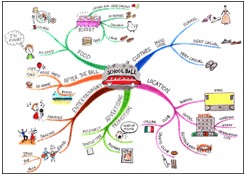
Fifty years later, Buzan has become the world’s leading speaker on the brain and learning. In the late 1960s, he invented the mind map, a visual representation of thought processes.
This kind of thinking has become a popular tool for planning, organizing, problem solving, and communicating across the world. He has since authored and co-authored over 100 books that have appeared in more than 30 languages.
“I think in most cases, people use less than 1 percent of their brains,” he says.
But how do you expand this 1 percent? How do you become the best student you can be?
According to Buzan, the answer is simple. You take a section of whatever it is that you are trying to learn, he says, and you read it for its essence (精髓、要素). Then you make a mind map of all the important details. For a truly effective mind map, you start with a colored image in the center of your page. Draw the first image that comes to mind on the topic you are mind mapping. Branch off from your central image and create one of your main ideas. From your main branches draw some sub-branches and from those sub-branches you can draw even more branches. He emphasizes that you should use plenty of images and colors as these help with memory recall and encourage creativity.
By using this visual format (形式), according to Buzan, your mind will begin to make associations that will help you remember more information for longer periods of time.
Buzan believes that traditional note-taking methods, such as lists and summaries, do not stimulate the brain’s recall capacity or ability in the same way. Because of this, students will often find themselves locked away in their rooms for hours, trying hard to memorize separate details. Buzan believes that for a more effective and lasting way of studying, you must first understand how your brain works.
“Everyone is born smart,” he says. “You just have to learn how to learn.”
1.What is the main purpose of the first two paragraphs?
A.To show that Tony Buzan was worried about his study.
B.To invite us to think about the importance of manuals.
C.To prove that the mind map is a useful tool for the brain.
D.To show why Tony Buzan studies the brain and learning.
2.What does the word “stimulate” mean in the passage?
A.Excite. B.Improve. C.Encourage. D.Affect.
3.What can we infer from the passage?
A.If we learn the mind map, we will become the best student.
B.The mind map will help your brain connect separate details.
C.The mind map will be more effective if we put more details in it.
D.We will solve the problem if we make connections between ideas.
4.What is the best title for the passage?
A.How to make the mind map?
B.Is the mind map widely used?
C.Can your memory be mapped?
D.Is the mind map helpful in thinking?
湖北省互联网违法和不良信息举报平台 | 网上有害信息举报专区 | 电信诈骗举报专区 | 涉历史虚无主义有害信息举报专区 | 涉企侵权举报专区
违法和不良信息举报电话:027-86699610 举报邮箱:58377363@163.com