任务型阅读 (共10小题; 每小题1分,满分10分)
请认真阅读下列短文,并根据短文的内容要点完成文章后的表格列单。
注意:补全填空应符合语法和搭配要求,每格只填一个单词。
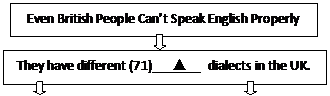
Even British People Can’t Speak English Properly
There are different regional accents across the UK, and a number of regions have several different dialects, that is, they have their own unique vocabulary and grammatical phrases. There were at least six different accents born to London the last time I counted.
Worse than that, it is not just where a person is born in the UK that decides their accent. For example, a language and its accents often vary across class or level of education. Another example is how language can differ among age groups in the UK. The words and pronunciations used by young people in the UK can be radically different compared with those used by adults.
Yoof culture
The word ‘yoof’ is a slang spelling of ‘youth’. Some people consider ‘yoof’ to be a negative term, since its pronunciation is easier and lazier than ‘youth’. Other people see the term as positive, because it describes how young people are creating their own language, concepts and identity. When people find it difficult to understand their children, the children can say more things than without censorship(审查,检查) of their parents. In this way, young people are starting to find freedom, independence and self-expression. They are creating a ‘yoof culture’.
It is not possible to come up with a complete list of words used by yoof. By the time the list was completed, it would be out of date. New words come and go like fashions. However, a few features of the yoof style of language are as follows:
◆instead of saying something like ‘That’s good!’ or ‘I understand’, yoof will use a single adjective like ‘Safe!’, ‘Sorted!’, ‘Sound!’, ‘Cool!’ or ‘Wicked!’.
◆instead of ‘He then said no!’, yoof will say ‘She was like: no!’
◆Instead of ‘She’s attractive!’, yoof will say ‘She’s fine!’ or ‘She’s fit!’
◆Instead of ‘I don’t care!’, a yoof will say ‘Whatever!’.
New social and political language
Certain groups of society feel threatened by ‘yoof culture’ or by the British working classes having more social freedom. As a result, a negative term now commonly used in the UK is ‘chav’. It is insult and is meant to describe someone who is uneducated and anti-social (e.g. ‘He’s a chav!’). A young person who wears a jacket with a hood(风帽,头巾) (after all, it rains a lot in the UK) is sometimes called a ‘hoodie’. It is a negative term and suggests that the young person is interested in committing crime.
Where does that leave us?
Learners of English often feel that the best test of their English is how well they can talk to a native speaker. Yet learners should not worry about communicating with native speakers so much. Research conducted by the British Council shows that 94 per cent of the English spoken in the world today is spoken between non-native speakers of the language. In fact, when we think about ‘international English’, there is no such thing as native or non-native speakers. The UK no longer owns the English language.
|
|  |
| Different (72) ▲ of education
查看答案和解析>>
请根据以下的任务说明和写作要求,以We Cannot Do without Gratitude 为题写一篇150字左右的英语短文,在校园英文小报上的Hot Topic栏目发表。 [任务说明] “感激”是每个人都应该懂得的一种待人接物的态度。请认真阅读下面的短文,然后完成以下写作任务。 1.概括故事的内容要点,以此引入话题,该部分的词数大约30; 2.就“感激”这个主题发表你的看法,至少包含以下内容要点: 1)什么是感激(gratitude)? 2)感激的表现方式。 3)表达感激最重要在于真诚(sincere)。 4)故事的启示和你的结论。 [写作要求] 1.你可以使用实例或其他论述方法支持你的论点,也可以参照阅读材料的内容,但不要抄袭阅读材料中的句子。 2.短文的开头已给出,不计入所限字数。短文开头: The other day I read a story which is about … [阅读材料] As I got into a taxi one afternoon, the driver was very angry about something that had happened to him earlier that day. Here’s how he told the story: “One of my fares (旅客) left a wallet in my cab this morning. Nearly three hundred dollars in it. I spent more than an hour trying to trace the guy. Finally I found him at his hotel. He took the wallet without a word and glared at me as though I’d meant to steal it.” “He didn’t give you a reward?” I asked. “Not a cent. But it wasn’t the money I wanted,” he fumbled, then exploded, “If the guy had only said something…” Why was the driver so upset? All he wanted was something simple, but even more valuable than money: to be thanked for his efforts. In short, what he wanted, what he needed but did not get, was a little bit of gratitude.
查看答案和解析>>
Green is an important color in nature. It is the color of grass and the leaves on trees. It is the color of most growing plants, too.
Sometimes, the word green means young, fresh and growing. Sometimes, it describes something that is not yet finished or plants that are not ripe.
For example, a greenhorn is someone who has no experience, who is new to a situation. In the fifteenth century, a greenhorn was a young cow or ox whose horns had not yet developed. A century or so later, a greenhorn was a soldier who had not yet had any experience in war (战争). By the eighteenth century, a greenhorn had the meaning it has today--a person who is new in a job.
About one hundred years ago, greenhorn was a popular expression in the American west. Old-timers used it to describe a man who had just arrived from one of the big cities in the east. The greenhorn didn’t have the skills that he would need to live in the hard, rough country.
Someone who has the ability to grow plants well is said to have a green thumb. The expression comes from the early nineteen hundreds.
A person with a green thumb seems to have a magic touch that makes plants grow quickly and well. You might say that the woman next door has a green thumb if her garden continues to grow long after your plants have died.
The Green Revolution (革命) is the name which was given some years ago to the development of new kinds of rice and other grains. The new plants produced much larger crops. The Green Revolution was the result of hard work by agricultural (农业的) scientists who had green thumbs.
【小题1】According to the passage, a greenhorn means________ now. | A.a young cow or ox whose horns have not yet developed | | B.a soldier who has not had any experience in war | | C.a person who is new in a job | | D.a man who doesn’t have the skills to live in the country |
【小题2】The meaning of the underlined word “ripe” in the second paragraph is ________. 【小题3】Which of the following about the Green Revolution is NOT right? | A.If there weren’t the Green Revolution, we would have no rice to eat. | | B.The expression “the Green Revolution” appeared several years ago. | | C.Because of the Green Revolution, we have more kinds of rice and other grains. | | D.Agricultural scientists with green thumbs started the Green Revolution. |
【小题4】We can know from the passage that _______. | A.all growing plants is green | | B.green is the most important color in nature | | C.a person with a green thumb can make plants grow well | | D.the expression “a green thumb” has a history of two hundred years |
【小题5】The main idea of the passage is ________. | A.a greenhorn | B.a green thumb | | C.the Green Revolution | D.the word “green” and its story |
查看答案和解析>>
| |
