
题目列表(包括答案和解析)
补全对话。
选择适当的句子,使对话完整
.注意有两个句子是多余的。A
.Where were you bornB
.They are fineC
.Where were youD
.it's only 4 hours by trainE
.I lived there before I was tenF
.They were my first friends in the primary schoolG
.it's very far(Kate=K John=J)
J: Hi, Kate! You weren't in school last week. (1) ________?
K: I was back to my hometown, the place I was born.
J: Really? (2) ________?
K: Oxford. It's a small town, but (3) ________.
J: Was it far from here?
K: No, (4) ________.
J: Do you have any friends there?
K: Yes, Lily and Lucy. (5) ________.
J: Maybe one day I can go with you and see your hometown.
K: Oh, you are welcomed at any time.
| A.should go abroad for vacations |
| B.needed to learn foreign languages |
| C.should often discuss their experiences |
| D.had problems with communications |
| A.nodding heads | B.raising eyebrows | C.shaking heads | D.saying “no” |
| A.he did not know much about Indian culture |
| B.he didn’t explain everything clearly enough |
| C.some students didn’t understand his questions |
| D.he didn’t know where the students came from |
| A.In Bulgaria, nodding heads means “no”. |
| B.Jan taught English on a Pacific island. |
| C.Lisa was trying to buy some cabbage. |
| D.In India, only shaking heads means “yes”. |
| A.body language in foreign restaurants |
| B.class discussion in India schools |
| C.miscommunication in different cultures |
| D.English teaching in other countries |
Living in a foreign culture can be exciting, but it can also be confusing(令人迷惑的). A group of Americans who taught English in other countries recently discussed their experiences. They decided that miscommunications(沟通误解)were always possible, even over something as simple as “yes” and “no”.
On her first day in Micronesia, an island in the Pacific(太平洋), Lisa thought people weren’t paying any attention to her. The day was hot. She went into a store and asked, “Do you have cold drinks?” The woman there didn’t say anything. Lisa repeated the question. Still the woman said nothing. She later learned that the woman had answered her: She had raised her eyebrows(眉毛),which in Micronesia means “yes”.
Jan remembered an experience she had in Bulgaria, a country in Europe. She went to a restaurant that was famous for its cabbage. She asked the waiter, “Do you have cabbage today?” He nodded his head. Jan waited, but the cabbage never came. In that country, a nod means “no”.
Tom had a similar problem when arrived in India. After explaining something in class, he asked his students if they understood. They answered with many different nods and shakes of the head. He thought some people had not understood, so he explained again. When he asked again, they did the same thing. He soon found out that his students did understand. In India, people nod and shake their heads in different ways depending on(依据)where they come from. You have to know where a person is from to understand whether they mean “yes” or “no”.
【小题1】The Americans teaching English in other countries found that they .
| A.should go abroad for vacations |
| B.needed to learn foreign languages |
| C.should often discuss their experiences |
| D.had problems with communications |
| A.nodding heads | B.raising eyebrows | C.shaking heads | D.saying “no” |
| A.he did not know much about Indian culture |
| B.he didn’t explain everything clearly enough |
| C.some students didn’t understand his questions |
| D.he didn’t know where the students came from |
| A.In Bulgaria, nodding heads means “no”. |
| B.Jan taught English on a Pacific island. |
| C.Lisa was trying to buy some cabbage. |
| D.In India, only shaking heads means “yes”. |
| A.body language in foreign restaurants |
| B.class discussion in India schools |
| C.miscommunication in different cultures |
| D.English teaching in other countries |
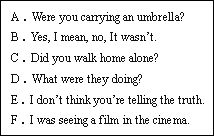
根据下面的对话内容,从方框内的选项(A、B、C、D、E、或F)中选出最佳选项,并在答题卡上将该项涂黑。选择中有一股为多余选项。
A:Now, Mr.Adama, what were you doing between 7:00 and 9:00 pm last night?
B: 1
A:Were your wife and children with you?
B:No, they weren't.
A: 2
B:They were watching TV at home.
A:I see.Now, was it raining when you went into the cinema?
B:Yes, I think so.
A: 3
B:No.It wasn't raining hard
A:What about when you left the cinema, was it raining then?
B: 4
A:And was your wife waiting for you outside?
B:No, of course not.
A: 5 Someone saw you outside the cinema, in the rain, carrying an umbrella, with your wife-and it was 7∶30 pm!
| |||||||||||||||||||||||||||
湖北省互联网违法和不良信息举报平台 | 网上有害信息举报专区 | 电信诈骗举报专区 | 涉历史虚无主义有害信息举报专区 | 涉企侵权举报专区
违法和不良信息举报电话:027-86699610 举报邮箱:58377363@163.com