
1. Point to the example in the box. Ask Ss to do a practice with his / her partners. Ask some groups to act.
4. Play the recording again and ask Ss to complete the activity individually. Correct the answers.
Step 3 While-task
SB Page25, 1c.
3. Say now listen to the recording. Write the name of each person next to his or her picture.
2. Call attention to the words in Activity 1a. Read together. Say, look at the picture. Ask Ss to tell what they see in each scene. Match the words with the picture and check the answers.
1. Ask Can you come to my party? Ask some students to answer. Ask the students who say I can’t go to say why not.
4. 情感目标: 培养学生礼貌用语的习惯.
Teaching procedures:
Step 1 Leading in
Play the song: Happy birthday. Say, today it’s Meimei’s birthday. She wants to invite you to her birthday party. Can you tell me what she should say? Ask students to say .
Step 2 Pre-task
Page 25, 1a, 1b
3. 能力目标: 学会邀请别人以及回答的方式.
2. Patterns: Can you come to my party?
Sure, I’d love to.
Sorry, I can’t. I have to …
1. vocabulary: lesson, hey, baseball game, test, piano, guitar, aunt, concert, party.
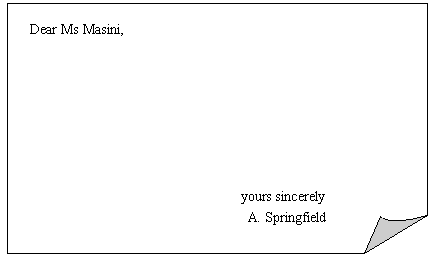
1. have to 与情态动词的区别 情态动词不能单独作谓语,后面必须接动词原形一起构成谓语,have to 也是这样。 情态动词没有人称和数的变化,而且所用的时态也受到一定的限制,但是have to 有人称和数的变化,可用于多种时态中,在一般现在时中,当主语是第三人称单数时,要用has to, 其余人称用have to;一般过去时中用had to;一般将来时中用will have to, 例如:She has to go to school by bus. If you get ill, you'll have to see the doctor. 2. have to 与must 的区别 have to 和must 都有“必须”的意思,那么它们 有哪些不同呢? (1) 含义和用法上的区别: have to 强调客观上需要做某事,即表示外界条件的需要不得不做某 事,含有“形势逼迫”的意味;must 强调说话者主观上认为必须做某事,含有“主观判断”的意味, 例如:My bike was broken on my way to school. I had to walk there.我的自行车在上学的路上坏了,我不得不走路去上学。(我本来不愿意走路,可是自行车坏了,不想走路也不行。)We must learn English well. 我们必须学好英语。(主观上有这种想法。) (2) 否定式的区别: have to 的否定式意为“不必”,must的否定式意为“禁止;不允许”。因此,以must开头的一般疑问句的肯定回答为“Yes, 主语+must”,否定回答为“No, 主语+needn't / don't have to”。例如: ---Must I finish the homework now? 我必须现在完成作业吗? ---Yes, you must. (No, you needn't / don't have to) 是的,你必须现在完成。(不,你不必。) 3. 反意疑问句的构成区别: (1) 陈述部分含有have to 时,其附加问句的谓语往往用助动词do的相应形式或助动词will。例如: You had to go shopping yesterday, didn't you?昨天你不得不去购物,是吗? (2) 陈述部分含有must 时,其附加问句的谓语,按下面几种情况来确定: A. must 意为“必须”时,附加问句谓语用needn't。例如: We must clean the room, needn't we? 我们必须打扫房间,是吗? B. mustn't意为“禁止”之意,附加问句谓语用must。例如: The boy mustn't play with the knife, must he? 那个男孩不能玩刀子,对吗? C. must 意为“应该”时,附加问句谓语用mustn't。例如: We must help each other, mustn't we? 我们应该互相帮助,对吗? D. must 意为“一定;想必”表示推测时,附加问句部分谓语要根据must后面的动词来 确定。例如:Mr Wang must be at home, isn't he? 王先生一定在家,对吗? 注:must 表示的是一种相当肯定的与事实非常接近的推测。例如: Mr Wang must be at home. 其实就相当于Mr Wang is at home. 因此,它的反意疑问句的附加问句部分是isn't he 也就很容易理解了。 又如:They must be right, aren't they? [综合能力检测] 一. 单项填空 1. What do you usually do _______ Saturdays?( ) A. at B. on C. in 2. I’m sorry I have to _______ for the English test.( ) A. study B. studies C. studying 3. Can you ______ to my birthday party?( ) A. visit B. go C. come 4. Thanks for ___________.( ) A. asking B. ask C. asks 5. On Wednesday , I’m _________ tennis with the school team.( ) A. play B. playing C. am playing 6. ---Must I clean my room, mom?--- No, you ______.( ) A. don't B. needn't C. aren't 二. 连词成句 1. Thanks, for, a lot, invitation , the ________________________________ 2. Can, come, to, you , my , party ? ______________________________________ 3. I’m , I’m , sorry , to , going , the , movies, my friends, with . ________________________________________________ 4. Tomorrow , have to , I , to , the , go , dentist. _________________________________________ 5. What , you, are , on , Sunday, doing? _____________________________________ 三. 根据所给词语的提示,写出问句和答句 1. does go school how Lucy to? (ride her bike) Q: _________________________________________ A: _________________________________________ 2. you how do get house your? (walk) Q: _________________________________________ A: _________________________________________ 3. it long take how does? (twenty minutes) Q: _________________________________________ A: _________________________________________ 4. far it his home is how from school to? (five miles) Q: _________________________________________ A: _________________________________________ 四. 补全对话 A: Hi, Tom? T: Yeah, hi, Amy. A: Tom, can you 1 tennis with me? T: Uh, 2 ? A: Today. T: Uh, no, sorry, I can't. I have to go to the doctor and 3 for a test today. A: How about 4 ? T: Sorry, tomorrow I'm playing soccer and I have a piano lesson. A: Oh. Well, what are you doing the day after tomorrow? T: I have 5 babysit my sister. A: Oh, I see. T: I'm sorry, Amy. I'm really busy this week. 五. 重新安排所给句子的顺序,使其成为一个完整的信件。 A. Dear Ms Masini, B. yours sincerely A. Springfield C. We usually try to arrange such visits on Fridays, D. are 21st May and 4th June. E. if one of these is suitable for you? F. In view of your interest in the Institute for the Blind G. for you to spend a morning H. Could you please let us know I. Thank you for your letter of 12th April. J. visiting our organization, K. because one of our staff is then free to show guests round the buildings. L. Two possible dates which we can offer M. we are extremely happy.
湖北省互联网违法和不良信息举报平台 | 网上有害信息举报专区 | 电信诈骗举报专区 | 涉历史虚无主义有害信息举报专区 | 涉企侵权举报专区
违法和不良信息举报电话:027-86699610 举报邮箱:58377363@163.com