
1. (利用图片或歌曲导入1c。)
T: I am very pleased with your job. Maybe you watch TV every day. If I show you a picture or
a song, can you give some descriptions of it ? Let’s have a try. Listen to the song and tell us something about it.
(播放歌曲My Heart Will Go On的一小段。)
T: What do you think of it when you hear the song?
Ss: Very beautiful. This is a song of a film called Titanic.
T: Yes, you are right. Look, here are some pictures from CCTV-6 and some descriptions.
3. (让学生用would rather ... than ... 句式造句,巩固并加深新句式的用法。)
T: Please express your preference one by one as soon as possible according to 1b. Let’s see which group is the winner.
(步骤:
(1)把全班学生分成5组,每个小组各派一个监督员到其他组监督。
(2)每组成员均要依次表述各自喜好,要求内容不得重复出现。
(3)最先完成者为胜方。)
Step 4 Practice 第四步 练 习(时间:5分钟)
学生独立完成1c。
2. (把1b中的图片全部展示。也可利用前面板书的电视节目名称,用would rather … than … 句型让学生谈论电视节目。)
T: Talk about the TV programs that you prefer, using“would rather do sth. than sth.”
1. (分角色朗读1a并表演。教师可给予适当的帮助。)
T: Now let’s act it out in roles. S1 is Michael, S2 is Kangkang, S3 is Maria and S4 is Jane.
(表演对话。)
T: Good. The next group can make some changes according to your own ideas.
(根据情况,安排2~3组学生练习。)
2. (复习动名词作宾语的用法,让学生找出动名词作宾语的句子然后进行适当操练。)
T: Let’s go over the usage of gerund (v.-ing) as an object. Please find out the sentences with gerunds. Go ahead, please!
(1)I enjoy watching TV, …
(2)I’m tired of watching those shows.
(3)I like watching soccer games best.
Step 3 Consolidation 第三步 巩 固(时间:8分钟)
以表演形式巩固1a。学习1b并巩固句型would rather do sth. than sth.。
1. (呈现1a。)
T: We’ve talked much about TV programs and our preference. Now, let’s learn what Kangkang and his friends like to watch. Listen to the tape and answer the following questions:
(出示小黑板,让学生根据问题听对话然后回答问题。)
|
(1)
What does Michael want Kangkang to do? (2) Why does Maria like watching TV shows? (3) What do Michael and Kangkang think of watching quiz shows? |
T: Now listen to the tape carefully!
(播放录音磁带。)
T: Could you answer the questions on the blackboard? Any volunteers?
OK, S1, please! Question 1.
S1: Michael wants Kangkang to teach him to play Chinese chess.
T: Great. S2, please answer Question 2.
S2: Because she thinks TV shows are wonderful and she can learn a lot from them.
T: You are wonderful!S3, could you give the answer to Question 3?
S3: OK. They think quiz shows are very boring./They don’t like quiz shows.
T: Very good.
(让学生读1a,根据所提问题进一步理解对话内容。)
T: Now, let’s turn to 1a on page 25 and read through the dialog.
(2分钟后)
T: Finished?
Ss: Yes.
T: S4, could you tell me how Maria and Michael express their preference?
S4: Maria likes watching TV, especially quiz shows, but Michael would rather watch sports shows.
2. (让学生结对讨论各自喜欢的电视节目,并说明原因。)
T: We’ve discussed some TV programs. Now, let’s discuss what programs you would like to watch. You’d better give your reasons. Work in pairs.Let’s begin!
(让学生进行结对练习。)
T: Now, stop here. S8 and S9, please show us your job.
(表演对话。)
S8: Which program do you prefer, TV plays or sports shows?
S9: I would rather watch TV plays than sports shows because TV plays are more interesting.
How about you?
S8: I would rather watch news reports because I can learn a lot of things at home and abroad from it.
T: What do you think of their job?
Ss: Good!
Step2 Presentation 第二步 呈 现(时间:10分钟)
呈现1a,通过回答问题加深对1a内容的理解。
Step 1 Review 第一步 复 习(时间:15分钟)
复习上一单元的功能话题与本课相关内容。再由图片导入新词并介绍电视节目名称。
1. (简要复习,导入新学内容,激活学生的思维,让学生进入英语学习状态。)
T: Nice to see you again.
Ss: Nice to see you, too.
T: Could you tell me what you usually do in your spare time?
S1: I like watching TV.
S2: I like reading books.
T: What kind of books would you like to read?
S2: Humorous story books and history books.
T: You are all great. Indeed, reading is a good habit. And also some students like playing Chinese chess.
(鼓励学生开展健康、合理的课外活动,建立和谐民主的师生关系。)
T: There are so many students who enjoy playing Chinese chess. Who is the best player in our class?
Ss: S3.
T: S3, could you teach us how to play Chinese chess after class/in your spare time?
S3: Of course.
T: Thank you. This is a set of Chinese chess. Now it belongs to you.
(教师张贴李瑞英、王小丫、刘纯燕的图片在黑板旁。)



T: Some people like playing Chinese chess and some people like watching TV. Look, there are some pictures on the blackboard. Could you tell me who they are?
Ss: They are Li Ruiying, Wang Xiaoya and Liu Chunyan.
T: Do you know what programs they host?
Ss: Li Ruiying hosts CCTV news. Liu Chunyan hosts children’s programs.
T: This is Wang Xiaoya. She is usually in charge of quiz shows.
(导入新短语并板书画线部分解释其意义及用法,领读。)
|
quiz
shows |
T: How many TV programs do you know?
(开展心脑风暴活动,让学生尽量多说出一些电视节目名称。)
S4: TV plays, CCTV news, sports shows ...
T: S4, do you know anything else?
S4: Cartoon, entertainment shows ...
(板书电视节目名称,引出需理解生词entertainment。)
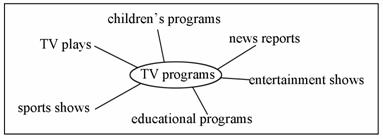
T: Great! How wonderful! There are so many programs. But which one is your favorite, TV plays, cartoon or quiz shows?
S5: I like watching TV plays better than quiz shows.
T: I see. S5 says he/she would rather watch TV plays than quiz shows. What about you, S6?
S6: I would rather watch CCTV news. But I don’t like sports shows.
T: S6 says he/she likes watching CCTV news. But he/she would rather not watch sports shows. How about you, S7?
S7: I would rather not watch TV. I like surfing the Internet.
T: S7 says he/she would rather surf the Internet than watch TV.
(板书本课中出现的重难点句式,让学生弄清其句式结构,为下一步教学活动扫除障碍。)
|
He/she
would rather watch TV plays than quiz shows. →would rather do sth. than
sth. He/she would rather not watch sports shows. →would rather not do sth. He/she would rather surf the Internet than watch TV. →would rather do sth. than do sth. |
录音机/李瑞英、王小丫、刘纯燕等一些节目主持人的图片/一副象棋/《泰坦尼克号》主题曲磁带/小黑板
5. Broaden the students’ horizons.
湖北省互联网违法和不良信息举报平台 | 网上有害信息举报专区 | 电信诈骗举报专区 | 涉历史虚无主义有害信息举报专区 | 涉企侵权举报专区
违法和不良信息举报电话:027-86699610 举报邮箱:58377363@163.com