
1. (先学后练)
T: Look at the useful expressions, read and learn them, and then we’ll do some translation exercises. I’ll give you 2 minutes. Hurry up!
T: I would rather watch sports shows. In Chinese it means … S1.
S1: …
T: I would rather watch TV plays than sport shows. What does it mean? S2.
S2: …
T: How do you say“你是个幸运儿”in English? S3.
S3: …
T: What do you mean by“Every dog has its day”? S4.
S4: …
T: Do you know the last sentence? S5.
S5: …
T: Here“would rather do sth. than sth.” means “prefer sth. to sth.”or“prefer doing sth. to doing sth.”OK, so much for it. You all have done good jobs.
2. T: Now, let’s have a further discussion of those questions about the text one another, then I’ll ask some students to report your answers.
(教师呈现写有下列任务的小黑板,让学生讨论。)
|
Fill
in the blanks after reading the text: (1)The topic sentence of the text is . (2)The main idea of Paragraph 1 and Paragraph 2 is . (3)The main idea of Paragraph 3 is . (4)The last paragraph tells us . |
(此活动的目的是使学生进一步加深对文章内容的理解,培养学生从整体把握文章主题或大意的能力,了解文章的结构,把握文章的内在联系。)
T: Now, well! Stop here! S1, would you like to have a try?
S1: OK. Let me have a try. The topic sentence of the text is that television has a huge influence on our lives. The main idea of Paragraph 1 and 2 is advantages of watching TV. The main idea of Paragraph 3 is disadvantages of watching TV. The last paragraph tells us to choose proper television programs.
(教师把画线部分填入上述表格内。学生回答若有困难,教师可提示一些关键词,如: advantage 和disadvantage。)
T: It’s wonderful of you to finish the job. Thank you.
Step 4 Practice 第四步 练习(时间: 8分钟)
完成活动2和3。
1. (读1a,进一步加深对课文的理解。)
T: Please read 1a and pay attention to the pronunciation and intonation.
3. (学生找出重点词组及难点句子。)
T: Some phrases are very important to you and some sentences are too difficult for you to understand. Please find them out.
(教师板书,讲解。)
|
have
a huge influence on … keep … away from be suitable for … Not everything on TV has positive effects on viewers. |
Step 3 Consolidation 第三步 巩固(时间: 7分钟)
巩固1a。
1. (1)(以课文图片作为突破口,呈现课文内容,进入1a。)
T: Please turn to page 31. Here is a picture of a family. They are watching TV together. The viewers are the father, the mother and the child. I think the program must be very funny because all of them are smiling.
(描述并板书需理解生词viewer,领读。)
|
viewer
n. |
T: Perhaps, there is another “person” in the picture, but we can’t see her. She is a babysitter. The word“babysitter”in Chinese means“保姆”.
(了解babysitter。)
T: What is this? (老师指着图片中的电视机问。)
Ss: TV!
T: Watching TV is an important part of our life. Think carefully! What influence does television have on us? There are some statements in 1b on page 31. Discuss which ones are good for us, and which ones are bad. Write“A”for agreement“D”for disagreement. Finish it in 2 minutes.
(学生独立完成1b作业。培养学生的预测能力和独立思考问题的能力。)
T: Have you finished?
Ss: Yes.
T: S2, which ones do you agree with?
S2: 1, 5 and 7.
T: Do you agree with him?
Ss: Yes, we do./No, we don’t.
T: Indeed, television has many good influences on us. But what bad influences does it have on us? S3, could you tell us your opinion?
S3: 2, 3, 4 and 6.
4. (教师呈现写有复习任务的小黑板,其内容为已学短语,但在本课中重新出现,用以激活相关背景知识,为下一活动作铺垫。)
T: Do some exercises and fill in the blanks with the phrases that I give you.
|
选用下列短语的适当形式填空。 have an influence, a lucky dog, spend some time on sth./(in) doing sth., keep away from, agree with (1) Anna is really . She has been invited to act as the chairman of the company. (2) Television on our life. (3) Though I don’t believe you, I your idea on this point. (4) He three hours the work. (5) Staying at home all the time him healthy activities. |
T: Finish the task alone. S5, come to the blackboard and write your answers on it.
(学生板书答案。)
T: Finished?
Ss: Yes, we have.
T: Let’s check S5’s answers.
The answers are: (1)a lucky dog (2)has an influence (3)agree with
(4)spent ... on/ (in) finishing (5)keeps ... away from
(此环节也可以让其他学生到黑板前帮助修正错误答案,培养学生探究、合作意识。)
T: When you do the exercises, you should make out the meaning of each sentence at first, then choose the right phrases, and at last fill in the blanks with proper forms.
(教师可用彩色粉笔标出学生易错部分。)
Step 2 Presentation 第二步 呈现(时间: 12分钟)
由1a的课文图片谈起电视。先完成1b,再学习1a。
3.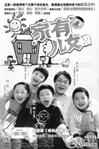 (教师呈现一幅《家有儿女》电视剧的图片,并以此为例解释一下肥皂剧。)
T: Now, let’s discuss another TV program. It’s called soap opera. It’s a kind of TV or radio play about family lives.《A family with kids》/《家有儿女》is a popular soap opera.
(板书需掌握单词soap及需理解词组soap opera,领读。)
|
soap soap opera |
2. (运用头脑风暴的形式,复习所学的电视节目。)
T: Review all the programs that we’ve learned.
TV programs: TV plays, sports shows, talk shows, quiz shows, news reports, entertainment shows, children’s programs, educational programs …
(Soccer Night, Lucky 52, CCTV News, Animal World, Cartoon City, The Same Song …)
Step 1 Review 第一步 复习(时间: 10分钟)
学生说出中西方文化中有关狗的描述。运用头脑风暴的形式复习所学的电视节目,呈现新词,为1a的学习作准备。
1. (说出中西方文化中有关狗的描述。)
T: Hello, boys and girls! During this Class, we’re going to review some sayings about dogs in Chinese and western culture, and you may add your own opinions. Now, let’s begin!
S1: In China,“a homeless dog”,“a mad dog”,“a running dog” and “a dog catching a mouse”have negative meanings.
S2: In western countries, dogs are considered honest and good friends of humans.
S3: In western countries, “You are a lucky dog”means you are a lucky person.“Every dog has its day”means each person has good luck at times.
S4: …
湖北省互联网违法和不良信息举报平台 | 网上有害信息举报专区 | 电信诈骗举报专区 | 涉历史虚无主义有害信息举报专区 | 涉企侵权举报专区
违法和不良信息举报电话:027-86699610 举报邮箱:58377363@163.com