阅读理解
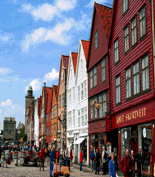
A Tour City—PompeiiEvery year thousands of tourists visit Pompeii(庞贝,意大利那不勒斯附近一座古城), Italy. They see the sights that Pompeii is famous for—its stadium(运动场)and theatres, its shops and restaurants. The tourists do not, however, see Pompeii's people. They do not see them because Pompeii has no people. No one has lived in Pompeii for almost 2000 years.
Once, Pompeii was a busy city of 22,000 people. It lay at the foot of Mount Vesuvius(维苏威火山), a grass-covered volcano(火山). Mount Vesuvius had not erupted(爆发)for centuries, so the people of Pompeii felt safe. But they were not.
In August of AD 79, Mount Vesuvius erupted. The entire top of the mountain exploded, and a huge black cloud rose into the air. Soon stones and hot ash began to fall on Pompeii. When the eruption ended two days later, Pompeii was buried(埋葬)under 20 feet of stones and ashes. Almost all of its people were dead.
For centuries, Pompeii lay buried under stone and ash. Then, in the year 1861, an Italian scientist named Ginseppe began to uncover(发现)Pompeii. Slowly, carefully, Ginseppe and his men dug. The city looked almost the same as it had looked in AD 79. There were streets and fountains, houses and shops. There was a stadium with 20,000 seats. Perhaps the most important of all, there were everyday objects, which tell us a great deal about the people who lived in Pompeii. Many glasses and jars had some dark blue colour in the bottom, so we know that the people of Pompeii liked wine. They liked bread, too; metal bread pans were in even bakery(面包房). In one bakery there were 81 round, flat loaves of bread—a type of bread that is still sold in Italy today. Tiny boxes filled with a dark, shiny powder tell us that women liked to wear eye-makeup(眼部化妆品).
Ginseppe has died, but his work continues. One-fourth has not been uncovered yet. Scientists are still digging, still making discoveries that draw the tourists to Pompeii.
1.Why do large numbers of people come to Pompeii each year?
[ ]
2.Why had so many Pompeiians remained by volcanic Mount Vesuvius?
[ ]
A.The city nearby offered all kinds of fun.
B.The area produced the finest wine in Italy.
C.Few people expected the volcano to erupt again.
D.The mountain was beautiful and covered with grass.
3.Why did the city uncovered look almost the same as it had looked in AD 79?
[ ]
A.Because Ginseppe and his men dug it slowly and carefully.
B.Because the city was buried alive and remained untouched.
C.Because scientists successfully rebuilt the city with everyday objects.
D.Because nobody had lived in the city ever since the volcano erupted.
4.What's the meaning of the underlined word“exploded”in the third paragraph?
[ ]
5.What do we know about the Pompeiians who lived 2000 years ago?
[ ]
A.They lived more or less the same as Italians now do.
B.They liked women wearing all kinds of makeup.
C.They enjoyed a lazy life with drinking and eating.
D.They went back to Pompeii after the eruption in AD 79.
 天天向上一本好卷系列答案
 小学生10分钟应用题系列答案
科目:高中英语 来源:英语教研室 题型:050
A higher reading rate, with no loss of comprehension (理解), will help you in other subjects as well as in English, and the general principle (原则) apply to any language. Naturally, you will not read every book at the same speed. You would expect to read a newspaper, for example, much more rapidly than a physics or economics textbook—but you can raise your average reading speed over the whole range of materials you wish to cover so that the percentage (百分比) gained will be the same whatever kind of reading you are concerned (有关的) with.
The reading passages which follow are all of an average level of difficulty for your stage of instruction. They are all about five hundred words long. They are about topics of general interest which do not require a great deal of specialized knowledge. Thus they fall between the kind of reading you might find in your textbooks and the much less demanding kind you will find in a newspaper or light novel. If you read this kind of English, with understanding at four hundred words per minute, you night skim (浏览) through a newspaper at perhaps 650-700, while with difficult textbooks you might drop to two hundred or two hundred and fifty.
Perhaps you would like to know what reading speeds are common among native English-speaking university students and how those speeds can be improved. Tests in Minnesota, U.S.A., for example, have shown that students without special training can read English of average difficulty, for example, Tolstoy’s War and Peace in translation, at speeds of between 240 and 250 words per minute with about seventy percent comprehension. Students in Minnesota claim (自称) that after twelve half-hour lessons, once a week, the reading speed can be increased, with no loss of comprehension, to around five hundred words per minute.
1.According to the passage, the purpose of effective reading with higher speed is most likely to help you .
A. only in your reading of physics textbook
B. improve your understanding of an economics textbook
C. not only in your language study but also in other subjects
D. choose the suitable material to read
2.Which of the following does not describe the types of reading materials mentioned in the second paragraph?
A. Those beyond (超越) one’s reading comprehension.
B. Those concerned with common knowledge.
C. Those without the demand for specialized knowledge.
D. Those with the length of about five hundred words
3.The average speed of untrained native speakers in the University of Minnesota is .
A. about three hundred words per minute
B. about two hundred and forty-five words per minute
C. about sixty words per minute
D. about five hundred words per minute
4.According to the passage, how fast can you expect to read after you have attended twelve half-hour lessons in the University of Minnesota?
A. You can increase your reading speed by three times.
B. No real increase in reading speed can be achieved.
C. You can increase your reading speed by four times.
D. You can double your reading speed.
5.Where do you think the passage is taken from?
A. The introduction to a book on fast reading.
B. A local newspaper for young people.
C. A school newspaper run by students.
D. The introduction to an English textbook.
查看答案和解析>>
科目:高中英语 来源:设计必修一英语外研 题型:050
| |||||||||||||||||||||||||||||||||||||||||||||
查看答案和解析>>
科目:高中英语 来源:福建省莆田一中2012届高三第一学段考试英语试题(人教版) 题型:050
| |||||||||||||||||||||||||||||||||||||||||||||
查看答案和解析>>
科目:高中英语 来源:福建省期中题 题型:阅读理解
阅读理解
This tour takes you back in history to a moment that “will live in infamy (声名狼藉).” Explore
the historic artifacts at the Arizona Memorial Visitor Center commemorating(纪念) the attack on
Pearl Harbor, then travel around beautiful Oahu on a Circle Island guided bus tour.
The Arizona Me morial Visitor Center is Hawaii’s number one visitor attraction.View the film
of the attack on Pearl Harbor and browse the historic artifacts on display.Then ride the Navy launch
across Pearl Harbor to visit the Arizona Memorial.Then, board a tour bus for a scenic trip around
the island of Oahu.Get your cameras ready for the beautiful view over Windward Oahu at Nu’uanu
Pali Lookout.Visit Byodo-In Temple, which is set against a picturesque mountain backdrop.
You’ll also see the famous North Shore surfing beaches of Sunset, Banzai Pipeline, and Waimea
Bay and drive through rustic Haleiwa Town.Visit Dole Plantation and discover the history of
Hawaii’s pineapple industry before enjoying a no host lunch at the Polynesian Cultural Center (lunch is
not included in the listed-price).
Inclusions:
Scenic bus tour of Oahu island
Film viewing at Arizona Memorial Visitor Center.Pearl Harbor
Visit of Byodo-In Temple and Dole Plantation
Available:
Mon.-Fri.
Hours of operation:
7 AM to 5 PM
Note:
Strict security measures forbid purses, handbags, fanny packs, backpacks, camera bags, diaper
bags, luggage and/or other items.Visitors may bring a camera and cam-recorder.A storage
facility, operated by a private vendor, is available for visitors coming to the USS Arizona Memorial,
USS Bowfin Submarine Museum & Park, the Battleship Missouri and the Pacific Aviation Museum.
1. What is the purpose of the passage above?
A.To introduce the beautiful scene in Oahu
B.To tell the writer attractions in Hawaii.
C.To attract more tourists.
D.To describe a wonderful tour in Oahu.
2. Which of the following is the right order of the tour?
A. The Arizona Memorial, Byodo-In Temple, Nu’uanu Pali Lookout, Polynesian
Cultural Center
B. Pearl Habor, Dole Plantation, Nu’uanu Pali Lookout, Sunset Beach
C. Pearl Habor, North Shore, Byodo-In Temple, Dole Plantation
D. The Arizona Memorial, Nu’uanu Pali Lookout, Dole Plantation, Polynesian Cultural
Center
3. A tourist will see everything below at Pearl Harbor except _________.
A. the Arizona Memorial
B. some historic artifacts
C. a film
D. Windward Oahu
4. Which of the persons below will not be allowed to enter the attractions in Pearl Harbor?
A. Alice, a student from LA, comes with her parents, with a Sony digital camera in her
hand.
B. Geogre Zhang, from Shanghai, leaves his backpack in a locker outside the entrance.
C. Billy, from Italy, with small bag in hand and inside the bag is a cam-recorder.
D. Hose, from Spain, who has left his luggage in the hotel.
查看答案和解析>>
湖北省互联网违法和不良信息举报平台 | 网上有害信息举报专区 | 电信诈骗举报专区 | 涉历史虚无主义有害信息举报专区 | 涉企侵权举报专区
违法和不良信息举报电话:027-86699610 举报邮箱:58377363@163.com