
题目列表(包括答案和解析)
阅读理解填词。
Teenagers are always stressed out now.They are often too b 1 to think about their diets and exercise.The truth is, healthy eating, a 2 with regular exercise.Is the only way to k 3 fit.
During your teenage years, it is important to give your body the e 4 it needs.Teenager girls need about 2,200 calories(卡路里)a day and boys need a bit more.Doctors suggest 2,800 calories for teenage boys.50% of your calories should come from rice, bread, v 5 and fruit.You also need to drink a lot of water, six to eight g 6 a day.Enough water will improve your skin and give you healthy hair.
Exercise can help to make you look good, feel good and be healthy.Scientists suggest that teenagers should spend at least 30 minutes e 7 every day.
When you exercise, your body p 8 something.It makes you feel r 9 and energetic.It can even help you sleep better at night and let you pay more a 10 when you study.
Let's eat healthily and take regular exercise.
| |||||||||||||||||||||||||||||||||||||||||||||||||||||||||||||||
阅读理解
Everybody has a home. People have homes. Animals have homes, too. People live in different kinds of homes. Animals also have different kinds of homes.
Some animals live in holes under the ground. The woodchuck lives under the ground His home has two doors. If any enemy comes through one door, the woodchuck goes out of the other. Some animals live in holes in trees. Some squirrels build nests high in trees. Some birds live in holes in trees. Most of the birds live in nests. Crows build their nests high in trees. But hawks build their nests high in the mountains.
Some animals even carry their homes on their backs.
注释 1.woodchuck[V(DCM)E]n.土拨鼠 2.nest[Q-KC]n.窝
3.squirrel[KEV!T+S]n.松鼠 4.crow[ET+(]n.乌鸦
根据短文内容,选择正确答案。
1.The text is about ________.
[ ]
A.some trees
B.some animals and birds
C.animals' homes
D.different animals
2.________ live under the ground.
[ ]
A.All the animals
B.The woodchuck and the squirrel
C.Some animals
D.Some birds
3.How many doors has the woodchuck in his house?
[ ]
4.Animals' homes are ________.
[ ]
5.Which animal carries his home on his back?
[ ]
| |||||||||||||||||||||||||
听力部分
(共五大题,30小题,每小题l分,满分30分)1.听句子,选出与所听句子意思相符的图片(其中有一幅是多余的)。每个句子读两遍。
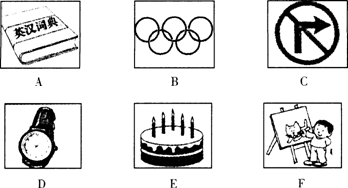
1.________ 2.________ 3.________ 4.________ 5.________
Ⅱ.听句子,选择正确答案。每个句子读两遍。
6.A.Here you are. B.Thank you. C.You are welcome.
7.A.Yes, I do. B.Yes, I will. C.Sorry, I won't.
8.A.Good idea. B.Not at all. C.What a shame!
9.A.An apple. B.Some bread. C.A glass of milk.
10.A.Good luck. B.Bad luck. C.No problem.
Ⅲ.对话理解。(听下面7段对话,每段对话后有一个或几个小题,从题中所给的A、B、C三个选项中选出最佳选项。在听每段对话前,你将有时间阅读各个小题,每小题3秒钟;听完后,每个小题将给出3秒钟的作答时间。每段对话读两遍。)
听第一段对话,回答第
11小题。11.Which sport does Tom like?
A.Ping-pong.
B.Volleyball.
C.Basketball.
听第二段对话,回答第12小题。
12.How will the man go to Shanghai?
A.By bus.
B.By train.
C.By air.
听第三段对话,回答第13小题。
13.What happened to Maria?
A.She lost her key.
B.She fell ill.
C.She was late for school.
听第四段对话,回答第14小题。
14.What kind of music does the woman like now?
A.Rock music.
B.Soft music.
C.Pop music.
听第五段对话,回答第15小题。
15.When did the woman buy her skirt?
A.Last Monday.
B.Last Tuesday.
C.Last Wednesday.
听第六段对话,回答第16、17小题。
16.Is there going to be a fashion show tomorrow?
A.Yes, there is.
B.No, there isn't.
C.I don't know.
17.Where will they meet?
A.At the bus station.
B.In the classroom.
C.At the school gate.
听第七段对话,回答第18至20小题。
18.How did the man make a hotel reservation?
A.On the Internet.
B.On the phone.
C.In the hotel.
19.How long will the man stay there?
A.About one day.
B.About two days.
C.About three days.
20.How much will the man pay for the rooms?
A.¥240.
B.¥260.
C.¥280.
Ⅳ.听短文,判断下列句子是否符合短文内容(符合用“T”表示,不符合用“F”表示)。短文读两遍。现在,你有15秒钟的时间阅读这几个小题。
21.Kumiko came to China three years ago.
22.She came to study Chinese.
23.She joined an English club.
24.She can speak Japanese, English and Chinese.
25.She will return home next month.
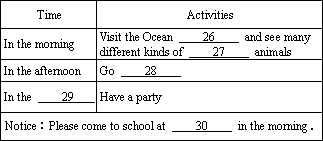
V.听短文,根据短文内容填写表格(每空一词)。短文读三遍。现在,你有15秒钟的时间阅读这几个小题。
湖北省互联网违法和不良信息举报平台 | 网上有害信息举报专区 | 电信诈骗举报专区 | 涉历史虚无主义有害信息举报专区 | 涉企侵权举报专区
违法和不良信息举报电话:027-86699610 举报邮箱:58377363@163.com