
题目列表(包括答案和解析)
A group of swans flew down to a beach where a crow(乌鸦) was jumping around. The crow watched them with disdain(鄙视).
“You have no flying skills at all!” he said to the swans. “All you can do is to move your wings. Can you turn over in the air? No, that’s beyond you. Let’s have a flying competition. I’ll show you what real flying is!”
One of the swans, a strong young male, took up the challenge. The crow flew up and began to show his skills. He flew in circles, performed other flying tricks, and then came down and looked proudly at the swan.
Now it was the swan’s turn. He flew up, and began flying over the sea. The crow flew after him, making all kinds of comments(评价) about his flying. They flew on and on till they couldn’t see the land and there was nothing but water on all sides. The crow was making fewer and fewer comments. He was now so exhausted that he found it hard to stay in the air, and had to struggle to keep himself from falling into the water.
The swan pretended(假装) not to notice, and said, “Why do you keep touching the water, brother? Is that another trick?”
“No,” said the crow. He knew he had lost the competition. “I’m in trouble because of my pride! If you don’t help me, I’ll lose my life…”
The swan took pity on him, and took him on his shoulders and flew back to the beach.
1.What’s the correct order of the following events?
a. The crow showed off its flying skills.
b. The swan felt pity for the crow and saved it.
c. The crow laughed at the swan’s flying.
d. The crow followed the swan and got into trouble.
e. The crow challenged the swans and a strong young swan accepted it.
A. e, c, d, a, b B. a, e, c, d, b C. c, e, a, d, b D. e, a, d, c, b
2.What does the underlined word “exhausted” in Paragraph 4 mean?
A. Tired. B. Angry. C. Frightened. D. Regretful.
3.Why did the crow keep touching the water?
A. It was showing another flying skill.
B. It was struggling to keep itself from falling into the water.
C. It was thirsty and wanted to drink some water.
D. It was enjoying itself by doing so.
4.What can we infer(推断) from the passage?
A. The crow didn’t know flying.
B. Flying skills were useless.
C. The swan saved the crow because they were good friends.
D. The swan was better at long-distance flying than the crow.
5.What does the story tell us?
A. No pains, no gains. B. The early bird catches the worm.
C. Pride goes before a fall. D. Practice makes perfect.
从框里选择填入对话相应空白处的适当选项
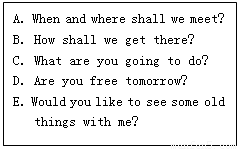
A: Hello, this is Ann.Is that Helen ?
B: Yes, speaking.
A:Helen, The happy weekend is coming. 1.____
B: Yes, I’m not busy. I’ve already finished my homework.
A: 2.______________
B: I’ve no idea. What about you ?
A: Let me see. Let’s do something interesting and helpful. 3._________
B: Certainly. Where?
A: In the new museum.
B: Oh, I remember. I heard of it last week. 4.___________________
A: By bike. It’s Saturday tomorrow. The traffic must be heavy, I think.
B: I agree. 5._____________
A: At the gate of our school at nine in the morning.
The woman asked the policeman where ________.
A. the post office is B. the post office was
C. is the post office D. was the post office
Teeth are important. Strong, healthy teeth help you chew foods that help you grow. They help you speak clearly. And, they help you look your best. Here are some advice for you to take care of your teeth.
● Brush your teeth the right way.
Brush your teeth at least twice a day after breakfast and before bedtime. If you can, brush after lunch or after sweet snacks(快餐), too.
Brush all your teeth, not just the front ones. Spend time brushing teeth along the sides and back of your mouth. Brush away from your gums(齿龈), too.
Spend at least three minutes each time you brush. Play a song you like to help pass the time.
Get a new toothbrush every three months. When you buy your tooth brush, be sure it has soft bristles(鬃毛).
● Learn how to floss your teeth.
Flossing is a very important way to keep your teeth healthy. Food may hide in places where a toothbrush cannot get to, like the space between the teeth. Flossing can help get rid of it. Carefully move the floss between two teeth, up and down. You need to floss your teeth at least once a day.
● Have good eating habits.
You need to be careful about what you eat and drink. Eating sugar is a major cause of tooth decay(腐朽). Eating sugar before you go to bed can make things even worse. Eat lots of fruit and vegetables and drink water instead of soda.
【小题1】 is helpful to your teeth.
| A.Eating fruit and vegetables | B.Eating sweet snacks |
| C.Eating sugar | D.Drinking soda |
| A.We should brush our teeth once a day. |
| B.We should keep our toothbrush away from our gums. |
| C.When we brush our teeth, at least three minutes is needed. |
| D.Brush our teeth before breakfast. |
| A.Go to see a dentist. | B.Fix a floss on the teeth. |
| C.Move the floss between two teeth. | D.Chew the floss in the mouth. |
| A.Flossing can help get ride of the food that hides between two teeth. |
| B.Healthy teeth can help you look more beautiful. |
| C.We don’t have to brush our teeth if we eat a lot of fruit and vegetables. |
| D.Your toothbrush should be changed every three months. |
| A.How to floss your teeth. |
| B.How to have good eating habits. |
| C.How to brush your teeth. |
| D.How to take care of your teeth. |
Living in a foreign culture can be exciting, but it can also be confusing(令人迷惑的). A group of Americans who taught English in other countries recently discussed their experiences. They decided that miscommunications(沟通误解)were always possible, even over something as simple as “yes” and “no”.
On her first day in Micronesia, an island in the Pacific(太平洋), Lisa thought people weren’t paying any attention to her. The day was hot. She went into a store and asked, “Do you have cold drinks?” The woman there didn’t say anything. Lisa repeated the question. Still the woman said nothing. She later learned that the woman had answered her: She had raised her eyebrows(眉毛),which in Micronesia means “yes”.
Jan remembered an experience she had in Bulgaria, a country in Europe. She went to a restaurant that was famous for its cabbage. She asked the waiter, “Do you have cabbage today?” He nodded his head. Jan waited, but the cabbage never came. In that country, a nod means “no”.
Tom had a similar problem when arrived in India. After explaining something in class, he asked his students if they understood. They answered with many different nods and shakes of the head. He thought some people had not understood, so he explained again. When he asked again, they did the same thing. He soon found out that his students did understand. In India, people nod and shake their heads in different ways depending on(依据)where they come from. You have to know where a person is from to understand whether they mean “yes” or “no”.
【小题1】The Americans teaching English in other countries found that they .
| A.should go abroad for vacations |
| B.needed to learn foreign languages |
| C.should often discuss their experiences |
| D.had problems with communications |
| A.nodding heads | B.raising eyebrows | C.shaking heads | D.saying “no” |
| A.he did not know much about Indian culture |
| B.he didn’t explain everything clearly enough |
| C.some students didn’t understand his questions |
| D.he didn’t know where the students came from |
| A.In Bulgaria, nodding heads means “no”. |
| B.Jan taught English on a Pacific island. |
| C.Lisa was trying to buy some cabbage. |
| D.In India, only shaking heads means “yes”. |
| A.body language in foreign restaurants |
| B.class discussion in India schools |
| C.miscommunication in different cultures |
| D.English teaching in other countries |
湖北省互联网违法和不良信息举报平台 | 网上有害信息举报专区 | 电信诈骗举报专区 | 涉历史虚无主义有害信息举报专区 | 涉企侵权举报专区
违法和不良信息举报电话:027-86699610 举报邮箱:58377363@163.com