
题目列表(包括答案和解析)
-What class are you ________?
-I’m in Class Five.
in
at
on
of
| 阅读理解。 | ||
| ||
| 1. Tim is unhappy because _____. | ||
| A. he has to work at 5 a.m. B. he has many rules C. he can't study at home D. he can't sleep well | ||
| 2. Tim can hang out with friends _____. | ||
| A. after school B. in the evenings C. on weekends D. in summer vacations | ||
| 3. Dr. Know tells Tim that _____. | ||
| A. he needn't obey the rules B. he has less rules at home C. school rules are more important D. parents make rules to help him |
听力理解(本大题共30小题,每小题1分,共30分)
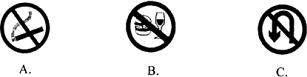
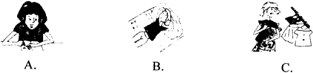
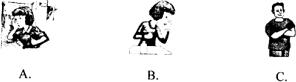
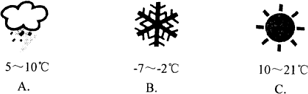
A.在下列每小题内,你将听到一个或两个句子并看到供选择的A、B、C三幅图画。找出与你所听句子内容相匹配的图画。
1.
2.
3.
4.
B.在下列每小题内,你将听到一个问句并看到供选择的A、B、C三个答语。找出能回答你所听到的那个问句的最佳选项。
5.A.I’m from Tianjin.
B.Tianjin is a beautiful city.
C.I’m a student.
6.A.It’s white.
B.It’s tall.
C.It’s young.
7.A.You’re welcome.
B.That’s a good idea.
C.Don’t mention it.
8.A.I like the school.
B.The school is far away.
C.I go by bus.
9.A.I was born in a small town.
B.I came here yesterday.
C.I had lunch at home.
10.A.I like holidays.
B.I went to Qingdao.
C.I stayed there for 2 weeks.
11.A.Since 1998.
B.Next year.
C.Last week.
12.A.I’m in Class One.
B.My name’s John.
C.I’m fifteen.
13.A.Her classes are interesting.
B.She is strict.
C.She is 26 years old.
14.A.Yes, go straight ahead.It’s opposite a school.
B.The hotel is very big.
C.People like going there.
C.下面你将听到十组对话,每组对话都有一个问题。根据对话内容,从每组所给的A、B、C三个选项中找出能回答所提问题的最佳选项。
15.What’s Harry’s favourite sport?
A.Football.
B.Table tennis.
C.Basketball.
16.When did the man come to China?
A.In August 1989.
B.In October 1999.
C.In October 2002.
17.Is Betty going to play the piano tomorrow morning?
A.No, she isn’t.
B.Yes, she is.
C.Yes.She likes playing the piano.
18.In Tom’s opinion, what’s the population of Shanghai?
A.10 million.
B.13 million.
C.15 million.
19.Where does the woman want to go?
A.Australia.
B.Africa.
C.Europe.
20.Who gave the man the advice?
A.The woman’s teacher.
B.The man’s pen friend.
C.The woman’s pen friend.
21.What haven’t they got at home?
A.Oranges.
B.Bananas.
C.Apples.
22.How many times has the woman been to the United States?
A.Three times.
B.Four times.
C.Five times.
23.What does Sam do on his birthday?
A.Have a party.
B.Make a cake.
C.Go dancing.
24.When is Charlie’s chemistry lesson?
A.At half past one.
B.At half past two.
C.At half past three.
D.听下面长对话或独白。每段长对话或独白后都有几个问题,从题中所给的A、B、C三个选项中选出最佳选项。
听下面一段材料,回答第25至第27题。
25.Where is Mary now?
A.At school.
B.At home.
C.On the Great Wall.
26.What are the students getting together for?
A.Having a school trip.
B.Having a swim.
C.Having a meeting.
27.Who is writing postcards?
A.Tony.
B.Wang Hui.
C.Lingling.
听下面一段材料,回答第28至第30题。
28.What does David like doing in the evening?
A.Staying at home.
B.Watching television.
C.Going out with his friends.
29.Where does David’s brother work?
A.In a school.
B.In a bank.
C.In a hospital.
30.What’s the difference between the two brothers?
A.The character.
B.The colour of eyes.
C.The colour of hair.
阅读理解:
Bill is now in China with his parents. He goes to a Chinese school
near here. He gets up at six o'clock and then he washes his face, brushes his teeth and has his breakfast quickly. After that he goes to school. He gets to school at a quarter past eight on weekdays. He never gets to school late. In class he works hard and listens to the teacher carefully. He is very good at all his lessons but Chinese. He's a beginner of it. He finds it a bit difficult to learn Chinese. He says,“ it's not easy to learn Chinese. And it takes time. But I like it. ”He can speak quite a little Chinese now.
Bill does not go home for lunch. He has it at school. After lunch he has a short rest. The classes in the afternoon are over at about four o'clock. Bill does not go home before five. He enjoys sport. He usually plays football with us after school. After that he goes home. He gets home at about half past five.
He sometimes helps his parents do some housework before supper. After supper. he does his lessons for an hour. Sometimes he watches TV,but he does not watch TV for long. He goes to bed at about a quarter to nine at night.
At weekends he turns on his computer. He sends and gets e-mails to and from his friends hack in England. He also gets on the Interact(因特网)to learn about what is going on in the world. He says that the Internet can bring him the world news very quickly. Sometimes his parents take him to some places of great interest in China. He likes going out. Sometimes I ask him to come over to my home for a weekend. Myparents say they cannot understand what we talk about because there are two languages in our talks, Chinese and English. My mother sometimes says to him,“ Bill, can you talk to my son in Chinese only?” He smiles and answers, “Not today. I'm going to speak good Chinese very soon ,I think. ”He is not very good at Chinese and I am not very good at English, you know. But we like these talks because we can learn While talking.
At home he is a good boy, and at school he is a good student. And he is my good friend both in and out of school!

(1) What does the writer of the passage tell us?
[ ]
A. Bill's school life in China.
B. Bill's after-school time.
C. Bill's life in China.
D. Bill's hobbies and school work.
(2) How long is Bill at school on weekdays?
[ ]
A. He is at school for more than eight hours.
B. He is at school for about seven hours.
C. He is at school for less than seven hours.
D. He does not go to school on weekdays.
(3) What does he do after school?
[ ]
A. He has sport with his classmates.
B. He goes to one of his friends' homes.
C. He begins to learn Chinese.
D. He has a short rest.
(4)Which country does Bill come from?
A. He comes from Canada.
B. He comes from Australia.
C. He comes from the USA.
D. He comes from England.
(5)What do you know about his weekends?
A. He sometimes goes to see his friends back home.
B. He sometimes gets on line to read the world news.
C. He sometimes takes his parents out to see the cities in China.
D. He sometimes practise speaking Chinese with his teachers and friends.
(6) What do you know of Bill's Chinese now ?
A. He is very good at his Chinese lessons now.
B. He is only beginning to learn it and can speak a little of it.
C. He finds it hard to learn Chinese and dislikes it.
D. He can talk to his Chinese friends in Chinese without speaking any English.
(7) What do you know of the writer from this passage?
A. The writer of this passage is a Chinese teacher.
B. She is good at English.
C. He is Bill's good friend.
D. The writer can send and get e-mails to and from Bill's foreign friends.
| 【小题1】 |
|
| 【小题2】 |
|
| 【小题3】 |
|
| 【小题4】 |
|
| 【小题5】 |
|
| 【小题6】 |
|
| 【小题8】 |
|
| 【小题9】 |
|
| 【小题10】 |
|
| 【小题11】 |
|
| 【小题12】 |
|
湖北省互联网违法和不良信息举报平台 | 网上有害信息举报专区 | 电信诈骗举报专区 | 涉历史虚无主义有害信息举报专区 | 涉企侵权举报专区
违法和不良信息举报电话:027-86699610 举报邮箱:58377363@163.com