
题目列表(包括答案和解析)
一、听力(共25小题;每小题1分,满分25分)
A)听句子,按所听句子的顺序将图片字母代号填入下面的横线上.每句读一遍.(4分)


1.________ 2.________ 3.________ 4.________
B)听对话,根据所听对话及问题选择正确答案.听两遍.(5分)
5.A.It’s rainy.
B.It’s windy.
C.It’s snowy.
6.A.Three
B.Four
C.Five
7.A.The best football player
B.The school
C.The football
8.A.In the police station
B.In the museum
C.In the cinema
9.A.7∶15
B.6∶55
C.7∶05
C)听下面的对话,每段对话后有几小题,请根据你所听到的内容,从所给的A、B、C三个选项中选出一个适当的答语.听每段对话前,你都有时间阅读各个小题,每小题5秒钟;听完后,各个小题将给出5秒钟的作答时间.每段对话读两遍.(共10小题;每小题1分,满分10分)
听第1段材料,回答10~11题.
10.Who are the man’s parents staying with?
A.His sister.
B.His brother
C.His friend
11.Why doesn’t the man’s father like the city?
A.He likes to live alone.
B.He likes the country life.
C.He hates the noise.
听第2段材料,回答12~14题.?
12.When did the boy go to school this morning?
A.7∶5.
B.6∶45.
C.7∶05
13.How did the boy go to school this morning?
A.On foot.
B.By bus.
C.By bike.
14.How many minutes was the boy late for school?
A.Five minutes.
B.Fifty minutes.
C.Fifteen minutes
听第3段材料,回答15~17题.
15.Where are they talking?
A.In the park.
B.In the post office.
C.In the shop.
16.What does Wang Wei want to buy?
A.A watch.
B.A cap.
C.A bag
17.How much does Wang Wei have got?
A.16 yuan.
B.18 yuan.
C.30 yuan.
听第4段对话,回答第18~20题.
18.Why is the man calling Mr.Smith?
A.He has something important to tell Mr.Smith.
B.He wants Mr.Smith to call Mr.Sharp at once.
C.He’d like to meet Mr.Smith in the office.
19.When will Mr.Sharp be back?
A.Next month.
B.Two hours later.
C.Next Monday.
20.What did the woman speaker ask Mr.Johnson to do at first?
A.She asked him to leave a message.
B.She asked him to meet Mr.Sharp instead.
C.She asked him not to leave his office.
D)听短文,从下面所给的A、B、C三个选项中选出所给问题的正确答案.听两遍.(5分)
21.When did the first laughter club open?
A.In 1996
B.In 1994
C.In 1995
22.Where did the man who opened the first laughter club come from?
A.India
B.America
C.England
23.Who is Steve Wilson?
A.The man opened laughter club.
B.The scientist who discovered that laughter is good for health.
C.The man who took laughter club to America.
24.Which of the following is NOT TRUE?
A.Laughter is the same in any language.
B.laughter is good for us.
C.Laughter is different in different languages.
25.How many laughter clubs are there around the world now?
A.Less than 1,000
B.More than 1,000
C.About 1,000
听力
一、听句子,选择与句子情景相关的图。每小题念一遍
0(每小题1分。共5分)1.

2.

3.

4.

5.

二,听句子,选择恰当的答语。每小题念一遍。
(每小题1分,共5分)6.A.Good night. B.Bye-bye. C.Nice to see you, too.
7.A.My pleasure. B.It doesn't matter. C.It's very kind of you.
8.A.I like apples. B.I'm hungry. C.Well done.
9.A.Not at all. B.Thank you. C.That's right.
10.A.I'm Ann. B.I don't agree. C.This is Ann speaking.
三、听对话,选择正确的答案。对话念两遍。(每小题1分,其10分)
听第
l段对话,完成第11小题。11.Whose ruler is this?
A.Betty's. B.Lily's. C.Lucy's.
听第2段对话。完成第12小题。
12.When will Jane go to the party?
A.Next Saturday. B.This Saturday. C.Tomorrow evening.
听第3段对话,完成第13小题。
13.What color is Mary's hair?
A.Red. B.Yellow. C.Black.
听第4段对话,完成第14小题。
14.What does Kate's father do?
A.A driver. B.A teacher. C.An office worker.
听第5段对话,完成第15至17小题。
15.What did Bruce use to do during the summer vacation?
A.Go fishing. B.Go shopping. C.Go camping.
16.Where is Bruce's house?
A.Near the lake. B.Near the sea. C.Near the river.
17.What does the woman think of Bruce?
A.Silly. B.Clever. C.Friendly.
听第6段对话,完成第18至20小题。
18.What is Sam doing?
A.Flying a kite. B.Making a kite. C.Mending a plane.
19.Who is the present for?
A.Sam's mother. B.Sam's sister. C.Sam's friend.
20.What's the relationship between the two speakers?
A.Mother and son. B.Father and daughter. C.Brother and sister.
四、听短文,选择最佳答案。短文念两遍。(每小题1分,共5分)
21.Where is Rose now?
A.In Hainan. B.In Shanghai. C.In Nanjing.
22.Which subject does Rose like best?
A.Math. B.Chinese. C.English.
23.When does Rose go to the English corner?
A.On weekends. B.On Saturday morning. C.On Tuesday afternoon.
24.How often does Rose go to the school library?
A.Every day. B.Once a week. C.Twice a week.
25.How is Rose's school life?
A.Hard. B.Busy. C.Interesting.
五、听对话。完成下面表格。每空一词。对话念两遍(每小题1分。共5分)

听力
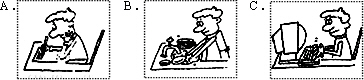
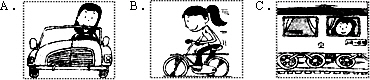
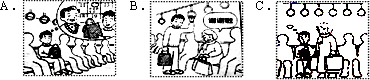
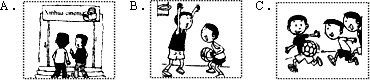
一、听对话选图:听下面五则对话,从每小题A、B、C三个选项中,找出能回答所提问题的图片。(听完每则对话后,你将有10秒钟的时间做出选择和准备下一小题。每则对话读两遍。)(每小题1分,共5分)
1.
2.
3.
4.
5.
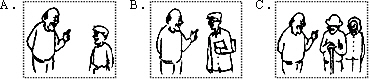
二、对话理解:听下面三则对话,从每小题A、B、C三个选项中,找出相应问题的最佳答案。(听每段对话前,你将有时间阅读各个小题,每小题5秒钟;听完后,各小题将给出5秒钟的作答时间。每则对话读两遍。)(每小题1.5分,共15分)
听第一段对话,回答6-8小题。
6.Who is Hector visiting?
A.His parents.
B.His grandparents.
C.His cousins.
7.Where is Susan going?
A.To the countryside.
B.To Shanghai.
C.To the Central Park.
8.When is Susan leaving?
A.On June 25.
B.On July 25.
C.On July 5.
听第二段对话,回答9-11小题。
9.What time did the girl call Tom?
A.At 7∶00 yesterday evening.
B.At 7∶00 this morning.
C.At 7∶00 yesterday morning.
10.What did Tom do last night?
A.Went to a concert.
B.Had the piano lesson.
C.Sang in the theatre.
11.Why was the concert held?
A.To help the poor people in Taiwan.
B.To build new schools for the students in Sichuan.
C.To raise money for the poor people in Yushu.
听第三段对话,回答12-15小题。
12.What was the boy afraid of doing?
A.Speaking English.
B.Talking with the foreigners.
C.Making mistakes.
13.Which advice did Mrs.James give to the boy?
A.Talk as much as possible.
B.Listen to tapes.
C.Watch videos.
14.Where did the boy meet the foreigner?
A.In a park.
B.At KFC.
C.On a bus.
15.What did the foreigner want to know by asking“Where are you from?”?
A.Which country the boy was from.
B.More about China.
C.Which place of China the boy came from.
三、短文理解:听下面一则短文,从每小题A、B、C三个选项中,找出相应问题的最佳答案。(听短文前,你将有30秒钟的时间阅读各小题。短文读两遍。)(每小题2分,共10分)
16.What does the mother say when the girl has something difficult to do?
A.I will help you.
B.Do it yourself.
C.Ask the teacher for help.
17.Who did the cleaning for the girl that day?
A.The girl herself.
B.Her friends.
C.Her mother.
18.Whom does the girl see a dentist with?
A.Nobody.
B.Her classmate.
C.Her father.
19.What's the girl like?
A.Friendly and sunny.
B.Lazy and crazy.
C.Clever and hard-working.
20.What does the girl think of her mother?
A.A busy mother.
B.A good teacher.
C.A hard-working woman.
| |||||||||||||||||||||||||||||||||||||||||||||||||||||||||||||||||||||||||||||||||||||||||||||||||||||||||||||||||||||||||||||||||||||||||||||||||||||||||||||||||||||||||||||||||||||||||||||||||||||||||||||||||||||
| 完形填空。阅读下面短文,从短文后所给的A、B、C、D四个选项中,选出可以填入空白处的最佳选项。 | ||||
| Do you know who invented tea? In fact, tea, the most popular drink in the world (after water), was invented by accident (偶然). According to an ancient Chinese legend (传说), the emperor Shen Nong 1 tea when he was boiling drinking water over an open fire. Some leaves from a nearby bush (灌木丛) fell into the water and remained there for 2 . The emperor noticed that the leaves in the water produced a 3 smell. Later he decided 4 the hot mixture (混合物). It was quite delicious. And 5 , one of the worl's favorite drinks was invented. China is the home of tea, 6 has more than 4,000 years history. People throughout China drink tea daily. 7 the three major drinks-tea, coffee and cocoa, tea is drunk by 8 people in the world. Tea from China, along 9 silk and porcelain, began to be known by the world over a thousand years ago and has been an important Chinese export 10 . Tea leaves 11 mainly in the area south of the Yangtze River, in the provinces of Zhejiang, Jiangxi and Fujian, becauuse of the mild 12 and rich soil there. Longjing, Wulong, Pu'er and Tieguanyin are all 13 kinds of tea. Over the past centuries, Chinese people 14 their unique tea culture, which includes tea planting, tea-leaf picking, tea making and so on. Tea is 15 a popular topic which is often mentioned in dances, songs, poems and novels. | ||||
|
湖北省互联网违法和不良信息举报平台 | 网上有害信息举报专区 | 电信诈骗举报专区 | 涉历史虚无主义有害信息举报专区 | 涉企侵权举报专区
违法和不良信息举报电话:027-86699610 举报邮箱:58377363@163.com