Do you know English is the main language use by people? 查看更多


题目列表(包括答案和解析)

下列各句均有一处错误,请找出并改正。
1. Do you know English is the main language use by people?
2. How many boat can you see on the river?                
3. Can you see some children?                            
4. It's time for play volleyball.                        
5. We should understand the world news.                  
6. Don't playing basketball in the room.                  
7. The students are doing their homework careful.        
8. I hope you can find a good work.                      
_____
_____
_____
_____
_____
_____
_____
_____

查看答案和解析>>

仔细阅读下列短文, 根据题目, 选出最佳选项. Have you ever noticed an advertisement which says "Learn a foreign language in six weeks, or your money back! From the first day your pronunciation will be excellent. Just send ... " and so on Of course, it never happens quite like that. Anyone who learns a foreign language would think that it is not true. The only language that is easy to learn is the mother tongue. What is the mother tongue It is the first and main language that you learnt when you were a child. And think how much practice that a child gets! Before the Second World War, people usually learned a foreign language in order to read the literary(文学的) works of the country. Nowadays, speaking the foreign language is what most people want. Every year many millions of people start learning one. How do they do it Some people try at home, with books and tapes; some use radio or television programs; others go to evening classes. If they use the language only two or three times a week, learning it will take a long time, like language learning at school. A few people try to learn a language fast by studying for six or more hours a day. It is clearly easier to learn the language in the country where it is spoken. However, most people cannot afford this, and many language learners need the language in order to do their work better. For example, scientists and doctors mainly need to be able to read books and reports in the foreign language. Machines and good books will help, but they cannot do the student's work for him. Whether the language is learned quickly or slowly, it is hard work with a lot of training in reading, listening, speaking, and writing.

(1)

In the advertisement it is possible for a person to learn a foreign language ________. In fact, everyone who learns English would think it is not true.

A. more than a century

B. half a week

C. six years

D. less than two months

[  ]

(2)

Before the Second World War, people wanted to learn a foreign language in order to_______.

A. speak to each other

B. write the literary report of the other country

C. read something they didn't know

D. listen to the radio

[  ]

(3)

The easiest way for us to learn a foreign language is________.

A. using the language six or more hours a day

B. learning the language at school

C. studying the language in the foreign country

D. reading the foreign stories as many as possible

[  ]

(4)

Nowadays most people now learn a foreign language to________.

A. read books and reports in a foreign language

B. communicate(交流) with foreign friends

C. go to the other country for further study

D. try their best to work better

[  ]

(5)

The passage tells us that________.

A. the more time you spend, the quicker you'll learn the language

B. it is possible for you to learn a foreign language in six weeks

C. it is not good to learn a foreign language by yourselves

D. the quicker you learn a foreign language, the more you may pay for it

[  ]

查看答案和解析>>

完形填空。
        A good dictionary is     1    important tool (工具). It will tell you     2    only what a word means but
   3    how it    4   . A dictionary needs to be printed again about every ten years. Languages develop (发展)
and a good dictionary must     5    these new changes. 
       A new English dictionary will only tell you     6    most people use the language today. It will not tell you
what is right     7    wrong. It may tell you the right time to use a word. If only     8    people use a word, a
dictionary will     9    tell you this or not list (编列) it. 
        10    dictionary will tell you many interesting facts. If you type (用打字机打) a word and the word is too
long,    11   in your dictionary. All dictionaries show you    12    to break (拆开) a word. And they also show
you how a word    13   
       Every dictionary, of course, tells you what a word means. But some words, like "get" or "take", may have
lots of meanings (意思). In some dictionaries, the main (主要的) meanings are often listed first. In   14   , the
newest meanings are listed last. So before you use your dictionary, you should always    15    the front part.
This part explains    16   .
       Some dictionaries also show you where a word comes    17   . Do you know that the word "brand" (标记)
comes from an old word? This old word means "to burn". This is because    18    years ago people burned their
names on tables or boats to show who    19    them. They also burned their own names on their farm animals
  20    they would not be stolen.
       Your dictionary also has a lot of other interesting facts in it. After you have learned to use a dictionary, it
can become your best useful book.
(     )1. A. a         
(     )2. A. no       
(     )3. A. too       
(     )4. A. uses     
(     )5. A. to show    
(     )6. A. how       
(     )7. A. and       
(     )8. A. a little  
(     )9. A. neither    
(     )10. A. Every    
(     )11. A. look up it 
(     )12. A. when      
(     )13. A. speaks    
(     )14. A. another  
(     )15. A. see     
(     )16. A. how use it 
(     )17. A. into      
(     )18. A. hundreds of    
(     )19. A. builds    
(     )20. A.when                   
B. an        
B. that      
B. either     
B. is using    
B. show       
B. what       
B. or        
B. many       
B. nor      
B. Some       
B. look for it 
B. where     
B. is spoke   
B. the other  
B. look      
B. to how use it
B. up                       
B. hundred of  
B. makes     
B. in order to 
C. the         
C. not         
C. yet         
C. is used      
C. shows        
C. why         
C. but         
C. a few         
C. both       
C. All          
C. look it up    
C. why       
C. be spoken      
C. others      
C. watch      
C. how to use it  
C. by           
C. a hundred of           
C. build       
C. so that  
D. very             
D. if               
D. also             
D. used             
D. be shown         
D. if               
D. not              
D. a lot of           
D. either         
D. Many              
D. look it out       
D. which          
D. is spoken          
D. other          
D. read             
D. to how to use it 
D. from             
D. hundred                
D. made             
D. before       

查看答案和解析>>

阅读下面短文,从各题A、B、C、D四个选项中选出最佳选项。

  More and more new languages appear on the Internet.We call them "cyber* languages” .Recently “geili” is everywhere.It is a Chinese word in English alphabet*.Since “geili” sounds like “geli” in pinyin, netizens* invented the word “geli” .And Chinese does not have part of speech, so it can be a noun, a verb, an adjective or adverb at the same time.To fit into different parts of speech, they created “gelivable” the adjective, and “gelivability” the noun.It means “giving power” or “cool” .

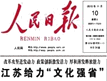
  We have many cyber words like this.Some of these words and expressions were even picked up in serious media* reports.On November 10, the People's Daily, carried a front-page* news story with the title “Jiangsu gelivable cultural province” .

  David Tool, a professor with the Beijing International Studies University, first heard the word “gelivable” from his students.He said it was very interesting to combine Chinese with English to create new words.

  Sergey Dmitriev, a student from Russia studying international politics at Liaoning University, believed the words are a way to learn more about Chinese society.“In Russia, similar words were created, as well, ” he said, adding that creation of the English words showed greater influence and more of an opening of China to the world.

  “Cyber language is more vivid*, ” Wu Zhongmin, a professor at the Party School of the Central Committee of the Communist Party of China, said.A writer, Wang Pei, thinks language is always developing.

  But an unnamed official said that, in fact, many senior* staff from news media were worried that years later, the younger would forget how to use formal* Chinese expressions.

  “My father is Li Gang” is another popular cyber language.What other cyber language do you know? What do you think of them?

(1)

“Geli” is a(n) ________ word in English alphabet.

[  ]

A.

Chinese

B.

English

C.

Russian

D.

Japanese

(2)

Words like “gelivable” were created by ________.

[  ]

A.

professors

B.

netizens

C.

some senior staff

D.

English people

(3)

It's clear that ________.

[  ]

A.

David Tool doesn't think it's good to create new words like “gelivable”

B.

Sergey Dmitriey is a professor at the Party School of the Central Committee of the Communist Party of China

C.

Wu Zhongmin were worried that years later, the younger generation would forget how to use formal Chinese expressions

D.

some serious media also use cyber languages

(4)

The main idea of the passage is ________.

[  ]

A.

people and “gelivable”

B.

how “gelivabe” come into use

C.

cyber languages like “gelivable”

D.

what is “gelivable”

查看答案和解析>>

How quickly can you count from one to ten? Do you use ten different words to do it? Can you do it in English, or do you have to use your first languages? Do you count on your fingers? Many people think that numbers and math are the same all over the world. But scientists have discovered that it is not true.
People in different parts of the world use different ways to count on their fingers. In the United States, people think begin counting with their first fingers, which they extend or stick out. They then extend the rest of their fingers and finally the thumb(拇指)to count to five. Then they repeat this with the other hand to get to ten. In China, people count by using different finger positions. In this way, a Chinese person can easily count to ten on only one hand.
Besides ways of finger counting, scientists have found that cultures and languages are also different when it comes to numbers. Some languages have only a few words for numbers, and others have no words for numbers. A group of scientists studied aboriginal(土著的)people in Australia. These people don’t have hand movements to stand for numbers. They don’t even have word for numbers. However, they are still able to understand different ideas about numbers.
In a similar study, researchers from the Massachusetts Institute of Technology discovered that people of the Piraha tribe(部落) in northwestern Brazil don’t have words for numbers such as “one” or “three.”. They are not able to say “five trees” or “ten trees” but can say “some trees,” “more trees,” or “many trees.” Professor Edward Gibson said that mist people believe that everyone knows how to count, “but here is a group that does not count. They could learn, but it’s not useful in their culture, so they’ve never picked it up.”
Although all humans are able to understand quantities(数量),not all languages have numbers and not all people use counting. Number words in a certain language are a result of people needing numbers in their daily lives. Now we know that people have different ideas about numbers and math, too.
小题1:The writer begins with the four questions in order to______.
A.make a surveyB.interest readers
C.tell a storyD.solve math problems
小题2:What do we learn from the difference in finger counting between the U.S. and China?
A.People from China count much faster than people from the U.S.
B.People from China need two hands to count from one to ten.
C.People of different cultures may use different ways of finger counting
D.People of different cultures use the same way of finger counting.
小题3:Which of following is true about aboriginal Australians?
A.They have only a few words for numbers
B.They have hand movements to stand for numbers
C.They can only count to five on their fingers
D.They can understand different ideas about numbers
小题4:The study of the Piraha tribe shows that____
A.people all over the world know how to count
B.People of the tribe have words for number
C.Some groups of people are not smart enough to count
D.Counting is not useful in the culture of the tribe
小题5:What is the main idea of the passage?
A.people from different cultures have different ideas about numbers and math
B.Chinese people can count more easily on their fingers than Americans
C.In some aboriginal culture,people don’t even know how to count
D.Some languages don’t have number words because people don’t need numbers.

查看答案和解析>>


同步练习册答案