
题目列表(包括答案和解析)
23. Do you think ______ doing some listening in the morning is a nice way of developing listening?
(A) why (B) how (C) that (D) whether
22. Clara often took her pigeon to some places far away ________ let it fly home.
(A) so that (B) hence (C) otherwise (D) and then
21._____ we had expected, Liu Tian was admitted into Fudan University.(A) Like (B) What (C) As (D) What if
Pare A: Short Conversations
Directions: In Part A, you will hear ten short conversations between two speakers. At the end of each conversation, a question will be asked about what was said. The conversation and the question will be spoken only once. After you hear a conversation and the question about it, read the four possible answers in your paper, and decide which one is the best answer to the question you have heard.
1. (A) He can't go this weekend. (B) He has a hole in his bathing suit.
(C) They should stay at the beach longer. (D) They shouldn't spend much money.
2. (A) Turn the alarm off. (B) Live on a farm. (C) Move his alarm clock. (D) Go to bed earlier.
3. (A) He hasn't and time to find another apartment.
(B) His mother dusted her apartment the day before last.
(C) He hasn't cleaned the apartment since his mother visited.
(D) His mother was the last person to come over to his apartment.
4. (A) Making a pot of coffee. (B) Trying different brands of coffee.
(C) Drinking less coffee. (D) Getting a different coffee pot.
5. (A) Some music cassettes.(B) Some school supplies (C) Something to drink.(D) Something to eat.
6. (A) He has finished his biology project. (B) He'll feel happier when the project is completed.
(C) He's annoyed with everyone. (D) He took a nap in biology class.
7. (A) She knows very little about bicycles. (B) She doesn't want the man to study.
(C) The man likes to study outdoors. (D) The man isn't ready to study yet.
8. (A) Try to find it in the house (B) Repair the roof. (C) Lend his friend a pen (D) Become extremely angry.
9. (A) She agrees with the man. (B) She didn't hear what the man said.
(C) She is surprised by his opinion. (D) She thinks he should look at it again.
10.(A) The weather forecast has often been wrong. (B) No more rain is needed
(C) It's going to rain today (D) They'll have more time tomorrow.
Part B: Longer Conversations
Directions: In Part B, you will hear two longer conversations. After each conversation, you will be asked two question. The conversations will be read twice, but the questions will be spoken only once. When you hear a question, read the four possible answers in you paper and decide which one would be the best answer to the question you have heard.
Questions 11 and 12 are based on the following conversation:
11. (A) To a rock and mineral show. (B) To an opera at the concert hall.
(C) To a movie at the student center. (D) To a popular music concert.
12. (A) She gets a student's discount. (B) Bob doesn't have very much money.
(C) She lost a bet and owes Bob money. (D) Bob left his wallet at home.
Questions 13 and 14 are based on the following conversation:
13. (A) In a classroom. (B) In a snack bar (C) In the dormitory. (D) In a camera shop.
14. (A) He worked for a radio station. (B) He lived in a dormitory.
(C) He took a long trip. (D) He visited the man's family.
Part C: Passages
Directions: In Part C, you will hear two short passage, and you will be asked three questions on each of the passages. The passages will be read twice but the questions will be spoken only once. When you hear a question, read the four possible answers in your paper and decide which one would be the best answer to the question you have heard.
Questions 15 through 17 are based on the following passage:
15. (A) To explain the importance of learning rhythm and harmony in jazz.
(B) To show that jazz is not really music at all.
(C) To point out similarities between jazz and classical music
(D) To describe what makes a good jazz performing it.
16. (A) They memorize their music before performing it.
(B) They are more famous than performers of other kinds of music.
(C) They perform their music as a means of individual.
(D) They possess detailed knowledge of the rules of jazz composition.
17. (A) Practice various jazz rhythms.
(B) Interview a jazz musician
(C) Watch a film about jazz performers
(D) Listen to some recordings of jazz music.
Questions 18 and 20 are based on the following conversation:
18. (A) A radio broadcast. (B) A political discussion (C) A sales promotion (D) A health documentary
19. (A) Where fruit is grown (B) How fruit becomes ripe (C) Why fruit falls from trees. (D) Which fruits are edible
20. (A) The fruit itself (B) The air surrounding the fruit
(C) The spray applied by farmers. (D) The tree or vines to which the fruit is attached.
第二节:书面表达(满分25分)
假设你是图1中的男孩,请根据以下图画提供的情节线索,以Sharing Housework为题,用英文叙述你帮妈妈做家务的经过及感想。
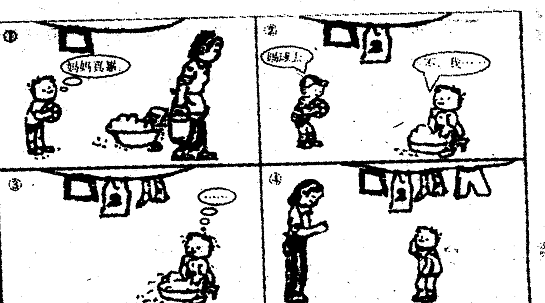
注意:1.书面表达必须包括图画所表现的主要内容,可以适当增减细节,使其连贯、完整。
2.词数:100左右。
3.请在答题卡上作答。
2004年全国普通高等学校统一招生考试(重庆卷)
第一节:短文改错(共10小题;每小题1分,满分10分)
在答题卡上改正所给短文中的错误。对标有题号的每一行做出判断:如无错误,在该行右边横线上画一个勾 (√);如有错误(每行只有一个错误),则按下列情况改正:
该行多一个词:把多余的词用斜线(\)划掉,在该行右边横线上写出该词,并也用斜线划掉。
该行缺一个词:在缺词处加一个漏字符号(∧),在该行右边横线上写出该加的词。
该行错一个词:在错的词下划一横线,在该行右边横线上写出改正后的词。
注意:原行没有错的不要改。
During the summer of 2001, I started reading books
in English, mostly stories. I would learn a lot of new 76.
words from these books, but I had terribly problems 77.
memorizing them. I had to look up to the same word 78.
many times, for which was quite troublesome. I realized 79.
I do need a way to remember all this vocabulary. It was 80.
a great achievement for myself. I started writing down 81.
words from books that I read. I would come back from 82.
school, and then sit for an hour and two. I wrote down 83.
new words and added it to my collection. By the end 84.
of last year,my collection has grown to 3,000 words. 85.
湖北省互联网违法和不良信息举报平台 | 网上有害信息举报专区 | 电信诈骗举报专区 | 涉历史虚无主义有害信息举报专区 | 涉企侵权举报专区
违法和不良信息举报电话:027-86699610 举报邮箱:58377363@163.com