
题目列表(包括答案和解析)
Winter is dangerous because it’s so difficult to know what is going to happen and accidents take place so easily. Fog can be waiting to meet you over the top of a hill. Ice might be hiding under the melting(融化)snow, waiting ahead to send you off the road. The car coming to you may suddenly slip across the road.
Rule Number One for driving on icy roads is to drive smoothly(平稳地). Sudden movements can make a car very difficult to control. So every time you either start or stop your car, increase or reduce your speed, you must be as gentle and slow as possible. Suppose you are driving with a full cup of hot coffee on the seat next to you. Drive so that you wouldn’t spill(溅) it.
Rule Number Two is to pay attention to what might happen. The more ice there is, the further down the road you have to look. Test how long it takes to gently stop your car. Remember that you may be driving more quickly than you think. Generally, allow twice of your usual stopping distance when the road is wet, three times this distance on snow, and even more on ice. Try to stay in control of your car at all times and you will not get into trouble.
1.The writer tries to in this passage.
A.show his dislikes about bad winter weather
B.give information about winter weather
C.ask people not to drive in winter
D.advise people about safe driving in winter
2.According to the passage, the writer thinks that .
A.people should not drive in the snow
B.drivers should think more about problems in winter driving
C.people drive too fast in winter
D.winter drivers should stop their cars less
3.In the passage the writer talks about a cup of coffee .
A.to show how important smooth movements are
B.to ask the drivers to bring some soft drinks with them
C.to tell the drivers to be more relaxed
D.to show how it can be spilled
4.Which of the following is NOT TRUE?
A.Traffic accidents take place easily in winter.
B.Fog and melting snow often cause car accidents.
C.The stopping distance on ice is as long as the usual one.
D.In winter you should drive your car with great care.
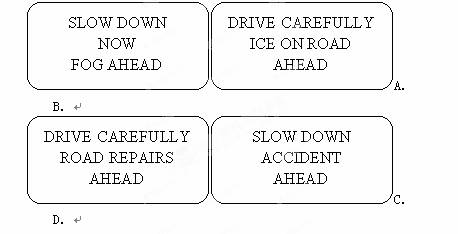
5.Which traffic sign shows the main idea of the passage?


A. B.


C. D.
Winter is dangerous because it’s so difficult to know what is going to happen and accidents take place so easily. Fog can be waiting to meet you over the top of a hill. Ice might be hiding under the melting(融化)snow, waiting ahead to send you off the road. The car coming to you may suddenly slip across the road.
Rule Number One for driving on icy roads is to drive smoothly(平稳地). Sudden movements can make a car very difficult to control. So every time you either start or stop your car, increase or reduce your speed, you must be as gentle and slow as possible. Suppose you are driving with a full cup of hot coffee on the seat next to you. Drive so that you wouldn’t spill(溅) it.
Rule Number Two is to pay attention to what might happen. The more ice there is, the further down the road you have to look. Test how long it takes to gently stop your car. Remember that you may be driving more quickly than you think. Generally, allow twice of your usual stopping distance when the road is wet, three times this distance on snow, and even more on ice. Try to stay in control of your car at all times and you will not get into trouble.
【小题1】The writer tries to in this passage.
| A.show his dislikes about bad winter weather |
| B.give information about winter weather |
| C.ask people not to drive in winter |
| D.advise people about safe driving in winter |
| A.people should not drive in the snow |
| B.drivers should think more about problems in winter driving |
| C.people drive too fast in winter |
| D.winter drivers should stop their cars less |
| A.to show how important smooth movements are |
| B.to ask the drivers to bring some soft drinks with them |
| C.to tell the drivers to be more relaxed |
| D.to show how it can be spilled |
| A.Traffic accidents take place easily in winter. |
| B.Fog and melting snow often cause car accidents. |
| C.The stopping distance on ice is as long as the usual one. |
| D.In winter you should drive your car with great care. |


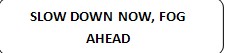


Winter is dangerous because it’s so difficult to know what is going to happen and accidents take place so easily. Fog can be waiting to meet you over the top of a hill. Ice might be hiding under the melting(融化)snow, waiting ahead to send you off the road. The car coming to you may suddenly slip across the road.
Rule Number One for driving on icy roads is to drive smoothly(平稳地). Sudden movements can make a car very difficult to control. So every time you either start or stop your car, increase or reduce your speed, you must be as gentle and slow as possible. Suppose you are driving with a full cup of hot coffee on the seat next to you. Drive so that you wouldn’t spill(溅) it.
Rule Number Two is to pay attention to what might happen. The more ice there is, the further down the road you have to look. Test how long it takes to gently stop your car. Remember that you may be driving more quickly than you think. Generally, allow twice of your usual stopping distance when the road is wet, three times this distance on snow, and even more on ice. Try to stay in control of your car at all times and you will not get into trouble.
51、 The writer tries to in this passage.
A. show his dislikes about bad winter weather
B. give information about winter weather
C. ask people not to drive in winter
D. advise people about safe driving in winter
52、 According to the passage, the writer thinks that .
A. people should not drive in the snow
B. drivers should think more about problems in winter driving
C. people drive too fast in winter
D. winter drivers should stop their cars less
53、 In the passage the writer talks about a cup of coffee .
A. to show how important smooth movements are
B. to ask the drivers to bring some soft drinks with them
C. to tell the drivers to be more relaxed
D. to show how it can be spilled
54、 Which of the following is NOT TRUE?
A. Traffic accidents take place easily in winter.
B. Fog and melting snow often cause car accidents.
C. The stopping distance on ice is as long as the usual one.
D. In winter you should drive your car with great care.
55、 Which traffic sign shows the main idea of the passage?
完形填空,阅读下面的短文,掌握其大意,然后从短文后各题所给的A、B、C、D四个选项中,选择最佳选项。
A
IQ(intelligence quotient智商)is a score that shows a person’s level of intelligence. People used to believe that some people are born with a high IQ and some aren’t.
1 a study by scientist at University College London has challenged(挑战)this idea. According to an article last October on the Journal Nature, scientists are beginning to think that our IQ is not a constant(不变的)score.
The scientists tested 33 healthy young people in 2004 between the ages of 12 and 16. Then they did tests again four years later, when the same people were between 16 and 20.
Scientists found big changes in the IQ scores between 2008 and 2004. Some 2and some fell 3 as many as 21 points.
To test whether these scores were meaningful, the scientists compared them with results from brain scans(扫描). They found that the IQ changes matched changes in the structure(结构)of the subjects’ brains. “A change in 20 points is a huge 4 ,” said Professor Cathy Price, who led the research. He said it could mean the difference between an average and a 5 person. The team has not found a clear cause for these changes. However, they say it is 6 that education plays a role in changing IQ. “Here we have shown that children’s 7 is likely to be still developing, ” says Price. “We have to be careful not to write off 8 performers at an early stage. In fact, their IQ may improve in a few more years. ”
1 A. And B. However C. Besides D. Though
2 A. rise B. rose C. raise D. raised
3 A. of B. with C. by D. from
4 A. difference B. matter C. thing D. meaning
5 A. successful B. gifted C. able D. rich
6 A. natural B. true C. certain D. possible
7 A. score B. intelligence C. skill D. interest
8 A. clever B. prettier C. nicer D. poorer
B
As darkness fell, hundreds of people in the Swiss village left their houses. They were staring(注视)forward at the mountain top in the distance. It was covered with ice and snow-beautiful and dangerous.
The huge mountain is called Matterhorn. Mountain climbers had 9 the top through the southern route(路线). But no one had ever dared to try a winter climbing up the northern side. But now one man was daring to try the 10 route. He was Walter Bonatti, a great mountain climber 11 Italy. For two days he had climbed. The village people had watched him anxiously(焦虑). Now they were waiting to see his signal. If he planned to 12 the next day, he would light(点燃)a green signal(信号). A red light would mean that he was turning back. A tiny green light 13 high on the mountain side. Bonatti was not giving up! The people 14. The next day he continued his way upward. He was so lonely and so 15 ! But he would not give up. Again that night he lit the green light. In the morning, Bonatti 16 . He could not see the top;he knew he was 17there. Though the climb was painful, he moved up. Bonatti had spent months 18for the climb. Was the training enough? Did he have the strength and skill to climb to the top? He was finally at the top! News about his. 19 was radioed to the world.
The trip down the southern route was easy. He was warmly welcomed in the village. He had done the “ 20” and would be well remembered as a climber of all time.
9A. reached B. passed C. watched D. followed
10A. comfortable B. important C. difficult D. nervous
11 A. with B. from C. in D. at
12 A. turn back B. come down C. go on D. get back
13A. placed B. appeared C. pulled D. found
14 A. cried B. laughed C. jumped D. cheered
15 A. sleepy B. excited C. tired D. happy
16 A. woke up B. turned up C. got up D. looked up
17 A. already B. almost C. hardly D. surely
18A. training B. practising C. planning D. asking
19 A. importance B. success C. climb D. courage
20A. necessary B. dangerous C. perfect D. impossible
湖北省互联网违法和不良信息举报平台 | 网上有害信息举报专区 | 电信诈骗举报专区 | 涉历史虚无主义有害信息举报专区 | 涉企侵权举报专区
违法和不良信息举报电话:027-86699610 举报邮箱:58377363@163.com