
题目列表(包括答案和解析)
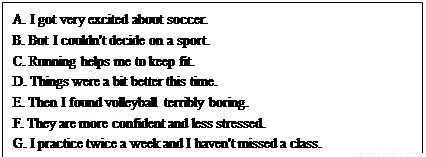
请先阅读下面短文,掌握其大意,然后根据短文内容从下面方框内的七个选项中,选择五个还原到文中,使短文意思通顺、结构完整,并在答题卷上将其序号涂黑。(每小题2分)
Hi Grace,
How's it going? Sorry I haven't emailed for a while, but I had so much to do!
I had told you about my decision to take up a sport. I knew I wasn't fit and I wanted to get some exercise. But that wasn't the only reason that I decided to do a sport. Students who play sports do better at school. 1. Exercise also helps learning and memory (记忆).
2. First, I tried soccer. I had played a bit of soccer before and I thought it wouldn't be too bad. I knew I couldn't nm for very long without feeling tired. On the first day, I was able to nm for the first ten minutes, but then I was so tired that I couldn't even kick the ball!
Then, I tried volleyball. 3. I was able to run for the first twenty minutes and I wasn't the slowest runner in the team! After a few weeks .I could run faster and longer. I was doing better and feeling better. 4. Maybe I'm not a team sport person after all!
Finally, I tried kung fu (功夫). It's a great sport that exercises the body and the mind. You learn to follow instructions carefully and do what you are asked to do. This is the right sport for me! 5. I feel so confident that l even showed some moves to the class last week! Can you believe it?
I hope you're OK! Write and let me know what you've been doing!
Bye for now!
Kristie

An armless pianist who plays with his toes has won the first series of China’s version of the internationally popular TV talent show, “China’s Got Talent.”
Liu Wei, a 23-year-old Beijing-born pianist, who lost both his arms at the aged of 10 when he was electrocuted(触电)during a game of hide-and-seek. Liu Wei stayed in rehabilitation(康复)centre for 2 years. When he got out, he was introduced to Beijing’s disabled swimming team, and he managed to take 2 gold medals in the National Disabled Swimming Championship at the aged of 14. But soon he was told not to do too much sport by the doctor.
Liu Wei was very sad. Luckily, the door was shut on sports, but it opened in music. At the age of 18, he started to learn the piano. He could not find a teacher to lead him to play with his toes, so he began teaching himself. Liu said, “I knew if I tried, I might get a chance at success. If I didn’t try, I would lose my future.”
He carried on a daily 7-hour practice, his improvement gave him hope. He kept practicing and made progress gradually. In early 2011, he gave a memorable performance in Vienna’s Golden Concert Hall. In 2012, he received the award “Top Ten People Who Moved China”.
【小题1】Liu Wei lost both his arms when he was______ years old.
A. 10 B. 14 C. 23
【小题2】Besides playing the piano, Liu Wei is also good at _______.
A. playing games
B. learning from others
C. armless swimming
【小题3】Liu Wei was taught by ________ to play the piano with toes.
A. his teacher B. his mother C. himself
【小题4】The sentence “The door was shut on sports, but it opened in music” means that Liu Wei ______.
A. lost the future of music
B. got other chances at success
C. couldn’t do sports
【小题5】The best title of this passage is “_________”
A. One is never too old to learn
B. Time and tide wait for no man
C. Where there’s a will, there’s a way
Everyone has worries. How do you deal with your worries? There is always something you can do to help yourself feel less worried. Sitting there worrying is no fun and it won't solve your problems.
Grades at school are often a top worry for kids. ff you worry most about grades, ask yourself these questions:
● Why are grades important? What do grades mean to me?
● How do I get ready for class? Do I go over my notes even when there isn't a test?
● Do I have a good place to do my homework?
● Have I tried different ways of studying?
If your worry is about a fight you had with your friend, you might write down al! the things you could do-write a note to him or her, invite him or her to watch a basketball game, say sorry to him or her and so on. Once you have a list of things you could do, you can choose one thing that could get your friend back.
You can ask for help when you're worried. You can find someone to talk to, such as your parents, friends, and teachers.
1.What do kids often worry most about?
A. Their hobbies. B. Their homework.
C. Their marks at school. D. A fight with their friends.
2.According to the passage, when you're worried, you'd better _______.
A. work hard B. talk to someone
C. get ready for class D. write down your worries
3.If you're worried about grades, DON'T ask yourself "_______".
A. Why are grades important? B. What do grades mean to me?
C. How do I get ready for class? D. Why not give up my studies?
4.If you had a fight with a friend, you could _______.
A. invite him or her to watch a game B. put the blame on him or her
C. try to make new friends D. leave him or her alone
5.What does the passage mainly tell us?
A. Who is often worried. B. When people are worried.
C. How to deal with worries. D. What kinds of worries people have.
先阅读短文,然后从文中每小题的四个选项中选出一个可以填入短文中相应空白处的最佳答案。
I did very badly at school. My headmaster thought I was useless and when I was 14, he said, “You’re never going to be (1) but a failure(失败者).
After five years of poor jobs, I fell (2) with a very nice girl. But her mother said to me, “You’ve (3) in everything you’ve ever done. You can’t give any happiness to my daughter!” It was the frustrating thing that could have changed me later. I decided to do something (4) about my life, because I wanted to show her that what people said about me was (5) .
So I tried hard with my writing and went to college. My first book came out while I was at college. After college I (6) during the day in high schools and went to evening classes at college. Later, I gave up that job to write full time. At the same time, I was offered a part-time job as a (7) at Leeds University. I began to feel (8) of myself –here was once a poor boy who’d left school early, now teaching at the university. My writing career(生涯) (9) when I discovered my own style.
Now I’m rich and (10) , have been on TV, and met lots of film stars. But what does that mean? I just wish all the people who have put me down had said: “I believe in you. You’ll succeed.”
|
1. |
|
|
2. |
|
|
3. |
|
|
4. |
|
|
5. |
|
|
6. |
|
|
7. |
|
|
8. |
|
|
9. |
|
|
10. |
|
Everyone has worries. How do you deal with your worries? There is always something you can do to help yourself feel less worried. Sitting there worrying is no fun and it won’t solve your problems.
Grades at school are often a top worry for kids. If you worry most about grades, ask yourself these questions:
● Why are grades important? What do grades mean to me?
● How do I get ready for class? Do I go over my notes even when there isn’t a test?
● Do I have a good place to do my homework?
● Have I tried different ways of studying?
If your worry is about a fight you had with your friend, you might write down al! the things you could do-write a note to him or her, invite him or her to watch a basketball game, say sorry to him or her and so on. Once you have a list of things you could do, you can choose one thing that could get your friend back.
You can ask for help when you’re worried. You can find someone to talk to, such as your parents, friends, and teachers.
( )1. What do kids often worry most about?
A. Their hobbies. B. Their homework.
C. Their marks at school. D. A fight with their friends.
( )2. According to the passage, when you’re worried, you’d better _______.
A. work hard B. talk to someone
C. get ready for class D. write down your worries
( )3. If you’re worried about grades, DON’T ask yourself "_______".
A. Why are grades important? B. What do grades mean to me?
C. How do I get ready for class? D. Why not give up my studies?
( )4. If you had a fight with a friend, you could _______.
A. invite him or her to watch a game B. put the blame on him or her
C. try to make new friends D. leave him or her alone
( )5. What does the passage mainly tell us?
A. Who is often worried. B. When people are worried.
C. How to deal with worries. D. What kinds of worries people have.
湖北省互联网违法和不良信息举报平台 | 网上有害信息举报专区 | 电信诈骗举报专区 | 涉历史虚无主义有害信息举报专区 | 涉企侵权举报专区
违法和不良信息举报电话:027-86699610 举报邮箱:58377363@163.com