
题目列表(包括答案和解析)
[ ]
Chuck Wall teaches management and human relations at Bakersfield College. He walked into class one day and told his students that their homework was to perform one act of random kindness. His students did not understand the homework and didn’t know what to do, but the professor would not answer their questions. He encouraged his students to work it out for themselves.
One week later, the students entered the classroom excited to share their stories. One student told of giving away blankets to the homeless. Another reported on helping a dog to find its owner, and another student had been trying to find a long, last friend. Students were engergized by the homework assignment and wanted other people to be kind too. With the support of local businesses, the students made stickers to put on cars that invited people to do something kind for others. They sold the stickers and decided to donate the money to a center for the blind—not surprising as Professor Wall is blind.
Since then, similar knidness activities have been started in schools around the world. Many schools organize a Random Acts of Kindness Week, around November 13th, to celebrate World Kindness Day. Some schools use each day of Random Acts of Kindness Week to perform a different kind act, such as making a new friend, helping someone, doing community service, or raising money for a charity. Students learn to consider other people and think about how small actions can make the world a better place.
61. The professor’s homework was to ask his students _________.
A. to write about kindness
B. to be kind to strangers
C. to spend time helping others
D. to go out to raise money.
62. We learn from the passage that __________.
A. Chuck’s students are not clever enough
B. the students didn’t do Chuck ‘s homework
C. Chuck Wall is an unusual teacher
D. no students enjoyed Chuck’s homework.
63. It is certain that ___________.
A. the students got good grades in Chuck’s class
B. kindness activities are not widely accepted
C. Chuck Wall was not good at designing homework
D. the students only helped people they knew
64. In kindness activities students learn ___________.
A. to deal with difficult things
B. to do great things every day
C. to know about the world
D. to consider other people
65. Which is the best title of the passage?
A. Learning Kind Things B. Teaching Kindness
C. World Kindness Day D. Bakersfield College
A teacher stood in front of his history class of twenty students just before handing out the final exam. His students sat quietly and waited for him to speak.
“It’s been a pleasure teaching you this term,” he said. “You’ve all worked very hard, so I have a pleasant surprise for you. Everyone who chooses not to take the final exam will get a ‘B’ for the course.”
Most of the students jumped out of their seats. They thanked the teacher happily, and walked out of the classroom. Only a few students stayed. The teacher looked at them. “This is your last chance,” he said. “Does anyone else want to leave?” All the students there stayed in their seats and took out their pencils.
The teacher smiled. “Congratulations (祝贺),” he said. “I’m glad to see you believe in yourselves. You all get A’s.”
1.This story most probably took place .
A. at the beginning of the term B. in the middle of the term
C. at the end of the term D. at the beginning of the school year
2. Most of the students got Grade ______.
A. ‘A’ B. ‘B’ C. ‘C’ D. ‘F’
3.Why did some students stay in their seats?
A. Because they wanted to take the exam.
B. Because the teacher told them to stay in their class.
C. Because they were afraid to leave.
D. Because they didn’t have anything to do.
4. The teacher gave the students who stayed in the classroom A’s because ______.
A. the teacher liked them
B. they were cleverer than the other students
C. they believed in themselves
D. they studied hard
5. The underlined word “them” in Paragraph 3 refers to “______”.
A. students staying in their seats B. students leaving the classroom
C. their seats D. all the students
March 29, 2013 Sunny
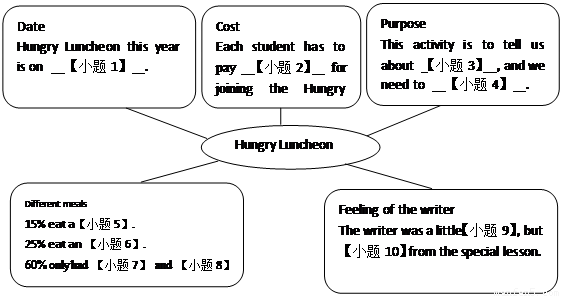
Today was the Hungry Luncheon (饥饿午餐日). Every year, at our school, there is a lunch event called the Hungry Luncheon.
If you want to join the event, you must pay two dollars at the door of the dining hall and get a letter. All the money is used for helping those poor people who don’t have enough (足够的) food to eat. My letter was “K”.
After all the students sat down, the teachers called the letters for the meals: 15% of the students got to eat a best dinner. 25% of the students got to eat an Okay meal. But 60% of the students just had a small piece of bread and a small cup of water!
The purpose (目的) of this event is to tell us about the unfairness (不公平) of the world, and that we need to start helping the poor!
I was one of the 60% of the students. I was a little hungry for the rest of the day, but I learned something from this special lesson. Now every time I eat, I think about the poor.
| A.a teacher has more questions | B.a student has more questions |
| C.a teacher has no questions | D.a student has no questions |
| A.a student has fewer questions than his teacher |
| B.a teacher has more questions than a student |
| C.those who have less knowledge have more questions |
| D.those who have more knowledge have more questions |
| A.a student should learn more from his teacher |
| B.a teacher should not have many question |
| C.a student knows much more than his teacher |
| D.a teacher has more chances to face unknown knowledge |
| A.You will Never Learn English | B.A Teacher and His Student |
| C.There Is No Limit to Knowledge | D.One Is Never Too Old to Learn |
| A.a guidebook to a museum | B.any kind of books |
| C.a newspaper or a magazine | D.an encyclopedia(百科全书) |
湖北省互联网违法和不良信息举报平台 | 网上有害信息举报专区 | 电信诈骗举报专区 | 涉历史虚无主义有害信息举报专区 | 涉企侵权举报专区
违法和不良信息举报电话:027-86699610 举报邮箱:58377363@163.com