
题目列表(包括答案和解析)
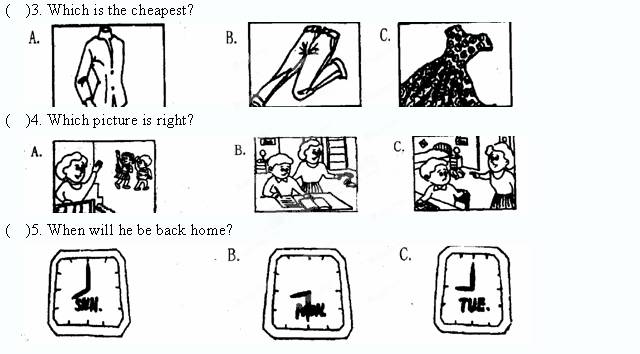
I. 听对话选图片 : 5%
( )1. What did she do yesterday morning?

( )2. What will the weather be like later on?

II. 听长对话回答问题: 5% (第一段回答6--7小题。第二段回答8--10小题)
( )6. How does the woman know that the man comes from the USA?
A. From the way he walks B. From the language he speaks.
C. From the way he spea ks. D. From his parents.
( )7. Where are the two speakers?
A. In China. B. In America. C. We don’t know. D. In London.
( )8. When is Mary’s birthday?
A. August  15 th. B. August 16 th. C. August 12 th. D. August 13 th.
( )9. What time will the party begin?
A. At 2:00 p.m. B. At 2:20 p.m. C. At 1:40 p.m. D. At 1:30 p.m.
( )10. Will Jean come to the party?
A. No, she won’t, because she’ll meet her sister at the station.
B. Yes, she will, but she’ll be late for the party.
C. Not sure. Perhaps she won’t be able to come.
D. We can’t know from the dialogue.
III. 短文理解: 10%
( A )
( )11. When does Jim usually get up in the morning?
A. At 5:30. B. At 6:00. C. At 6:30. D. At 7:00.
( )12. Where does Jim have lunch on weekdays?
A. At school. B. At home. C. At the table. D. At the desk.
( )13. Does Jim watch TV on Sunday evening?
A. Yes, he does. B. No, he doesn’t. C. Yes, he is. D. No, he isn’t.
( )14. How many people are there in Jim’s family?
A. One. B. Two. C. Three. D. Four
( )15. When does Jim go to bed?
A. At 7:00. B. At 8:00 C. At 9:00. D. At 10:00.
任务型阅读(每小题1分,共10分)。
阅读下列短文,并根据所读内容在文章后表格中的空格里填入一个最恰当的单词。注意:每个空格只填1个单词
Susan is 14 years old and she is an American girl. She is one of my best friends. She is interested in Chinese and good at it. Every summer she travels(旅行) with her parents. She believes that traveling is an important part in her life. She likes London best because it is both clean and beautiful. She knows that China is a large country with lots of interesting places. This July, her family are coming to China. I am very happy to know that they will first come to my city. They will stay here for three days. I will take them to visit the city. Then they will fly to Beijing. I am sure they will have a nice time in China.
|
Who |
Susan is an 1. girl. She is interested in Chinese and does 2. in it. |
|
What |
She 3. with her parents every summer. Traveling is an important 4. in her life. |
|
Where |
Her 5. place is London because London is both 6. and beautiful. |
|
When |
This 7. , her family are coming to China. She knows China is a large country with a lot of 8. places. |
|
How long |
They will stay here for three 9. . |
|
How |
Then they will go to Beijing by 10. . |
| A.invites | B.will be invited | C.is invited | D.invited |
Before you can start speaking and writing in English, your brain must get enough correct English sentences. This is obvious(显而易见的).
There are two ways to get correct English sentences: listening and reading. Both are good, but reading is much easier than listening. With the help of a good dictionary, you will be able to understand English texts much more easily than movies. If you just read one book in English, you will see that your English has become much better. English phrases will just come to you without thinking when you are writing or speaking.
This is true for hundreds of words and grammar structures(结构). If you read in English, you can forget about grammar rules. Throw away your grammar book! You needn’t know the rules for the present perfect tense(现在完成时). Instead, read a few books in English, and soon you will feel that “I have seen Paul yesterday” is wrong. The only difference between you and native speakers is that they have heard and read more English sentences than you have.
1.From the first paragraph, we know that ________.
|
A.English is difficult to learn |
|
B.if you have seen an English sentence, you can speak English |
|
C.before you use English, you must know some English |
|
D.everyone is a born English speaker |
2.What is the best way to get correct English sentences according to the passage?
|
A.Speaking. |
B.Writing. |
|
C.Thinking. |
D.Reading and listening. |
3.In the writer’s opinion, we can grasp English grammar rules _______.
|
A.by reading English books |
B.by reading grammar books |
|
C.by writing and speaking |
D.by learning grammar rules |
4.The only difference between you and native speakers is that native speakers _______.
|
A.have parents as their English teachers |
|
B.are born to know grammar rules and phrases |
|
C.read and hear more English than you |
|
D.have a gift in learning English |
5.What’s the main idea of the passage?
|
A.It is important for us to know English words. |
|
B.Reading is important for us to learn English. |
|
C.English grammar is not so important. |
|
D.The best way to learn English is going to England. |
湖北省互联网违法和不良信息举报平台 | 网上有害信息举报专区 | 电信诈骗举报专区 | 涉历史虚无主义有害信息举报专区 | 涉企侵权举报专区
违法和不良信息举报电话:027-86699610 举报邮箱:58377363@163.com