
题目列表(包括答案和解析)
Can you swim? Do you like swimming? Yes? Well, how can you learn to swim? I think the best way is to go into the water and learn. I’m afraid you’ll never learn to swim just by reading books about swimming or looking at others’ swimming. It’s the same with the English study. We must practice, practice and practice.
Listening and speaking are very important for beginners. The children in English-speaking countries first listen to others. Then they try to imitate and speak. We can listen to English programs on the radio or watch them on TV. You may just understand a few words. It doesn’t matter. Just be relaxed, try to catch every word.
Somebody may be a good listener. But he doesn’t speak. He’s afraid of making mistakes. You know we sometimes make mistakes when we speak Chinese. Don’t be afraid. We must be brave. If you really want to learn English well, you must try to speak with everyone so long as he knows English. Whether you know him or not is not important. When there’s nobody to talk with, you can talk to yourself in English. It’s interesting and also a good way to practice your spoken English. Remember, the more you speak, the fewer mistakes you’ll make.
Reading and writing are more important for senior school students. First we must choose the books we’re interested in. A lot of reading will improve your language sense. This is the most important.
Keep writing English diaries. We can also write English articles. You may even post them to English magazines. Don’t be afraid of failure. Failure is the mother of success.
Easier said than done. Well, let’s do more practice from now on. I’m sure you’ll learn English well in this way.
1.You can learn to swim by_________.
A. reading books about it B. looking at others’ swimming
C. having lessons on it D. going into the river to learn
2.We should learn English by__________.
A. listening and speaking B. reading and writing
C. A and B D. swimming
3. What will you do with mistakes when you speak?
A. Don’t make mistakes. B. Study hard
C. Try not to speak English D. Don’t be afraid.
4.What’s important for senior school students?
A. Listening B. Speaking C. Reading and writing D. Learning
5. We can listen to English __________, according to the passage.
A. for beginners. B. on the radio
C. by writing English diaries D. in English-speaking countries
| A.as well as | B.so good as |
| C.much better than | D.much worse than |
根据短文内容判断正误,正确的在括号里填A, 错误的在括号里填B。
A man has a parrot (鹦鹉). It’s blue and green. It can speak like a man. Every morning, the man wants to talk with it. But the parrot never says any words to him. One morning, the man says something to the parrot, but the parrot doesn’t say anything. The man is angry (生气) with it. He doesn’t give it any food or water. The next morning, the man goes and sees the parrot. He says something to it. But the parrot still (仍然) doesn’t speak. At last , the man says , “ Fool (笨蛋)!You are a fool.” After that he hears the same words from the parrot. Then he loves it very much. It’s a clever parrot.
【小题1】The parrot is white and blue.
【小题2】The parrot talks to the man every day.
【小题3】The man doesn’t give the parrot food or water when it doesn’t speak.
【小题4】The parrot is really a fool.
【小题5】At last, the parrot says the same words as the man says.
完形填空。 (每小题1分,共15分)
阅读下面短文,掌握大意,然后从A、B、C、D四个选项中选出一个最佳选项。
Hello, my friends, long time no see! My family and I went on a 1 trip to Europe during our recent vacation. We visited Paris, France, and London, England. Here I want to share my tour of Paris with you.
2 we set out, we all expected (期望) a fun and interesting vacation. For my sister and me, our stay in Paris had 3 meaning. It was a golden chance(机会) 4 our French, since English and French are the two official (官方的) languages in Canada. My mom doesn’t speak French, and my sister can’t speak it very 5 (she is only in Grade Three). So it was my duty 6 directions(方向), order food, and deal with any person-to-person communication. I was, of course, really nervous: 7 they couldn’t understand my French 8 I couldn’t understand theirs?
My 9 soon went away. The people in Paris 10 very happy to answer my questions. They listened patiently (耐心地) and carefully, and spoke slowly 11 we could understand. One gentleman was even kind enough to lead us to the hotel we were 12 .
13 the places we visited? We visited many places in Paris. My sister liked the Eiffel Tower and the Arc de Triomphe (凯旋门). My mom liked the Louvre Museum(卢浮宫) most. Her favorite painting was the Mona Lisa. Which places did I like? I liked all of them.
14 its romantic air, people’s friendly greetings (问候) and historic buildings, Paris is a city that we will 15 forget.
1. A.two week B.two-week C.two-weeks D.twos-weeks
2. A.When B.If C.Before D.After
3. A.another B.other C.the others D.others
4. A.practice B.practiced C.to practice D.practicing
5. A.good B.better C.well D.best
6. A.ask B.answer C.ask about D.to ask for
7. A.what if B.unless C.because D.instead
8. A.and B.but C.although D.or
9. A.sadness B.happiness C.pleasure D.worries
10. A.as if B.sounds C.seemed D.smells
11. A.so that B.so C.that D.such that
12. A.looking after B.looking for
C.looking up D.looking down
13. A.Shall we B.What about C.Let’s D.Why not
14. A.With B.Without C.Under D.Behind
15. A.always B.often C.never D.sometimes
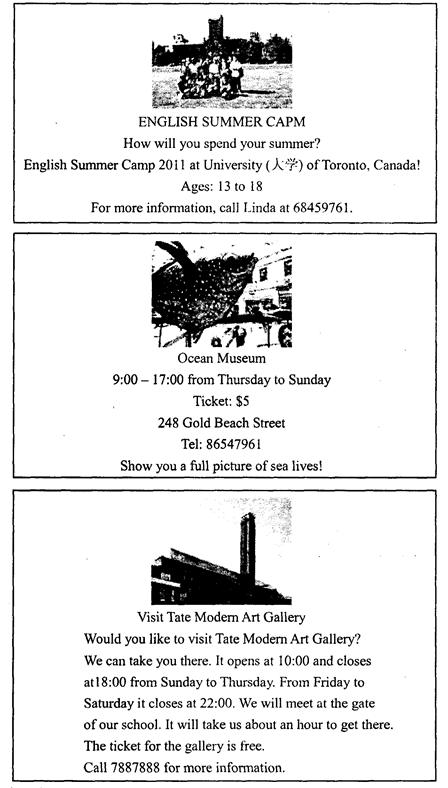
【小题1】Tom can't join the summer camp because he _______.
A.doesn't speak English well speak English well | B.doesn't like the university |
| C.is 20 years old | D.isn't a Canadian |
| A.¥5 | B.¥10. | C.¥15 | D.It's free. |
| A.On a poster. | B.In  a textbook. a textbook. | C.In a letter. | D.In a g uide book. uide book. |
湖北省互联网违法和不良信息举报平台 | 网上有害信息举报专区 | 电信诈骗举报专区 | 涉历史虚无主义有害信息举报专区 | 涉企侵权举报专区
违法和不良信息举报电话:027-86699610 举报邮箱:58377363@163.com