
从每小题A.B.C.D四个选项中选择一个可以填入空白处的最佳答案31. ------ Your mother isn’t a doctor, is she? ------ she teaches English in a middle school. A. Yes, she is. B. Yes, she isn’t. C. No, she isn’t. D. No, she is. 查看更多


题目列表(包括答案和解析)

听力选择(共25小题,计25分)

(一)录音中有5个句子,每个句子听一遍,然后在每小题A、B、C三个选项中,选择符合题意的图画回答问题。

1.What animal is endangered?

A.

B.

C.

2.Why is he anxious?

A.

B.

C.

3.What am I looking for?

A.

B.

C.

4.What is Grace’s favorite?

A.

B.

C.

5.What housework does Linda always help her mother do at home?

A.

B.
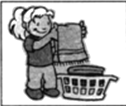
C.

(二)录音中有5个句子,每个句子听两遍,然后在每小题A、B、C三个选项中,选出能回答每个句子的正确答案。

6.A.I’d like to.

B.Good idea.

C.Sorry, I can’t.

7.A.I ride to work.

B.I like walking.

C.I don’t have a car.

8.A.I love it a lot.

B.No, thanks.

C.With pleasure.

9.A.10 minutes later.

B.About 10 minutes.

C.10 minutes ago.

10.A.Sorry, I can’t.

B.Yes, he has

C.No, he doesn’t.

(三)录音中有五段对话,听对话两遍后,从每小题A、B、C三个选项中,选出能正确回答下面每个问题的答案。

11.When is the train leaving?

A.Three ten.

B.Three twenty.

C.Three thirty.

12.How will the woman go to Qingdao?

A.By train.

B.By ship.

C.By plane.

13.How fast does the man often drive his car?

A.60 kilometers per hour.

B.80 kilometers per hour.

C.100 kilometers per hour.

14.How does the man go to Shanghai?

A.by bus.

B.by train

C.by plane

15.How does the girl often go to school?

A By bike.

B.By bus.

C.On foot.

(四)录音中有一段对话,听对话两遍后,从每小题A、B、C三个选项中,选出能正确回答下面每个问题的答案。

16.Where are they talking?

A.On the phone.

B.At Brian’s home.

C.At Jenny’s home.

17.What’s the date today?

A.December 20th

B.December 22nd

C.December 25th

18.How did Brian go to New York?

A.By plane.

B.By sea.

C.By train

19.Who did Brian go to New York with?

A.Nobody.

B.His father.

C.His mother.

20.What did Jenny ask Brian to do?

A.Call him.

B.Take photos.

C.Come back soon.

(五)录音中有一篇短文,听短文两遍后,从每小题A、B、C三个选项中,选出能正确的答案。

21.My family lived in _________ before I was 12 years old.

A.the city

B.town

C.the mountains

22.I spent _________ walking to school every morning.

A.half an hour

B.one hour

C.one and a half hours

23.I could meet _________ on the way to school.

A.my friends

B.my parents

C.nobody

24.There were _________ students in my class.

A.12

B.20

C.40

25.I could see _________ there.

A.the sea

B.many high buildings

C.many kinds of flowers

查看答案和解析>>

从每小题A、B、C、D四个选项中选择能填入相应空白处的最佳答案。(10分)

  Hello!   1   name is Li Ying.I'm twelve.I'm from Kunming.Now I'm in Beijing NO.14 High School.I'm   2   Class Five, Grade One.I'm Number 4.Miss Gao   3   my English teacher.She is   4   old teacher.I have a pen, a ruler and two   5   in my pencil-box.

  Liu Ping is in Grade One, too.She is   6   Guangzhou.She is my good   7  .We are in   8   same class.Now she   9   at school(在学校).I think(想)she is at home(在家).Look! That is a   10  .But it is not my book.

(1)

[  ]

A.

I

B.

My

C.

Mine

D.

Me

(2)

[  ]

A.

from

B.

to

C.

at

D.

in

(3)

[  ]

A.

is

B.

are

C.

am

D.

be

(4)

[  ]

A.

a

B.

an

C.

the

D.

/

(5)

[  ]

A.

buses

B.

desks

C.

schoolbags

D.

pencils

(6)

[  ]

A.

in

B.

to

C.

from

D.

at

(7)

[  ]

A.

friend

B.

teacher

C.

student

D.

mom

(8)

[  ]

A.

/

B.

the

C.

an

D.

a

(9)

[  ]

A.

is

B.

isn't

C.

are

D.

aren't

(10)

[  ]

A.

toy

B.

map

C.

pen

D.

book

查看答案和解析>>

阅读下文,完成小题。(17分)
水 问
王猛

当我们潜入蓝藻丛生的滇池底部,去寻找消失已久的栲栳鱼,我们想知道究竟是什么污染了我们的湖水?当我们在海河岸边一次又一次见证了打井队寻找水源的失败经历时,我们想知道那些地下几百米的水究竟到哪里去了?
如果世界人均水资源是一满杯水的话,中国的人均水资源不过仅仅是一个杯底;而且由于时空分布极不均匀,在华北等人口聚集的地区,我们的人均水资源量甚至低于以色列、中东等地区。
危机不是即将到来,而是已经从四面八方悄悄开始。
在富裕的南方,几十万人,一夜之间就可能没有水喝;在淮河岸边,一场污水过后,所有河蟹养殖户彻底破产;在发展中的北方,河流的生命几乎绝迹;长江的河道里,人们花费上百万元,只是为了寻找到一种名叫白鳍豚的水生鱼类;“太湖美”、“汾河清”这样的歌曲在全国的水污染地图面前显得滑稽、尴尬。从北到南,七大流域正在水污染危机崩溃的边缘。
水是宽容的,因为宽容才产生了生命,也因为这种宽容,它容纳了这个世界大部分肮脏的东西。中国的工业文明发展史浓缩了西方两百年的时间,作为代价,中国的河流与湖泊也浓缩了西方两百年的污染史。利益驱动、制度缺失、道德沦丧,对比农耕文明,对比泰晤士河的治理,一味追求利益与让中国的江河湖泊重新变清究竟什么最重要?

在开封城几十公里外,悬在几百万人口上方的黄河,又让我们不断地思考洪水的出路;在漳河两岸,每年夏天都会增派武警来保护水源;在城市里,拉动任何一个抽水马桶,宁夏缺水地区全家人一星期的生活用水就全部被冲到了下水道;在有些地方,水很贵,一瓶矿泉水的价格甚至比97号汽油还要贵两倍……
中国人并不缺乏节水的历史、节水的意识和节水的技术。坎儿井、北海团城这些古老的节水设施已经使用了几千年,那么我们缺什么呢?对一户农民、一个企业、一个地区而言,当节水比浪费水还要多花钱的时候,为什么要节水?当浪费水仅仅只是一个道德问题的时候,我们为什么要节水?
节水不仅是我们面对生存危机不得已的选择,也是考验我们这个民族道德与制度建设能力的一次机会。

黄河源头有“千湖之县”美誉的玛多要搬迁了,原因是没有水;太湖之滨的大款要搬走了,原因是水脏了;世界第四大湖——咸海,已经消失了一半;我们儿时记忆中的河流几乎全部干枯了——我们的祖先是否想象过我们今天的遭遇?
人类的文明诞生在大河两岸,苏美尔人的崛起就是因为找到了与水和谐相处的方式;但是,苏美尔文明的消亡,也正是由于对水的过度利用。两百多年以前,人类发明了蒸汽机——一种利用水循环的机器,它推动着我们到达了今天的文明程度。我们生活在地球历史中最美好的时期,但是我们是不是忘记了水可以诞生文明,也可以毁灭文明?
面对水,如果我们不能够找到新的文明方式,我们还能在地球上待多久?
(选自《文苑·经典美文》2010年第6期)
【小题1】中国面临水资源危机,其产生的原因是什么?(3分)
【小题2】读下面句子,联系上下文,体会表达效果。(6分)
⑴如果世界人均水资源是一满杯水的话,中国的人均水资源不过仅仅是一个杯底……(用了什么说明方法?有什么作用?)
⑵一味追求利益与让中国的江河湖泊重新变清究竟什么最重要?(这个问句是哪种类型的问句?表达了什么意思?)
⑶中国人并不缺乏节水的历史、节水的意识和节水的技术。坎儿井、北海团城这些古老的节水设施已经使用了几千年,那么我们缺什么呢?(想一想,我们缺的是什么呢?)
【小题3】如何治理水资源,这篇文章高屋建瓴,提出了一些新观点。下面对新观点的表达不正确的一项是(   )(3分)
A.改变水的宽容的特点,拒绝肮脏的侵害。
B.提高民族道德水平,建立起人们的新观念:认识到节约比经济利益更重要。
C.国家要加强节水的法律法规建设,地方要加强节水的制度建设。
D.寻找、建立新的文明发展方式。
【小题4】文章结尾告诉我们,如果要治理好水资源,就要找到新的文明方式。那么,这新的文明方式是怎样的呢?又如何实现这种新文明呢?谈谈自己的看法。(5分)

查看答案和解析>>

完形填空(共10小题,每小题1分,满分10分)
从A、B、C、D四个选项中选择能填入空白处的最佳答案,并将其字母代号填入答题卷相应空格内。
Mr. and Mrs. King have lived in our town for nearly twenty years. They have a bookshop by the bus station. They’re __1__ to everybody and have a lot of friends. They often __2__ the poor students and sell them some books cheaply. So there’re many young men in their shop. Of course people __3_ them and their friends often call on (拜访) them and _4__ them. We can always hear their rooms are full of __5__ and quarrel.
It was a Friday evening. Mr. and Mrs. King were going to have a picnic on the island the next __6__. It was a little far from our town. So they had to _7__ earlier than usual to catch a six o’clock train. After _8__ a few friends came to see them while they were cooking some _9 and drinks for the picnic. Mr. king and his wife had to stop _10__ them. They talked a lot and few of them looked at the _11__ on the wall. Mr. and Mrs. King were anxious (焦急) but they couldn’t tell the visitors about it. The woman thought for a few _12__ and had an idea. She said to her __13__, “Oh, it’s eleven o’clock! You’d better stop talking, dear! Our guests are anxious to _14__!
Mr. king heard this and stood up and said _15_ to the visitors and they left soon.

【小题1】
A.hadB.friendly C.cold D.careful
【小题2】
A.helpB.hurtC.hitD.watch
【小题3】
A.knowB.understandC.meetD.like
【小题4】
A.play withB.fight withC.talk withD.catch up with
【小题5】
A.cryB.shoutC.noiseD.laugh
【小题6】
A.morningB.afternoonC.eveningD.laugh
【小题7】
A.go to workB.get upC.go to sleepD.open the shop
【小题8】
A.breakfastB.lunchC.supperD.meal
【小题9】
A.clothesB.bagsC.booksD.food
【小题10】
A.receiveB.to receiveC.receivingD.to accept
【小题11】
A.phoneB.photoC.clockD.picture
【小题12】
A.minutesB.daysC.weeksD.months
【小题13】
A.visitorB.husbandC.brotherD.father
【小题14】
A.go homeB.go to bedC.go shopping D.have a rest
【小题15】
A.helloB.goodbye C.sorryD.nothing

查看答案和解析>>

完形填空(共10小题,每小题1分,满分10分)
从A、B、C、D四个选项中选择能填入空白处的最佳答案,并将其字母代号填入答题卷相应空格内。
Mr. and Mrs. King have lived in our town for nearly twenty years. They have a bookshop by the bus station. They’re __1__ to everybody and have a lot of friends. They often __2__ the poor students and sell them some books cheaply. So there’re many young men in their shop. Of course people __3_ them and their friends often call on (拜访) them and _4__ them. We can always hear their rooms are full of __5__ and quarrel.
It was a Friday evening. Mr. and Mrs. King were going to have a picnic on the island the next __6__. It was a little far from our town. So they had to _7__ earlier than usual to catch a six o’clock train. After _8__ a few friends came to see them while they were cooking some _9 and drinks for the picnic. Mr. king and his wife had to stop _10__ them. They talked a lot and few of them looked at the _11__ on the wall. Mr. and Mrs. King were anxious (焦急) but they couldn’t tell the visitors about it. The woman thought for a few _12__ and had an idea. She said to her __13__, “Oh, it’s eleven o’clock! You’d better stop talking, dear! Our guests are anxious to _14__!
Mr. king heard this and stood up and said _15_ to the visitors and they left soon.
小题1:
A.hadB.friendly C.cold D.careful
小题2:
A.helpB.hurtC.hitD.watch
小题3:
A.knowB.understandC.meetD.like
小题4:
A.play withB.fight withC.talk withD.catch up with
小题5:
A.cryB.shoutC.noiseD.laugh
小题6:
A.morningB.afternoonC.eveningD.laugh
小题7:
A.go to workB.get upC.go to sleepD.open the shop
小题8:
A.breakfastB.lunchC.supperD.meal
小题9:
A.clothesB.bagsC.booksD.food
小题10:
A.receiveB.to receiveC.receivingD.to accept
小题11:
A.phoneB.photoC.clockD.picture
小题12:
A.minutesB.daysC.weeksD.months
小题13:
A.visitorB.husbandC.brotherD.father
小题14:
A.go homeB.go to bedC.go shopping D.have a rest
小题15:
A.helloB.goodbye C.sorryD.nothing

查看答案和解析>>


同步练习册答案