
题目列表(包括答案和解析)
F. The spoon is more important than the fork G. People usually have rice in a different bowl |
请先阅读下面短文,掌握其大意,然后根据短文内容从下面方框的七个选项中,选择五个
还原到文中,使短文意思通顺、结构完整,并在答题卷上将其序号涂黑。(每小题2 分)
In Thailand, people do not eat with chopsticks, like in China, Japan, and Korea. They use spoons and forks. 1.____. Because most food is already cut. If you need to cut things use the side of your spoon . 2._____. If you are right-handed, keep the spoon in your right hand and the fork in your left hand.
3.______. The rice is not on the same plate with the other food. It is not necessary to finish all you rice or all your food. It is good to leave a little on your plate. If you eat anything, it means you want more.
4.______. The host(主人)will ask you two or three times if you want more food . It is the same with whatever you are drinking. During the meal, never empty your cup or glass. When it is less than half full, your host or neighbor will fill it again. 5.______. Always refill(再加满) your neighbor’s glass. This means that you must keep an eye on your neighbor’s glass all through the meal.
|
A. They never use knives B. Never fill your own glass C. People always offer you more food D. Remember to fill your bowl in time E. People often eat from the same bowl F. The spoon is more important than the fork G. People usually have rice in a different bowl |
请先阅读下面短文,掌握其大意,然后根据短文内容从下面方框的七个选项中,选择五个还原到文中,使短文意思通顺、结构完整。

In Thailand, people do not eat with chopsticks, like in China, Japan, and Korea. They use spoons and forks. 1______. Most food is already cut. If you need to cut things, use the side of your spoon first and then use your fork. 2______. If you are right-handed, keep the spoon in your right hand and the fork in your left hand.
3______. The rice is not on the same plate with the other food. It is not necessary to finish all your rice or all your food. It is good to leave a little on your plate. If you eat anything, it means you want more.
4______. The host(主人) will ask you two or three times if you want more food. It is the same with whatever you are drinking. During the meal, never empty your cup or glass. When it is less than half full, your host or neighbor will fill it again. 5______. Always refill(再加满) your neighbor’s glass. This means that you must keep an eye on your neighbor’s glass all through the meal.
| A.They never use knives B.Never fill your own glass C.People always offer you more food D.Remember to fill your bowl in time E.People often eat from the same bowl F.The spoon is more important than the fork G.People usually have rice in a different bowl |
The secret in re-remembering is to allow the full power of your memory to flow freely without “trying” to remember any one specific (特定的) thing.
I recently sat down to a relaxed and enjoyable dinner with some friends. At the beginning of the meal, a friend told us that his car had just been broken into and his briefcase (公文包) had been stolen. He was frustrated (懊恼的) because his diary and a number of other items (物品) important to him were in the briefcase. He said he could remember only four items that were in his stolen briefcase, that he knew there were many more, that he had to give a full report to the police within two hours, and that the more he tried to remember the more blocked he became.
Several of us at the table who were familiar with Memory Principles (规则) then took him through the following exercise: instead of continuing to allow him to think of what he could not remember, we asked him when he had last had his briefcase open. It turned out that it was at the office just before he left work, at which point he suddenly remembered that he had put two important magazine articles in the briefcase. We then asked him when he had last had the briefcase open before leaving home for work. It turned out to have been the night before, and he remembered having put in two more articles as well as a tape recorder, in preparation for the following morning. Finally we asked him to describe the inner (内部的) design of his briefcase, and as he went through a detailed description, he remembered pens, pencils, letters and a number of other items that he had completely “forgotten” before.
Within 20 minutes, he remembered 18 additional items.
The secret is to “forget about” whatever you are trying to remember and “relive” all experiences that connect in any way with the item you are trying to remember. This method works at once almost in all cases, and takes the form of a created Mind Map around the “missing” center.
This memory method, like the others, improves your memory as well as your creativity, and in addition gives you confidence when you realize that, no matter what you have forgotten, there is still a chance to solve any memory mystery (谜团)!
58. Which of the following shows how the man remembered the items according to the passage?
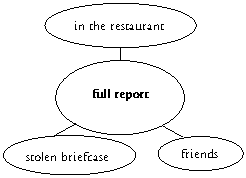 | 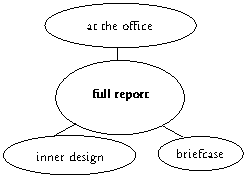 |
A. B.
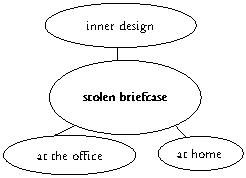 | 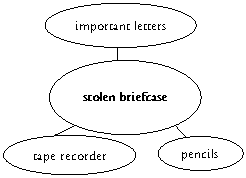 |
C. D.
59. What does the underlined word “relive” mean in the passage?
A. go through again B. get out of
C. get used to again D. pay attention to
60. What can be the best title for the passage?
A. Forgetting — You can never really forget
B. Drawing — The better way to remember things
C. Re-remembering — Remember what you have forgotten
D. Replacing — Forgetting something instead of remembering
If you want to become a fluent(流利的)English speaker you should take some advice: There are four skills in learning English. They are reading, listening, speaking, and writing. The most important thing you must remember is that if you want to improve your speaking and writing skills you should first master the skills of reading and listening.
Read as much as you can. But your reading must be active. It means that you must think about the meaning of the sentence, the meanings of the unfamiliar words, etc. There is no need for you to pay much attention to grammars or try to understand all the unfamiliar words you come across, but the fact that you see them for the first time and recognize them whenever you see them, for example in other passages or books, is enough. It would be better to prepare yourself a notebook so you can write down the important words or sentences in it_
As for listening, there are two choices: besides reading, you can listen every day for about 30 minutes. You can only pay attention to your reading and become skillful at your reading, then you can catch up on your listening. Since you have lots of inputs in your mind, you can easily guess what the speaker is going to say. This never means that you should not practice listening.
For listening you can listen to cartoons or some movies that are specially made for children. Their languages are easy. Or if you are good at listening you can listen to VOA or BBC programs every day. Again the thing to remember is being active in listening and preferably taking some notes.
If you follow these pieces of advice, your speaking and writing will improve automatically, and you can be sure that with a little effort they will become perfect.
46. According to the author, which should you improve first among the four skills?
A. Reading and writing. B. Reading and listening.
C. Writing and speaking. D. Speaking and listening.
47. The underlined phrase "come across" in Paragraph 2 can probably be replaced by "_______".
A. meet by accident B. discover
C. find on purpose D. look for
48. The author seems to agree with the view that_______.
A. everyone should listen to VOA or BBC programs every day
B. you needn't practice listening if you keep on reading every day
C. being good at reading is helpful in improving your listening
D. you should take notes of whatever you are hearing
49. The passage is mainly about how to_______.
A. choose suitable listening materials
B. deal with new words in reading
C. read as many English books as possible
D. become fluent in speaking and writing English
湖北省互联网违法和不良信息举报平台 | 网上有害信息举报专区 | 电信诈骗举报专区 | 涉历史虚无主义有害信息举报专区 | 涉企侵权举报专区
违法和不良信息举报电话:027-86699610 举报邮箱:58377363@163.com