
题目列表(包括答案和解析)
Many strong and out-of-control emotions are recognized as an illness. People who are always very sad have depression (抑郁症); those who worry a lot have anxiety.
But what about anger problems? Anger is largely viewed as a secondary emotion – one caused by other emotions. People are thought to be angry because they are sad, anxious or stressed. In the past, many doctors didn’t accept the idea that anger could be a problem all on its own.
Today, though, a growing number of mental health experts think that anger is a serious problem that needs its own treatment.
How to tell the difference between “normal” anger and “anger problem” is difficult. After all, everyone gets really mad from time to time. Experts point out a few ways.
Disordered anger, as it is sometimes called, tends to be of greater intensity (强度). It takes very little to set off a person with an anger problem, and their responses (反应) are very strong. An example: While most people would get upset if a driver cut them off, someone with disordered anger might try to chase down the car and force it off the road.
And in cases of disordered anger, the person gets angry more frequently and his/her anger lasts longer. For most people, angry feelings disappear quickly. But people with anger problems often stay angry for days, weeks or even years; their feelings of anger don’t disappear over time.
Consequences are also important to consider: Disordered anger often damages people’s lives. “It interferes (干扰) with people’s relationships and their jobs,” says Raymond Chip Tafrate, a US psychologist. “Even their health is affected.”
Anger clearly increases the risk of certain health problems, as many studies have shown. “When a person is angry, their heart beats faster and their blood pressure goes up,” says Howard Kassinove, a professor at Hofstra University in New York. Over time, these changes take their toll on the body, he adds.
Experts suggest that people with an anger problem take anger-management programs. The programs teach people to control their responses to stressful situations through the use of relaxation techniques. The programs sometimes include life-skills training as well: increasing someone’s level of competence (竞争)– whether on the job or as a parent or partner – helps bring down stress and cut angry feelings.
1. A person who _________ most possibly has disordered anger in the experts’ opinion?
A. can’t get out of anger quickly
B. is dissatisfied with relationships
C. has high blood pressure
D. is worried about his job
2. What does the underlined word Consequences mean?
A. Responses. B. Effects. C. Reasons. D. Feelings
3.Which of the following is TRUE according to the passage?
A. Anger is an secondary emotion that makes people sad and stressed.
B. Anger was recognized as an illness by most doctors in the past.
C. A person with an anger problem gets angry more often and easily.
D. The use of relaxation techniques is the best way to manage anger.
4. What is the best title of the passage?
A. Can anger be an illness?
B. Is it disordered anger?
C. Can anger influence our life?
D. Is anger management important?
句型转换
1.What were they doing? I don’t know. (合并为一个句子)
I don’t know what _________ _________ doing.
2. There isn’t any water in the glass. (改为同义句)
_________ _________ water in the glass.
3.His brother is not only a singer, but also an actor. (改为同义句)
His brother is a singer _________ _________ as an actor.
4. You mustn’t tell it to anyone. (改为祈使句)
Please _________ _________ it to anyone.
5. You can stay in the museum as long as you like. (对画线部分提问)
_________ _________ can we stay in the museum?
1阅读上面的短文,然后判断正(T)误(F)。
Jane,
After I left Paris I spent two days in New York City and one day in Washington DC. I got to Miami, Florida on Nov. 13. The weather is wonderful here. This morning I went swimming and then slept on the beach. When I woke up, I found Jennifer Lopez—my favorite movie star! She was just on my right! I asked her to take a picture with me. You know, that was my dream. She agreed! I'm going to show you the picture.
Yours,
John
Dear Dad,
I got here after 18 hours on a train at last! It's very cold here in Moscow. It's white everywhere. This afternoon I went to have a look at the city. I got lost. I was glad I took Russian lessons in my university. They helped me a lot. A young girl showed me the way back to my hotel. I think I can finish my work here and go back home soon. I'm longing for the warm sunshine at home. See you soon.
Max
Dear Amy,
I arrived in Guilin yesterday. What a beautiful place! The people are kind here and I have some new friends. Guess who I met here! Tom, my high school classmate. How small the world is! He is working here as an English teacher at a middle school. He showed me around the city. I also went to his school. I bought a special bag made in Guilin for you and a silk tablecloth for Mom. Tomorrow evening I'm going to fly to Beijing.
Love,
Mafia
1.Each of the three had a good time.
2.Maria went to see her classmate in Guilin.
3.It was warmer in Max's hometown than in Moscow.
4.Max came from Russia.
5.John was very glad that his dream of going to the beach came true.
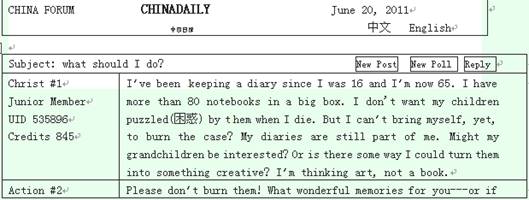
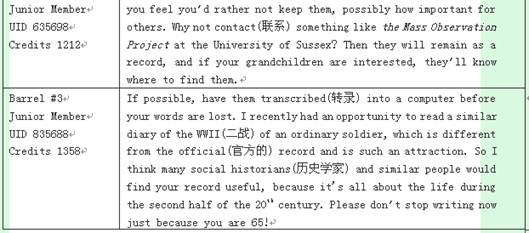
1.What worries Christ most?
A. His grandchildren B. His death C. His diary notebooks D. His case
2.What does Christ probably hope to happen to his diary?
A. They can come out as an interesting book
B. They can be made into a TV play or a film.
C. His children will put them together with him after his death.
D. His grandchildren will continue to write following his habit.
3.What does Action think of Christ’s diary?
A. They supply good memories for others especially his grandchildren.
B. They will educate the young to remember the hard life
C. They can make his grandchildren make more money.
D. They may help others learn more about the war.
4. What do the comments about an ordinary soldier’s war diary want to tell us?
A. To remind Christ to write more about war.
B. To show others will get help from Christ’s notebooks
C. To encourage Christ to write diaries like the brave soldier
D. To tell Christ social historians are interested in the soldier’s diaries.
5.Which of the following is mentioned in the page?
A. Barrel doesn’t stop writing diaries.
B. Action wants to remain the diaries as a record.
C. Christ’s children don’t get along well with him.
D. Christ’s grandchildren may show interests in his diaries.
Twelve-year-old Kitty O’Neil asked her coach, “Let me try.” She was already on the swim team, but this was different. One of the divers had not arrived, and Kitty needed much help. Her coach looked 36 at her. She had been practicing dives, but could she really stand up to the competition? Besides, 37 was completely deaf. Many people thought a person who was deaf wouldn’t be able to dive well. However, Kitty 38 , and she won first place at that swimming meet and went on to win the Junior Olympics in the area.
Kitty began diving with Dr. Sammy Lee, a famous coach and former Olympic diving champion. The teenager went to school in the morning and then spent most afternoons diving. It was 39 work, and Kitty often hit the water the wrong way. However, she was able to 40 practicing. While she was diving , Kitty won many gold medals, but she wanted 41 . Perhaps she learned something from her 42 . Kitty lost her hearing at the age of four months. Because she wanted Kitty to lead a normal life, Kitty’s mother went to college to 43 about teaching people who are deaf. Kitty’s mother finally started a school for those who are deaf.
Kitty’s life was 44 but normal, and as an athlete, Kitty was much bettter than others. When she gave up diving, she wanted danger and adventure. She raced cars, boats, and motorcycles. Many of these 45 usually require at least some hearing. For example many racers judge their speed by the sound of the engine. Kitty did it by 46 .
In 1972 she began to learn doing dangerous action for movies and television. Soon she became one of the 47 women in Hollywood. In 1976 Kitty O’Neil also became the fastest woman in the world in a rocket-powered car that went more than 512 miles per hour.
1.A. up B. down C. carefully D. closely
2.A. she B. he C. I D. it
3.A. worked B. did C. practiced D. came
4.A. easy B. usual C. pleasant D. hard
5.A. like B. finish C. keep D. begin
6.A. fewer B. more C.some D. many
7.A. father B. mother C. coach D. teacher
8.A. learn B. read C. write D.listen
9.A. something B. anything C. nothing D. everything
10.A. classes B. meetings C. activities D. parties
11.A. listening B. learning C. speaking D. feeling
12.A. latest B. fastest C. prettiest D. busiest
湖北省互联网违法和不良信息举报平台 | 网上有害信息举报专区 | 电信诈骗举报专区 | 涉历史虚无主义有害信息举报专区 | 涉企侵权举报专区
违法和不良信息举报电话:027-86699610 举报邮箱:58377363@163.com