
题目列表(包括答案和解析)
As young students ,you have many dreams. These dreams can be very big ,such as winning the Nobel Prize;they can also be small, such as becoming one of the best students in your class.
Once you find a dream, what do you do with it? Do you ever try to make your dream real?
Andrew Matews, an Australian writer ,tells us that making your dreams real is life’s biggest challenge. You may think you’re not very good at some school subjects, or that it’s impossible for you to become a writer. Those kinds of ideas stop you from realizing your dream.
In fact, everyone can realize his dream. The first thing you must do is to remember what your dream is. Don’t let it leave your heart. Keep telling yourself what you want every day and then your dream will come true faster. You should know that a big dream is, in fact, made up of many small dreams.
You must also never give up your dream. There will be difficulties on the road to your dreams.But the biggest difficulty comes from you. You need to decide what is the most important. Studying instead of watching TV will help you to get better exam results, while saving five yuan instead of buying an ice cream means you can buy a new book.
As you get closer to your dream, it may change a little. This is good as you have the chance to learn something more useful and find new hobbies.
【小题1】The biggest difficulty on the road to your dreams comes from_____________.
| A.yourself | B.your friends | C.your school | D.your parents |
| A.You may think you’re not good at some school subjects. |
| B.Making your dreams real is life’s biggest challenge. |
| C.You must never give up your dream. |
| D.Listening to English more can help you realize your dream. |
| A.can’t be realized | B.can be very small | C.will come true | D.can be very big |
| A.Remember what your dream is | B.Dont’ let your dream leave your heart. |
| C.Keep telling yourself what you want every day | D.A B,and C |
| A.How to become a writer | B.How to make your dream real |
| C.A big dream is made up of small dreams | D.Everyone can realize his dream. |
Many textbooks are not written in the kind of English that we speak every day. In fact, sometimes the reading is so difficult that it almost seems like a foreign language. In a way, it is—the language of science. You should not expect to be able to read a difficult science passage the same way you read an interesting story; you should not expect to read it easily and all at once. Instead, you may have to read it several times through, catching on the meaning of difficult words, going back over difficult sentences, and finally putting the whole thing together. Do not be discourages if the whole passage don’t make sense to you at first. You need to pick it apart patiently until you can understand it.
These are the steps to follow when you are reading something difficult:
1. Start to read normally until you run into a sentence that doesn’t make sense to you.
2. When a sentence doesn’t make sense, go back and read it again more slowly.
3. Look for any word you don’t know in the sentence. Try to understand their meanings using word parts and context clues(上下文线索). If necessary, look them up in the dictionary.
4. Look at the next few sentences to see if they explain more about the sentence you are working on. Do not read very much farther ahead until you understand what is being said.
5. Finally, read the sentence again. Try to put it into simpler words.
6. Read through the passage once. Try to understand all the hard parts well. Then read the whole passage once more at a usual speed. This helps you to put all ides together.
The stops sound a lot harder than they are. It is really just the normal way good readers understand anything that is difficult to read. After you have done the best you can this way, you should always feel free to ask for help from your teacher, if you have one.
【小题1】The underlined phrase “run into” means ___________.
| A.work out | B.come across | C.look into | D.pass by |
| A.we should look up new words before reading |
| B.it is sometimes difficult to read a science passage |
| C.the six steps are helpful in learning spoken English |
| D.interesting stories help readers to improve their English |
| A.steps of studying science | B.difficulties in reading science |
| C.ways of reading science passages | D.researches on science and English |
Different colours can affect us in many different ways; that’s according to Verity Allen. In a new programme “Colour me Healthy”, Verity looks at the ways that colours can influence how hard we work and the choices we make. They can even change our emotions and even influence how healthy we are.
“Have you ever noticed how people always use the same colours for the same things?” says Verity. “Our toothpaste is always white or blue or maybe red. It’s never green. Why not? For some reason we think that blue and white is clean, while we think of green products(产品)as being a bit unpleasant. It’s the same for businesses. We respect a company which writes its name in blue or black, but we don’t respect one that uses pink or orange. People who design(设计)new products can use these ideas to influence what we buy.”
During the programme, Verity studies eight different colours, two colours in each part. She meets people who work in the colour industry, from people who design food packages, to people who name the colours of lipsticks. Some of the people she meets clearly have very little scientific knowledge to prove their ideas, such as the American “Colour Doctor” who believes that serious diseases can be treated successfully by the use of coloured lights. However, she also interviews real scientists who are studying the effects of green and red lights on mice, with some surprising results.
Overall, it’s an interesting show, and anyone who watches it will probably find out something new. But because Verity goes out of her way to be polite to everyone she meets on the programme, it’s up to you to make your own decisions about how much you should believe.
1.What’s Verity’s opinion about colours?
|
A.Colours help people choose products. |
|
B.Different people prefer different colours. |
|
C.Colours have influences on people in many ways. |
|
D.People working in colour industry know little about colours. |
2.What can you infer from Paragraph 2?
|
A.Colours influence people’s feelings and opinions. |
|
B.People get ideas for new products from colours. |
|
C.New products are popular because of colours. |
|
D.Most companies prefer bright colours. |
3.The underlined part “goes out of her way” probably means ______.
|
A.feels very pleased |
|
B.makes a special effort |
|
C.goes on in her own way |
|
D.carries on very slowly |
4. What’s the passage mainly about?
|
A.How people use colours. |
|
B.How colours influence people. |
|
C.What happens in a programme. |
|
D.What makes a programme believable. |
Tony Buzan’s grades were going down at university. Disappointed with his low marks, he went to the library to find a book on how to use his brain. He was directed to the medical section. Confused, he said to the librarian, “I don’t want to take my brain out, I just want to learn how to use it.” Her reply was simple: “There’s no book on that.”
“I thought to myself,” says Buzan, “if I buy a little radio, I get an instruction manual (说明书). If I buy a microwave, I get an instruction manual. But for the most important machine in the world, no instruction manual?”
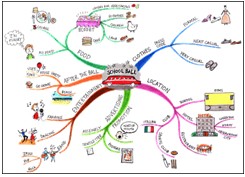
Fifty years later, Buzan has become the world’s leading speaker on the brain and learning. In the late 1960s, he invented the mind map, a visual representation of thought processes.
This kind of thinking has become a popular tool for planning, organizing, problem solving, and communicating across the world. He has since authored and co-authored over 100 books that have appeared in more than 30 languages.
“I think in most cases, people use less than 1 percent of their brains,” he says.
But how do you expand this 1 percent? How do you become the best student you can be?
According to Buzan, the answer is simple. You take a section of whatever it is that you are trying to learn, he says, and you read it for its essence (精髓、要素). Then you make a mind map of all the important details. For a truly effective mind map, you start with a colored image in the center of your page. Draw the first image that comes to mind on the topic you are mind mapping. Branch off from your central image and create one of your main ideas. From your main branches draw some sub-branches and from those sub-branches you can draw even more branches. He emphasizes that you should use plenty of images and colors as these help with memory recall and encourage creativity.
By using this visual format (形式), according to Buzan, your mind will begin to make associations that will help you remember more information for longer periods of time.
Buzan believes that traditional note-taking methods, such as lists and summaries, do not stimulate the brain’s recall capacity or ability in the same way. Because of this, students will often find themselves locked away in their rooms for hours, trying hard to memorize separate details. Buzan believes that for a more effective and lasting way of studying, you must first understand how your brain works.
“Everyone is born smart,” he says. “You just have to learn how to learn.”
【小题1】What is the main purpose of the first two paragraphs?
| A.To show that Tony Buzan was worried about his study. |
| B.To invite us to think about the importance of manuals. |
| C.To prove that the mind map is a useful tool for the brain. |
| D.To show why Tony Buzan studies the brain and learning. |
| A.Excite. | B.Improve. | C.Encourage. | D.Affect. |
| A.If we learn the mind map, we will become the best student. |
| B.The mind map will help your brain connect separate details. |
| C.The mind map will be more effective if we put more details in it. |
| D.We will solve the problem if we make connections between ideas. |
| A.How to make the mind map? |
| B.Is the mind map widely used? |
| C.Can your memory be mapped? |
| D.Is the mind map helpful in thinking? |

Two teachers were sitting in the teachers' room. For a moment there was silence. Then one of them, Miss Smith, said, "I'm afraid I'd have to fail him! I just can’t let him 16 . "
"Now Alice," said her friend, Mrs Jackson, "is he so terrible a student?"
"That's just the trouble!" the other woman answered, "Tom was ever my 17 student. The problem is that he is so lazy that he never gets his work done. He hasn't handed me a piece of homework for three 18 !"
Mrs Jackson had never seen Miss Smith so 19 before. "Have you had a word with him about it?" she asked.
"Why should I? Every student must hand in homework. I made 20 very clear on the first day for class. I don't know what has happened. When the lessons started, he did so well that I 21 thought about asking the school to give him a scholarship(奖学金). But now he often sleeps in class! I've never seen such a 22 in a student."
"You should have a talk with him. Give him a chance. "
Miss Smith spoke to Tom and learned all about it. He was studying all day and working most of the night in a factory to 23 for his schooling. Of course he was 24 in class and sometimes could hardly 25 awake. Miss Smith soon asked the school to give him a scholarship and he was able to devote himself to his lessons again.
| 【小题1】 |
|
| 【小题2】 |
|
| 【小题3】 |
|
| 【小题4】 |
|
| 【小题5】 |
|
| 【小题6】 |
|
| 【小题7】 |
|
| 【小题8】 |
|
| 【小题9】 |
|
| 【小题10】 |
|
湖北省互联网违法和不良信息举报平台 | 网上有害信息举报专区 | 电信诈骗举报专区 | 涉历史虚无主义有害信息举报专区 | 涉企侵权举报专区
违法和不良信息举报电话:027-86699610 举报邮箱:58377363@163.com