
题目列表(包括答案和解析)
Ⅰ.情景反应:根据你听到的内容选择正确答案。
1.
[ ]
A.We'll go to Beijing.
B.We'll go there.
C.We'll go by train.
2.
A. It's very big.
B.It's very long.
C.It's over there.
3.
[ ]
A.Do some washing.
B.To the park.
C.At six.
4.
[ ]
A.Two months.
B.Twice.
C.Twenty-four hours.
5.
[ ]
A.I can't decide.
B.Please take your time.
C.It doesn't matter.
Ⅱ.对话理解:根据你听到的小对话回答问题。
6.What would the man want to buy?
[ ]
A.A horse.
B.A house near the sea.
C.A house near the forest.
7.What does the man mean?
[ ]
A.Beijing Aoshen won.
B.Guangdong Hongyuan won.
C.The match was held in a rainy day.
8.What does the woman want the man to do?
[ ]
A.Let her go alone.
B.Drive her home.
C.Lend her his car.
9.How old is the man's bicycle?
[ ]
A.6 years old. B.5 years old. C.4 years old.
10.What does the man mean?
[ ]
A.He knew nobody else.
B.He went to the party alone.
C.Too many people at the party.
11.What does the woman mean?
[ ]
A.She doesn't agree with the man.
B.She also thinks it's a fine day to go to the cinema.
C.She would like to go for a walk, too.
12.What does the woman mean?
[ ]
A.She is glad to give the man some change(零钱).
B.She can't give the man any change.
C.The man has changed a lot.
13.What does the woman want the man to do?
[ ]
A.Give her regards to his family.
B.Remember her forever.
C.Don't forget her children.
14.What are the two people probably doing now?
[ ]
A.Driving to the airport.
B.Watching TV.
C.Starting the work.
15.What does the man mean?
[ ]
A.He doesn't like a bike.
B.He would rather have a bike.
C.He doesn't have a car or a bicycle.
Ⅲ.篇章理解:听下面各段长对话并回答问题。
听第16段材料,回答16~18小题。
16.Whose birthday is it the following day?
[ ]
A.Mary's. B.Mom's. C.Dad's.
17.How old do you think Mary is now?
[ ]
A.15. B.55. C.45.
18.Where are they going to have birthday dinner?
[ ]
A.At a restaurant.
B.At a park.
C.At home.
听第17段材料,回答19~21小题。
19.Where does the conversation(谈话)probably take place?
[ ]
A.In a library.
B.In the woman's office.
C.In a bookstore.
20.What's the woman trying to do?
[ ]
A.To buy a book.
B.To borrow a book.
C.To write a book.
21.What's the title(标题) of the book?
[ ]
A.Jameson.
B.Never Say Never.
C.Parker.
听第18段材料,回答22~24小题。
22.Where did the dialogue probably take place?
[ ]
A.At a port. B.At an airport. C.At a railway station.
23.Where does the man come from?
[ ]
A.Japan. B.England. C.America.
24.How long will the man stay in China?
[ ]
A.Six or seven days.
B.Six or seven weeks.
C.Seven or eight months.
听第19段材料,回答25~27小题。
25.He doesn't like his job now because ________.
[ ]
A.his boss is unkind.
B.he has to work at night.
C.he feels lonely.
26.The man wants to work in a hotel because ________.
[ ]
A.there are all kinds of people to make friends with
B.most hotels are beautiful
C.both A and B
27.The dialogue probably happened ________.
[ ]
A.in the office B.in the street C.at home
听第20段材料,回答28~30小题。
28.What was the woman?
[ ]
A.A teacher.
B.A student.
C.A newspaper woman.
29.Why did the woman want to talk to the man?
[ ]
A.She was interested in foreigners.
B.She planned to write about the evening school.
C.She tried to help newcomers in her country.
30.Where was the man now?
[ ]
A.In Greek. B.In France. C.In America.
Ⅳ.情景反应:根据你听到的内容选择正确答案。
31.
[ ]
A.Yes, I have. B.OK, I won't. C.Sorry, I can't.
32.
[ ]
A.A nice day, isn't it?
B.Fine, thanks. What about you?
C.Thank you. The same to you.
33.
[ ]
A.Next week. B.Last week. C.A week ago.
34.
[ ]
A.No, I hadn't. B.No, I didn't. C.No, thanks.
35.
[ ]
A.Yes, it is. B.Yes, I do. C.Yes, I was.
Maybe you have seen this in schools: some students are Studying nearly all the time but they just pass their exams, while some others may spend much less time on their books but do much better in exams.How could this happen? People used to think that hard work is the only way to success.But now they have understood that smart work can make them succeed, too.
Hard workers don't mind working for long hours, while smart workers always think of several different answers to these questions, "Why should I suffer this? Isn't there a better way to do this?" Thanks to these people, we can use computers instead of the abacus now.Progress in every field is the direct result of "try to find a better way" by smart workers.
There was a large soap factory in Japan. Once it received an unusual letter from someone who complained that there was no soap in the soapbox he bought.
How could empty soapboxes go out of the factory? The engineers checked the producing and packing The producing was fine, but in about one in ten thousand cases, the packing machine (机器)let an empty soapbox go.There was no need to spend a lot of money repairing the machine for such a small problem.The engineer soon worked out a solution: he put a huge X-ray (X光射线) machine and two large computers to find out the empty soapboxes.After teaching the workers how to use it, he sat down in his seat, exhausted.
"Sir, we could have solved the problems in a much simpler and cheaper way," a worker said.
"Really? How? "
"We can put a huge fan (风扇) near the packing machine. The wind coming from the fan will blow away the empty boxes, leaving the other boxes with soap.There would be no need for an X-ray machine, two computers, and operating by workers."
See, this is smart work. In order to succeed, we should not only work hard like the engineer, but also think smart like this worker.
根据短文内容,选择最佳答案。
1.Some students spend much less time on schoolwork but do much better in exams _______.
A.because of their hard work
B.because of different education
C.because they try to find a better way
D.because they study for a much longer time
2.Someone wrote to the soap factory and complained that _______.
A.the soapbox he bought was empty
B.their soap was too expensive
C.the soap he bought was terrible
D.their service was very bad
3.The soap factory could only _______ near the packing machine to solve the problems in a much simpler and cheaper way.
A.set some soapboxes
B.set an X-ray machine
C.put two large computers
D.put a huge fan
4.The phrase "blow away" here in Chinese means _______.
A.停止 B.吹走 C.熄灭 D.逃脱
5.The article mainly tells us that we should _______ in order to succeed.
A.think of different answers to our questions
B.spend much less time on our schoolwork
C.work hard like the engineer and think smart like the worker
D.spend enough money repairing the machine for any problem
听力
Ⅰ.Listen and choose the right picture(根据你听到的内容,选出相应的图片):(共6分)
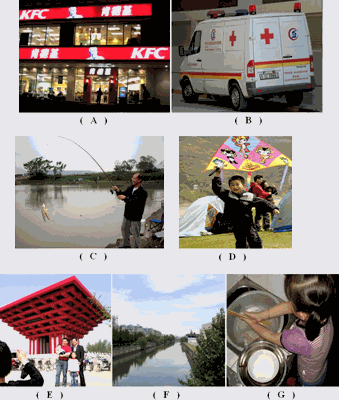
Ⅱ.Listen to the dialogue and choose the best answer to the question you hear(根据你听到的对话和问题,选出最恰当的答案):(共10分)
7.A.Mary
B.Jack.
C.Tom
D.Rose.
8.A.In the classroom.
B.In the office.
C.In the dinning hall.
D.In the playground.
9.A.Boring.
B.Difficult.
C.Exciting.
D.Interesting.
10.A.It's snowing.
B.It's raining.
C.It's fine.
D.It's cloudy.
11.A.Japanese.
B.French.
C.English.
D.Chinese.
12.A.By underground.
B.By car.
C.By bike.
D.By bus.
13.A.To visit Pudong.
B.To visit his grandparents.
C.To visit his aunt.
D.To visit his friends.
14.A.Tony was poor at math.
B.Tony likes to help others.
C.Ben failed to pass the math test.
D.Tony didn't like to study.
15.A.The woman can't return the skirt.
B.The shop hasn't got enough skirts.
C.The woman can have a change of the skirt.
D.The woman should pay more money.
16.A.Helen didn't ask for help.
B.Helen finished the work by herself.
C.Helen is hard-working and kind.
D.Someone helped Helen.
Ⅲ.Listen to the passage and tell whether the following statements are true or false(判断下列句子是否符合你听到的内容,符合的用“T”表示,不符合的用“F”表示):(共7分)
17.There was a big apple tree in front of Old John's house.
18.We know from the passage that the tree was there for more than fifty years.
19.John had a rich neighbour and the neighbour often gave him money.
20.The neighbour asked John to dig a hole to find some more money.
21.John dug a big hole for the neighbour to plant the young apple tree.
22.The neighbour gave John the young apple tree and John planted it himself.
23.After some years, the tree produced good apples and John sold them for money.
Ⅳ.Listen to the dialogue and fill in the blanks(根据你听到的内容,完成下列句子,每空格限填一词):(共7分)
24.There are about ________ hundred languages in the world.
25.English is not only used in England and the USA, but also in other ________ of the world.
26.It's hard to say how many people are learning English as a ________ language.
27.The only language that seems ________ to learn is the mother tongue.
28.We should ________ that we all learnt our mother language well when we were children.
29.We must do a lot of ________ when we want to learn English well.
30.Good teachers, records, tapes, books and dictionaries will be ________.
对话填空,每空一词
Mike:Tomorrow is Mother's Day.Let's buy Mum a gift, 1 we?
John:Sure.But what 2 we buy for her?
Mike:3 we buy her some hair clips?They are not expensive.
John:But she has already got some nice clips.Why 4 we buy her a watch?She hasn't got one yet.
Mike:That sounds like a good idea.But I know Mum doesn't like to 5 a watch.She usually looks at her cell phone when she wants to know the 6 ndline.
John:Then what 7 an MP3 player?Mum likes listening to music very much,you know.
Mike:That's a great 8 ndline.But how much does an MP3 player cost?Is it too expensive?
John:No.MP3 players are getting cheaper and cheaper these days.We can buy a fine one for only 300 yuan.
Mike:OK.Let's go to the computer shop together this afternoon.
John:Why 9 buy her some flowers,too?
Mike:Yes,of 10 ndline.
1.________ 2.________ 3.________ 4.________ 5.________
6.________ 7.________ 8.________ 9.________ 10.________
阅读下面对话,从方框内7个选项中选择5个恰当的句子完成此对话,并将其番号填入题前括号内。
| A.I’ll take them. B.Can you go to other shops? C.I feel sorry about it. D.May I have a look at other shoes? E. How much are they? F. I’d like a pair of shoes for my daughter. G. She likes white and black. |
A: What can I do for you?
( ) B: 1
A: For your daughter? Look, the shoes are really nice. Do you like them?
( ) B: Yes. But I’m afraid my daughter doesn’t like the color. 2
A: Sure. There are different kinds of shoes over there. What color does she like?
( ) B: 3 And black is her favorite.
A: What size does she need?
( ) B: Size 9. Let me see. Um, this pair of shoes must fit her. 4
A: They are not expensive, only 199 yuan.
( ) B: That would be fine. 5 Here is the money. Thanks very much!
A: You are welcome.
湖北省互联网违法和不良信息举报平台 | 网上有害信息举报专区 | 电信诈骗举报专区 | 涉历史虚无主义有害信息举报专区 | 涉企侵权举报专区
违法和不良信息举报电话:027-86699610 举报邮箱:58377363@163.com