
题目列表(包括答案和解析)
Everyone dreams of changing the world.But can teenagers really make a difference? And how can they go about it?
Michael Norton’s book 365 Ways to Change the World is a good starting point.The book gives an idea or a task for every single day of the year.The tasks include volunteering at a local homeless shelter(避难所)and hugging(拥抱)a tree.
The book says that one simple act, no matter how small,call help someone in need.It may even influence other teens to do something.
Nathan Anthony, a junior student at Enoch’s High School in Modesto,California, US agrees.”It is impossible to get anything in life without giving something to someone or making an effort at school or work, ”Anthony said.
Another Enoch’s junior, Arianne Mote,has the same opinion.”Giving is our way of repaying those who help us,”she said。”Whether it is a helping hand or a donation(捐赠):we should help others to improve their lives.”
But how often do teens see peers helping a stranger or doing something? According to Anthony, not a lot. Mote and he both believe this needs lo change.
"Humor is also a great tool," Anthony' said. "It can help us a lot when we face some embarrassment (尴尬) and it is a good way to solve some problems."
So whether you're helping to find a cure for cancer or simply smiling at a stranger, do something every day to help change the world for the better.
根据短文内容完成下列句子的填写。
1.The book 365 Ways to Change the World was written by
2.The tasks like are included in the book.
3.The word" "means teens (teenagers) of the same age.
4.The writer wrote the book to tell teenagers
5.Write out Anthony and Mote's opinions in two words (词语): ______ and____________
What do you do if you're in trouble on a lonely island? Surely you need to find a way to get in touch with the outside world. Your best chance of doing this is to draw the attention of a passing plane.
Body signals (信号)
Pilots from different countries understand body signals if they have the correct training, When you wave your arms up and down in a straight line, it means, "yes". When you point downwards and swing your arm from side to side, it means "no". If you want the pilot to know that it's safe to land, push your hands out in front of you and bend (弯曲) your knees. If you want to say that it's not safe to land, put your arms in the air and move them to one side.
Smoke signals
The smoke from a fire can be seen from far away, so it’s a good way to draw attention. If the weather is dry, it isn’t hard to start a fire. Remember, however, that fires can be very dangerous if they get out of control. Never light a tire unless you're sure that it can’t spread. If the ground is dark, light smoke can be seen more easily. Green grass and leaves produce light smoke.
Ground-to-air signals
It's a good idea lo build some signals, too. Use large pieces of wood to make the symbols (标记). If you can't find any wood, use earth. Some useful symbols are:
F "I need food and water"
II "I need medicine."
I "I am badly hurt."
X "I am unable lo move from here."
Pilots' replies
If the pilot lowers the plane's wings from side to side, this means: "message received and understood" (At night, the pilot flashes the plane's green lights.) If the pilot flies the plane in a clockwise circle, this means "message received hut not understood" (At night, the: pilot flashes the plants red lights.)
However, there is no signal which means "message not received. Why not'?
1.How many signals can we use to draw the attention of the passing plane if you're in trouble?
A. Three. B. Four C. Five D. Six
2.Which picture means "it's not safe to land"?
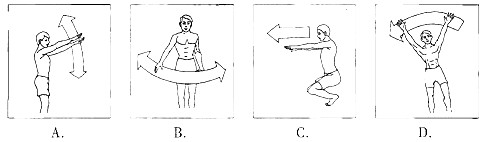
3.What can we learn from the passage?
A. Swinging your arm from side to side means "yes"
B. If the ground is dark, light smoke can’t be seen.
C If you need some medicine, make a symbol “Ⅱ”.
D. The pilots make replies with a blue light at night.
4.What is the passage mainly about?
A. The explanation of building signals on an island.
B. The importance of making signals on an island.
C. Ways of sending out signals on a lonely island.
D. Ways of receiving signals from a lonely island.
| A.①② | B.②③ | C.①②④ | D.①③④ |
| A.I will remember the bicycle number. |
| B.I won't let the rider go until I rail my parents. |
| C.will let the rider go before I call my parents. |
| D.I will letthe rider go because I know how seriously I am hurt. |
| A.put dry things on your body |
| B.run quickly and take the lift |
| C.run away and find an exit as quickly as you Can |
| D.take everything you have and then run away |
| A.3 | B.4 | C.5 | D.6 |
| A.How to Keep Calm | B.Self-protection |
| C.An usual lesson | D.Danger |
1Answer the questions (根据短文内容回答下列问题)
1.Helen Monson has always been interested in helping her community. Her first volunteer experience was for the American Red Cross when she was in high school. When she was a school teacher, she also found time to volunteer. One year, she organized a Super Saturday Fun Day for kids in the community. She also used to volunteer at the Mint Festival every year. One summer, she served food, another year she organized an art programme.
2.After she retired, she started volunteering to help the old. When her father was older, he was not able to see as well as he used to, which made her sad because he had always enjoyed reading. She decided it would be fun to read to elderly people in her community. She also helped one woman write her stories. Ann was almost 100 years old, and Helen wrote down information about her life when she visited her. She put the information in a book and got it published. Ann was very excited to share her life story with her children and her grandchildren.
3.After a hurricane(飓风) destroyed some southern cities, Helen volunteered again for the American Red Cross. She prepared food and answered phones in a care centre. She says, “I have always liked the Red Cross because the organization helps people in need no matter what.”
4.One day, Helen read an article in the newspaper about refugees(难民) who needed to learn English. Now, she meets once a week with Sahra, a 38-year-old woman, from Somalia. Sahra is living and working in a town about 30 minutes’ walk from where Helen lives. They work on reading and writing skills. Helen gave Sahra a camera and asked her to take pictures of her daily life. She developed the pictures, and then asked Sahra questions about them. In the end, they wrote a book together and used the photos in the book. This helped Sahra learn many new words about her everyday life.
5.Helen says, “The most rewarding(有益的) part of volunteer work is becoming friends with the people I help. They enrich my life as well as I enrich theirs.”
1.When was Helen’s first volunteer experience for the American Red Cross?
2.What did Helen do after she retired?
3.Why was Ann excited when her book got published?
4.Where did Helen work when she volunteered again for the American Red Cross?
5.How far is Sahra living and working from Helen’s home?
6.Did Helen help Sahra to learn English?
7.What can you learn from Helen?
湖北省互联网违法和不良信息举报平台 | 网上有害信息举报专区 | 电信诈骗举报专区 | 涉历史虚无主义有害信息举报专区 | 涉企侵权举报专区
违法和不良信息举报电话:027-86699610 举报邮箱:58377363@163.com