
题目列表(包括答案和解析)
The year was 1839. Vice (副……) President Richard M.. Johnson was in New York City on his way to Philadelphia. He was expected(希望) at a meeting at 6:30 that evening. When did he begin his trip? At noon! In 1839, it took six and one-half hours by train and ferry(渡船) to get from New York City to Philadelphia. That wasn't so bad. In 1817, the trip took three days!
If this were a cold winter day, Vice President Johnson would have started much earlier. The Delaware River might freeze over. There would be no ferry and he would have had to walk across the ice.
Today, it's possible to leave New York City on the 9:00 a. m.train and be in Philadelphia at 10:29 a. m. In fact, some people live in New York City and work in Philadelphia. They use the train schedule(时刻表) below.
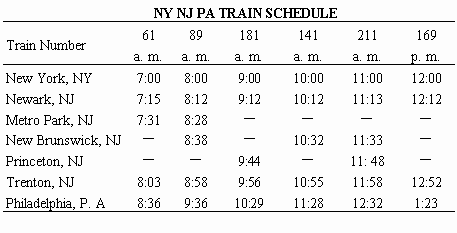
How do you read the train schedule? Suppose(假设) you're in New York City and you want to go to Princeton. Run your finger down the list of cities to find Princeton. Next, move your finger to the right. You will see the times that trains arrive in Princeton. Then run your finger up to the times listed across from New York. That's when the trains leave New York. Make your choice and enjoy the ride !
1.A doctor's office in Philadelphia opens at 9:00 a. m. What time must the doctor leave New York City to get there on time?
[ ]
2.Suppose Vice President Johnson rode today's trains. What time would he have to leave New York to be in Philadelphia by 1:30 p. m. ?
[ ]
3.You board the train in Newark at 8:13. When do you arrive in Trenton?
[ ]
4.Which is the fastest train to Philadelphia?
[ ]
5.Which two trains make the most stops?
[ ]
I’m five years old, and my mother is washing the kitchen floor. I’m telling her about a new girl in school, and she suddenly looks up at me and says, “ Who are your two best friends ? ”
I’m not sure what to say. I’ve been friends with Jill since I was three or so , and I really like Jaime , a friend in kindergarten .
“ Jill and Jaime .”
“ Well , what about Karen and Cindy ?”
“ I don’t know who their best friends are ,” I say .
“ No ,” she says . “ I’m saying , why aren’t they your best friends ?”
“ But they’re my sisters .”
“ Yes , but they can still be your best friends . Friends may come and go, but your sisters will always be there for you .”
At that time, the idea of my two sisters being my closest friends seemed strange to me. We fought all the time over toys, food , attention , and what to watch on television . How could my sisters be my best friends ?
But my mother never let the three of us forget it : Sisters are lifelong friends . Her wish—like most parents’—was to give us something that she never had. Growing up as an only child, she longed for brothers and sisters. She gave birth to three daughters. She had given us each a gift—our sisters.
As we grew up, we realized that our mother was right. Today I share things with my sisters that I do with no one else. My sister Cindy and I ran the New York City Marathon together , side-by-side , even holding hands when we crossed the finish line . The three of us trust each other with our greatest secrets.
It was twenty-three years ago that my mother first asked me who my two best friends were. Today she doesn’t have to. She already knows.
46. How old was the writer when she wrote the passage ?
A. 5 . B. 9 . C. 23 . D. 28 .
47. According to the writer , why can’t her sisters become her friends ?
A. Because they are older than her . B. Because they don’t like her .
C. Because they often fought with each other . D. Because they have their own friends .
48. What did the writer feel when her mother said her sisters could be her best friends ?
A. Strange . B. Excited . C. Interested . D. Pleased .
49. What might be the most suitable title for the passage ?
A. My best friends . B. The greatest gift .
C. My sisters and I D. My mother’s dream .
50. What can we learn from the passage ?
A. My mother used to give us some gifts .
B. My mother’s sisters are her best friends .
C. My sisters and I always get along well .
D. My sisters and I become good friends now .
“Sleep-disordered breathing (SDB)” is a term for a group of conditions that can influence normal breathing while people sleep. These include snoring (打鼾), mouth-breathing and sleep apnea. Sleep-disordered breathing can do more than just leave people feeling tired the next day. It can also have an effect on people's health. In children the effects can include behavioral and emotional problems.
In a new study, researchers asked parents about their children's breathing from when they were babies up to about age six. The study involved about eleven thousand children.
Karen Bonuck at the Einstein College of Medicine in New York led the study. She says, “The central finding overall is that sleep-disordered breathing is connected with a fifty percent increase in adverse neurobehavioral (不利的神经行为) outcomes.” She adds that the more serious the breathing problems, the more serious the behavioral issues were likely to be. Other studies have linked sleep with children's behavior, but this study could be able to reject (排除) other possible causes.
The study appears in the journal Pediatrics. It’s estimated one child in ten snores regularly. A smaller number suffer (遭受) from other sleep-disordered breathing.
How well do you sleep? A popular belief is that sleep gets worse with age. But, in another new study, those who reported the fewest problems with the quality (质量) of their sleep were people in their eighties.
Researchers did a telephone survey of more than one hundred fifty thousand American adults. Michael Grandner at the University of Pennsylvania medical school says the starting goal was to prove that aging is connected with increased sleep problems.
The survey did find an increase during middle age, worse in women than men. But except for that, people reported that their sleep quality improved as they got older. At least they felt it did.
Mr. Grandner says, “Even if sleep among older Americans is actually worse than in younger adults, feelings about it still improve with age.”
The findings appear in the journal Sleep. In the study, health problems and sadness were linked with poor sleep. Also, women reported more sleep disturbances and tiredness than men.
But, based on the study, Mr. Grandner says older people who are not sick or depressed should be reporting better sleep. “If they’re not, they need to talk to their doctor. They shouldn’t just take no notice of it,” he says. Nor should their doctor turn a blind eye to it. He says doctors generally dismiss sleep complaints (抱怨) from older adults as a normal part of aging.
57. From the passage we can learn that ______.
A. middle-aged men have more sleep problems than women
B. the older people get, the better the quality of sleep will be
C. doctors don’t take sleep complaints from older adults seriously
D. children suffer more mouth-breathing than other SDB conditions
58. What can we infer from the passage?
A. SDB can bring about serious illness to people.
B. Older adults think they get better sleep than they actually do
C. Ms. Bonuck’s studies have linked sleep with children's behavior.
D. A key period for children’s behavioral development is from 0 to 6.
59. What’s the best title for the passage?
A. Who sleeps Well, who lives Well
B. Who Sleeps Better, the Young or the Old?
C. New Findings on Sleep in Children, Older Adults
D. New Findings on Sleep-Disordered Breathing and Health
一、根据所听句子,从A、B、C三个选项中选出一个意思与其相同或相近的句子。(每个句子读一遍)
1.
[ ]
A.Wendy is from Canada, so is Grace.
B.Both Wendy and Grace are not from Canada.
C.Wendy is not from Canada, but Grace is.
2.
[ ]
A.They had a good meal in the park yesterday.
B.They had a good time in the park yesterday.
C.They liked playing in the park.
3.
[ ]
A.My daughter likes English best of all the subjects.
B.My daughter thinks it's better to learn English.
C.English is easy to learn than any other subject, so my daughter likes it.
4.
[ ]
A.They will take ship to Dalian.
B.They will swim to Dalian.
C.They will go to Dalian by train.
二、听句子,选择恰当的答语。(每个句子读一遍)
5.
[ ]
A.I don't like spring.
B.I like summer, too.
C.I prefer spring to summer.
6.
[ ]
A.You're welcome.
B.Hi! Nice to see you.
C.Fine. Thanks.
7.
[ ]
A.There is a show tonight.
B.OK. Go along this way and you will see it.
C.Thank you very much.
8.
[ ]
A.About two years.
B.You are welcome.
C.Come from China.
9.
[ ]
A.It's not my watch.
B.It doesn't work.
C.It doesn't matter.
10.
[ ]
A.Hold on for a second, please.
B.Hello. From Mr. Black.
C.Hello! Who are you?
三、听对话和对话后的问题,选择正确答案。(每段对话和问题读两遍)
11.
[ ]
A.At the No.19 Middle School.
B.At the No.5 Middle School.
C.At the No.9 Middle School.
12.
[ ]
A.She is Jim's mother.
B.She is Jim's sister.
C.She is Jim's aunt.
13.
[ ]
14.
[ ]
A.They are going to swim.
B.They are going to do some housework.
C.They are going to go fishing.
15.
[ ]
四、听短文选择正确答案。(短文读两遍)
16.How was Jack at school?
[ ]
A.He did well in his lessons.
B.He liked his school.
C.He was too lazy to study.
17.Where did Jack's parents work?
[ ]
18.What did Jack's parents want him to be?
[ ]
19.How many days did the cleaners work a week?
[ ]
20.What do you think of Jack?
[ ]
A.He was a lazy boy.
B.He was good at his lessons.
C.He was not clever.
五、听写。听短文,写出你听到的短文中所缺的单词。(短文读两遍)
Mike lives in a village not far from New York. He has a big 21 dog. He likes the dog very much.
It was a 22 morning. The dog stood near an old well(井). He stood 23 all the morning and looked at the well. “Wow…wow…wow.” The dog barked(吠) and barked all the time. Mike 24 to the dog and asked, “Why are you barking?” The dog looked at Mike, and then looked into the well. The dog thought there was another dog 25 the well.
湖北省互联网违法和不良信息举报平台 | 网上有害信息举报专区 | 电信诈骗举报专区 | 涉历史虚无主义有害信息举报专区 | 涉企侵权举报专区
违法和不良信息举报电话:027-86699610 举报邮箱:58377363@163.com