
题目列表(包括答案和解析)
| Topic:Increasing Your Vocabulary | |
| 【小题1】__________ of building up vocabulary | ●Improve your ability to express yourselves and communicate better with others. ●Be 【小题2】___________to your study. |
| Suggestions on remembering new words | 1.Remember every new word you meet with by【小题3】__________it. ●Learn about the word and anything that relates to it by looking it up in your dictionary. |
| 2.Make a 【小题4】__________of new words to learn. ●Review the words every day by looking at and speaking them out loudly. ●Copy the words and their meanings over and over again. | |
| 3.Do word games. ●Play these games,come across new words and study them with fun. | |
| 4.Learn words through reading. ●Read things you【小题5】__________. ●Do not skip over new words,but remember and use them more. | |
The ability to forgive others is a great thing that can certainly help to make life happier for everyone. However, some people think that it is very 1 to do, and they don’t know how to forgive others, especially their family and friends. This is all because they don’t understand the meaning of “forgiveness”.
In the dictionary, “to forgive” means “to 2 feeling angry with somebody that has done something bad to you.” I’m happy that many people have 3 in doing this. I have succeeded, too, and I know how hard it is.
I lived with a friend for two years. During that time, he did cause me many 4 . I easily got angry when communicating with him. However, we 5 had a talk about our problems. When he pointed out (指出) that I wasn’t treating him like a friend, I was 6 . I never knew that I also needed to be forgiven for doing something wrong. I thought however 7 I might get, I did love my friend deep in my heart. Then I understood the saying, “To love is to forgive.” And when we 8 each other, we feel great. After that long talk, we both 9 those bad moments. Our friendship became fresh again.
Now I understand the 10 of forgiveness better.
| 【小题1】 |
|
| 【小题2】 |
|
| 【小题3】 |
|
| 【小题4】 |
|
| 【小题5】 |
|
| 【小题6】 |
|
| 【小题7】 |
|
| 【小题8】 |
|
| 【小题9】 |
|
| 【小题10】 |
|
In order to know a foreign language thoroughly, four things are necessary. Firstly, we must be able to understand the language when we hear it spoken. Secondly, we must be able to speak it ourselves, correctly, with confidence and without hesitation. Thirdly, we must be able to read the language and fourthly, we must be able to write it. We must be able to compose(组成)sentences that are grammatically correct. We must know how to arrange sentences in paragraphs, so as to write a good letter or composition.
There is no easy way to succeed in language learning. A good memory is of great help, but it is not enough simply to memorize rules from a grammar book. It is not much use learning by heart long lists of words and their meaning. We learn words not by ourselves, but in sentences. We must learn by using the language. “Learn through use” is a good piece of advice for those who are studying a new language. Practice is very important. We must practice speaking and writing the language whenever we can.
1.The word “confidence” here probably means _____.
A.use B.eyes
C.need D.feeling sure of ourselves
2.The writer advises us to _______.
A.speak more and write more
B.read more
C.speak more
D.use a dictionary
3.The first step in learning a language is ______.
A.reading B.speaking C.writing D.listening
4.Words should be learned _____.
A.from a dictionary B.from a textbook
C.in sentences D.from a good grammar book
5.“Learn through use “is to say that ______.
A.we must practise speaking and writing
B.we must learn by using the language
C.we must learn everything by language
D.we must remember grammar rules as many as possible
 | 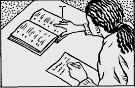 |  |  |
| 1.The weekend before she has to give it to the teacher, she sits on her own in the kitchen. First, she looks at the title and thinks a lot. | 2.Then she writes a few ideas onto a piece of paper, in no particular order. She looks up a couple of words in the dictionary and writes those down. | 3.Then she has a sandwich and goes to watch TV. | 4.The next day she looks at what she wrote. She adds some more ideas. Then she decides how to order her ideas. She starts to write. |
 |  |  |  |
| 5.There are some words she’s not sure about so she looks them up in her dictionary. | 6.When she has finished writing, she reads carefully through her composition. She crosses some things out and changes one or two sentences. | 7.Then she looks back at her notes from other written work. She makes sure she hasn’t made any of the same mistakes. | 8.Finally, she writes out her composition onto a clean piece of paper and puts it in her bag. |
| A.She looks at the title and thinks a lot. |
| B.She has a sandwich and goes to watch TV. |
| C.She writes a few ideas onto a piece of paper. |
| D.She looks up a couple of words in the dictionary. |
| A.she writes them down | B.she looks back at her notes |
| C.she crosses some things out | D.she looks them up in the dictionary |
| A.driver | B.doctor | C.student | D.parent |
1
1.I _____________ (be) Li Hua.I live (居住) in China.
2.What’s ____________ (he) phone number?
3.Are those Jim’s ____________ (photo)?
4.Tom and Mike ____________ (be) my brothers.
5.These ____________ (strawberry) are in the basket.
6.Let’s ____________(color) the apples red.
7.Jim ____________(not play) volleyball every day.
8.The music ___________ (sound) interesting.
9.I need two _____________(dictionary).
10.He _______(like) carrots and tomatoes very much.
湖北省互联网违法和不良信息举报平台 | 网上有害信息举报专区 | 电信诈骗举报专区 | 涉历史虚无主义有害信息举报专区 | 涉企侵权举报专区
违法和不良信息举报电话:027-86699610 举报邮箱:58377363@163.com