
题目列表(包括答案和解析)
Robots in class
Over 600,000 children in the United States spend their long time in hospital each year.Many of them say that they have difficult in returning to school after hospital stays.Thanks to technology,kids who are sick in the hospital no longer have to miss time in the classroom.
A program called PEBBLES makes it possible for kids in hospital to take part in classroom discussions by using robot.PEBBLES(Providing Education by Bringing Environments to Students)supplies robots to help kids who are staying in hospital keep up with their classmates.
For Achim Nurse,a 13-yers-old patient at Blythedale Children’s Hospital in Valhalla,New York,PEBBLES helped him so much.When he first learned about the program,he wasn’t so sure it would work.
“When I first saw it,it looked difficult,”said Achim.
However,after 30 minutes of working with the robot,Achim discovered that he had gotten good at operating it.
The robots work in pairs—一one in the hospital with the student,the other in the classroom.
The robot in the classroom gives the student in the hospital a feel of“tele-presence.”A live picture of the students is shown on a video screen in the classroom.Meanwhile,in the hospital room,the student knows clear about what is going on in the classroom.
The robot at the school has four wheels.so it can move around from class to class.Its“face” is an auto-focus(可以自动调焦的)camera.By using a control box,the student call turn the robot’s head,raise its hand,and adjust the volume(音量).It is even equipped with a scanner(扫描器)and printer,so if the teacher want to have an exercise or testing class,the student can participate from the hospital.
“The robot is greeted by students in the classroom.It is also greeted by the sick student。”said Andrew Summa,national director of the robot project.
根据短文内容完成下面各题。
1.Try to use the phrase underlined in the first paragraph to make a sentence.
2.Guess the Chinese meaning of“keep up with”.
3.The robot is greeted by students in the classroom.It is also greeted by the student in the hospital.(改写为同义句)
4.According to the passage,we can know that____
A.We can operate this kind of robot easily.
B.the student in hospital cannot adjust the volume by using control box.
C.The teacher wants to have a test in the class now. Although the student in the hospital has this kind of robot,he also cannot participate it.
5.What do you think of the robot project in the United States? Do you think it can help sick students? What do you think are its limitations?
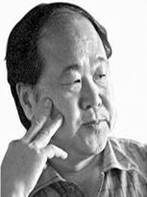
Mo was born into a farming family in a village in Shandong province .He grew up listening to folk stories about gods, spirits foxes .Those stories later became the inspiration (灵感)for Mo’s writing.
Mo left school at the age of 12 and started to work in the fields . Although he was tired after his daily hard work ,Mo was always hungry for books .However, there were very few in the village .He read his older brothers’ textbooks and even dictionaries .He helped others with farm work in exchange for books . “When I finished reading all the books around ,I thought I was the most knowledge man in the world ,”he told Xinhua.
After Mo left his hometown and joined the army in 1976,he began to read widely ,including works by Lu Xun and many other famous writers .He studied from these writers but did not copy them .Instead ,he developed his own style .As the first Chinese citizen(公民)to win a Nobel Prize in literature, Mo told a group of reporters in his hometown shortly after he won the award . “I grew up in an environment filled with folk culture .It enters my novels whenever I pick up a pen This has affected ,even decided my style.”
【小题1】When did Mo Yan leave school and start to work in the fields ?
| A.at the age of 12. | B.at the age of 11. |
| C.at the age of 13 | D.at the age of 15 |
| A.Shanxi | B.Jiangsu | C.Shandong | D.Guangdong |
| A.while listening to folk stories about gods ,spirits and foxes |
| B.during his dairy hard work in the fields. |
| C.when he won the Nobel Prize in literature. |
| D.after he studied from many famous writers. |
| A.Mo Yan left school when he was very young. |
| B.Mo Yan was the most knowledgeable man in the world. |
| C.Mo Yan read many books when he was very young. |
| D.Mo Yan is the first Chinese citizen to win a Nobel Prize in literature. |
| A.Rome was not built in a day. | B.Easier said than done. |
| C.Well begun , half done . | D.The older, the wiser. |
1
Teachers Wanted
Do you like kids? We need a teacher for our son. He’s six years old. We want you to work from March to November, 3 pm. to 6 pm., but you don’t need to work in July and August. You can get ¥ 30 an hour (小时). Sometimes we want you to work on weekends, and you can get ¥45 an hour.
You need to:
·Help our son with Chinese.
·Read to him.
·Play with him.
·Go to movies with him.
You need to work at my home. We live in (居住在) Taipei Road, next to the Zhongshan Bus Station(公汽站).
Please call (02)2956-4938. Ask Miss Liu.
1.The teacher can work for __________ months at this family.
A. six B. seven C. eight D. nine
2.The teacher must (必须) __________.
A. work every weekend
B. work at the kid’s home
C. help the kid learn English
D. work eight months a year
3.On Monday the teacher __________.
A. can’t work
B. works three hours
C. can have ¥ 135
D. comes in the morning
4.Which is Not True(不对)?
A. The teacher can get ¥30 an hour on weekends.
B. The student is a boy of six.
C. The teacher can call Miss. Liu.
D. The teacher can take a bus to work
BEIJING---Chinese Premier Wen Jiabao has visited the“left-behind” children whose parents are working in cities before Children’s Day.
During a visit to northwest China’s Shanxi Province, Wen visited the home of Yang Saike, a primary school boy in a village of Xingping City, Yang, whose parents were working in Fujian, thousands of kilometers away, was cared for by his grandparents. His parents fail to go home even once a year.
The premier held Yang in his arms and looked through his exercise books and praised him for his hard work. (83) Wen talked with many children and asked them many questions about their schooling and life.“ You are so pretty,” Wen said to Liu Mengqi, a seven-year-old girl living with her grandmother. Liu’s parents were also working in the city.
“Have you been to school yet?” Wen asked two other girls.
“ We are going to the pre-school class,” said one.
“ Mon and dad at home?” Wen asked. The children shook their heads.
“ Children cannot see their parents very often, which is a new problem in the countryside. We should give them more care and love,” said the premier.
(84) “ With fast economic(经济)development, more people in the country chose to work in cities and left their children with grandparents or relatives back home”,said Wen. The premier asked local governments to do something to protect and care for such children at home and free their parents in cities from worries about their children.
A. 根据短文内容简要回答问题。
【小题1】What questions did Wen Jiaobao ask the children in the countryside?
_________________________________________________________________
【小题2】What did the premier ask local governments do?
________________________________________________________________
B. 将短文中划线的句子译成汉语。
【小题3】_______________________________________________________________
【小题4】_______________________________________________________________
C. 请给短文拟一个适当的标题。
【小题5】____________________________________________________________
Scientist Without Laboratories
When you hear the word “scitentist”, what do you think of? Many people think scientist are people in clean white coats who work in labs. And some scientists do work in labs. But there are 26 scientist who work in woods and jungles. These scientists are called “animal behavior (行为) scientists”, and they study animals as they live in nature.
Why don’t these scientists catch animals and study them in zoos? The 27 is in the word “behavior”. Animals behavior scientists want to learn 28 animal behave in their wild homes. When animals live in cages (笼子) or in zoos, they do not act the same as they do when they are 29 . They may fight 30 each other, or they may not eat, or they may not raise (抚养) their babies as they usually would. To see real animal behavior, scitentists must go where the animals 31 .
So animal behavior scientists go into the jungles, the woods or the desert. There , their most important 32 are their eyes and ears. They watch and listen to the animals very 33 . They write down everything that happened in notebook. 34
they live near the animals, the scientists are careful not to frighten them. If the scientists are luncky, the animals will 35 no attention to them. Then the scientists can see how the animals really live.
The behavior scientists hope what they’ve learned about animal behavoir can provide clues (提供线索) to help people learn to live together more happily.
1.A. another B. other C. others D. the other
2.A. answer B. question C. problem D. text
3.A. when B. where C. how D. why
4. A. happy B. free C. sad D. angry
5. A. of B.among C. for D. with
6.A. live B. run C. play D. eat
7. A. machines B. tools C. thoughts D. ways
8.A. truly B. carefully C. woderfully D. nicely
9.A. But B. Unless C. Though D. As if
10.A. pay B. spend C. take D. cost
湖北省互联网违法和不良信息举报平台 | 网上有害信息举报专区 | 电信诈骗举报专区 | 涉历史虚无主义有害信息举报专区 | 涉企侵权举报专区
违法和不良信息举报电话:027-86699610 举报邮箱:58377363@163.com