
题目列表(包括答案和解析)
| 阅读理解,根据短文内容,选择同义词。 | ||
| The younger members of most American families don't like foreign food. They like hamburgers. T  heir idea of a good meal is a hamburger, served with ketchup and French fried potatoes, which are heir idea of a good meal is a hamburger, served with ketchup and French fried potatoes, which are called French fries. French fries are not considered foreign; most American children and teenagers love to eat them any time of the day or night. Millions of hamburgers and French fries are eaten every year. Thousands of roadside restaurants prepare and sell them. These are not really restaurants in the usual sense; they often have little space for tables and chairs. Many people buy their hamburgers and take them home to eat, or eat them in their cars. Sometimes it is not necessary to go inside in order to buy the hamburgers. They are ordered through a window in the restaurant and then are handed out  through the window to the waiting customer. through the window to the waiting customer. Sometimes the customer does not even have to get out of his car. When an American family travels abroad, this is almost always the custom that the younger members of t  he family miss most. he family miss most. | ||
|
Here are two stories from different parts of the world. They seem strange but, believe it or not, they re all true!
John Lee was an Englishman who refused to be hanged! In 1884 the police said Lee had killed an old woman who he used to work with. There was nothing to show that Lee had killed the woman. Lee told the police he hadn't done it, but no one believed him and he was going to be hanged. On the day of the hanging, however, the door in the floor, through which Lee's body would fall, did not open. They tried three times but each time the door stayed closed, even though it had worked well the day before. In the end they sent Lee back to prison, where he lived for the next twenty-two years. At all times, John Lee said he hadn't killed the woman, and he believed it was the "hand of God" that had saved him from death by hanging.
The police in Venezuela (委内瑞拉) in South America followed a man home one night. He was the thief they wanted to catch. However, half of his house was standing in Venezuela and the other half was standing in Colombia (哥伦比亚). Venezuela's neighbor. When the police entered the house, the man ran upstairs to his bedroom, which was in Colombia, and called his lawyer (律师). The Venezuelan police were not allowed to enter Colombia so they could not enter the bedroom. They asked the police in Colombia to help. The Colombian police refused to help because the man's crime (罪行 )was not a crime in Colombia. In the end, the Venezuelan police gave up and went back to the police station.
1.The underlined(下划线) word "hanged" in this passage probably means _.
A. shut in a room »
B. questioned by the police
C. killed by putting a rope around the neck
D. kept in a place
2. What do we1 know about the door in the floor?
A. It had opened the day before the hanging.
B. It had been broken a long time.
C. After three times, it opened.
D. John Lee's dead body fell through it.
3.From the story we know that the thief's bedroom was____.
A. in Venezuela B. in Colombia
C. in neither Venezuela nor Colombia I), in both Venezuela and Colombia
4.Why didn't the Venezuelan police go into the man's bedroom?
A. They didn't know where it was.
B. The Venezuelan police were not allowed to enter Colombia.
C. The police in Colombia told them that (hey would help.
D. The police in Colombia told them not to go inside.
5. The police in Colombia didn't help the police in Venezuela to catch the thief because
A. they didn't know where he was
B. the police in Venezuela didn’t ask for help
C. the man's lawyer told them not to help
D. the man's crime was not a crime in Colombia
Here are two stories from different parts of the world. They seem strange but, believe it or not, they re all true!
John Lee was an Englishman who refused to be hanged! In 1884 the police said Lee had killed an old woman who he used to work with. There was nothing to show that Lee had killed the woman. Lee told the police he hadn't done it, but no one believed him and he was going to be hanged. On the day of the hanging, however, the door in the floor, through which Lee's body would fall, did not open. They tried three times but each time the door stayed closed, even though it had worked well the day before. In the end they sent Lee back to prison, where he lived for the next twenty-two years. At all times, John Lee said he hadn't killed the woman, and he believed it was the "hand of God" that had saved him from death by hanging.
The police in Venezuela (委内瑞拉) in South America followed a man home one night. He was the thief they wanted to catch. However, half of his house was standing in Venezuela and the other half was standing in Colombia (哥伦比亚). Venezuela's neighbor. When the police entered the house, the man ran upstairs to his bedroom, which was in Colombia, and called his lawyer (律师). The Venezuelan police were not allowed to enter Colombia so they could not enter the bedroom. They asked the police in Colombia to help. The Colombian police refused to help because the man's crime (罪行 )was not a crime in Colombia. In the end, the Venezuelan police gave up and went back to the police station.
1.The underlined(下划线) word "hanged" in this passage probably means _.
A. shut in a room »
B. questioned by the police
C. killed by putting a rope around the neck
D. kept in a place
2. What do we1 know about the door in the floor?
A. It had opened the day before the hanging.
B. It had been broken a long time.
C. After three times, it opened.
D. John Lee's dead body fell through it.
3.From the story we know that the thief's bedroom was____.
A. in Venezuela B. in Colombia
C. in neither Venezuela nor Colombia I), in both Venezuela and Colombia
4.Why didn't the Venezuelan police go into the man's bedroom?
A. They didn't know where it was.
B. The Venezuelan police were not allowed to enter Colombia.
C. The police in Colombia told them that (hey would help.
D. The police in Colombia told them not to go inside.
5. The police in Colombia didn't help the police in Venezuela to catch the thief because
A. they didn't know where he was
B. the police in Venezuela didn’t ask for help
C. the man's lawyer told them not to help
D. the man's crime was not a crime in Colombia
Stay as safe as possible during an earthquake. Be aware that some earthquakes are actually foreshocks(前震) and a larger earthquake might occur. Reduce your movements to a few steps to a nearby safe place.
If you are indoors, do “duck, cover and hold”. Duck or drop down to the floor, under something strong, such as a table or a desk, cover your head and face with your arms and hands and hold on to that table or desk so that it does not move away from you as the ground shakes. Do this until the shaking stops and it is safe to move. Stay inside to avoid being injured by falling glass or building parts. If there isn’t a table or desk near you, cover your face and head with your arms and crouch(蜷缩) in an inside corner of the building.
Stay clear of windows, fireplaces, and heavy furniture that may fall over. Stay inside until the shaking stops and it is safe to go outside. Research has shown that most injuries occur when people inside buildings attempt to move to a different location inside the building or try to leave.
If you are outside, get into the open and stay there. Move away from trees, buildings, signs and power lines. Once in the open, stay there until the shaking stops. The greatest danger exists directly outside buildings, at exits and alongside exterior walls. Ground movement during an earthquake is seldom the direct cause of death or injury. Most earthquake-related casualties(伤亡) result from collapsing walls, flying glass, and falling objects.
If you are driving, you may not realize what is going on at first because the car may feel like it is going to blow up. Stop the car in as clear and open an area as possible and stay in it until the shaking stops. If it is a really bad quake, turn on the radio to find an emergency channel to get information. Follow the directions of people directing traffic.
If you are in a mountainous area, watch out for falling rock and other debris that could be loosened by the earthquake.
If you are at the beach, move quickly to higher ground or several hundred yards inland.
1.Which of the following pictures means “duck, cover and hold”?
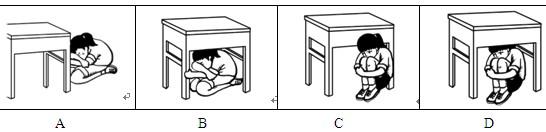
2.Which of the following statements is TRUE according to the text?
A.Ground movement during an earthquake is the main reason of death.
B.You should keep your windows, fireplaces and heavy furniture clear.
C.Stop your car in the clear area and get out of it if an earthquake happens.
D.Run away from the beach as quickly as possible if an earthquake happens.
3.The passage is mainly about ___________during the earthquake.
A.ways of keeping you safe
B.the importance of keeping safe
C.ways of finding safe places
D.researches on how to keep safe
The Sydney Opera House is a very famous building in the world. It has become Sydney’s best-known landmark and international symbol. The Opera House with a “sailing roof” was designed by a famous Danish architect(丹麦建筑师), Utzon. The base(基础)of the building was started in 1959, years before the designs were finished. Utzon spent four years deigning the Opera House. In 1962, the designs were finalized(定稿)and the construction began. In 1967, they started the decoration inside. It took 14 years in total to build the Opera House. Queen Elizabeth Ⅱ officially opened it on October 20th, 1973.
The Sydney Opera House cost around $100 million and was paid for by the public. 6225 square metres of glass was used to build it. The Opera House includes 1000 rooms. It is 185 metres wide. The building’s roof sections weigh about 15 tons. Each year, this fantastic building attracts 200 000 tourists to come for a visit or enjoy events in it.
The Opera House reaches out into the harbour(港湾). It is amazing and unforgettable, offering people a strong sense of beauty.
【小题1】The designer of the Sydney Opera House was from _____________.
| A.America | B.Australia | C.England | D.Denmark |
| A.from 1959 to 1973 | B.from 1962 to 1973 |
| C.from 1959 to 1967 | D.from 1962 to 1967 |
| A.创立 | B.设计 | C.施工 | D.竣工 |
| A.Utzon | B.The public |
| C.Queen Elizabeth Ⅱ | D.The government |
| A.Sailing Roof |
| B.Travelling in Sydney |
| C.The Sydney Opera House |
| D.The Opening of the Opera House |
湖北省互联网违法和不良信息举报平台 | 网上有害信息举报专区 | 电信诈骗举报专区 | 涉历史虚无主义有害信息举报专区 | 涉企侵权举报专区
违法和不良信息举报电话:027-86699610 举报邮箱:58377363@163.com