
题目列表(包括答案和解析)
Choose the words or expressions and complete the passage. (12分)
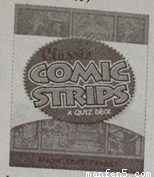
People of all ages, especially young children, follow comic strips in newspapers, magazines and the movies. Who is your favourite superhero --- Spideman? Wonder Woman? These heroes have been around for a long time. Comics came out even earlier. In ancient times, people made funny drawings of animals _____ paper.
Comic strips first came out during the 1800s and remain much the same style today. These comics are drawn in connected boxes. The boxes usually show a dramatic _________. Some comic strips are printed in newspapers, which often continue from day to day. Some people even read the comics before they read the front page.
The
comic books first _____ dur ing
the 1930s. It seemed that everyone wanted to read comic books. They loved
reading about the adventures of The Man of Steel and Batman. During the 1940s,
the nation was at war and some comic book characters, such as Captain America,
reflected (反映)the times. Others, such as Bugs Bunny and
Daffy Duck, made people laugh during this _______ time in history.
ing
the 1930s. It seemed that everyone wanted to read comic books. They loved
reading about the adventures of The Man of Steel and Batman. During the 1940s,
the nation was at war and some comic book characters, such as Captain America,
reflected (反映)the times. Others, such as Bugs Bunny and
Daffy Duck, made people laugh during this _______ time in history.
After the war, people became __________ interested in old comic book characters, so new superheroes had to be made. The new superheroes, such as Fantastic Four, X-Men, and Spideman, talked and acted more like real people. As time went on, comic books had to _________ TV because TV has offered a lot of fun to people.
Comic strips are usually good for a laugh or at least a smile. But they have held a place in history. They take people away from their daily lives into another world. In this world, the hero always wins, and failure only comes to the bad guys.
1.A. with B. on C. without D. over
2.A. story B. copy C. collection D. picture
3.A. grew B. knew C. appeared D. finished
4.A. happy B. alone C. noisy D. terrible
5.A. more B. much C. less D. little
6.A. link wih B. compete with C. talk with D. communicate with
You, of course, know that you will never add vcry rapidly to your vocabulary by merely coming across
words, or by reading or by talking. You must have a plan.
Here is one way to get ahead with words in everyday life. It's the simplest thing in the world.
Buy a small pocket notebook. When you read a newspaper, a magazine, or a book, or listen to TV or
radio, and come upon a strange word, enter it in your notebook. Then look it up in the dictionary. If you
find that it's a word too difficult to understand or a highly technical mterm, just pass it by. But if it sounds
like a word that will be helpful to you. take possession of it, make it your own personal possession. Say
it aloud many times. Study its exact meaning, and note its root. Be sure, also, to copy from the dictionary
the example sentence in which it is used, if such is given. Then write your own sentence in line with the
example in the dictionary.
| 完形填空。 | ||||
| You may think that English dictionaries have been used for many, many centuries. In fact an English dictionary you 1 today wasn't made until the Qing Dynasty (清朝). Three men did most of the important 2 work on dictionaries. They spent nearly all their lives trying to 3 words for their dictionaries. For them, it was a wonderful journey. The largest dictionary in the world is Oxford English Dictionary. The 4 for this dictionary came from an important meeting in Britain in 1857. Twenty-two years later, Oxford University asked Murray to be the editor of its new dictionary. Murray had never been to 5 . At the age of fourteen, he left his village school in Scotland and taught himself while working in a bank. 6 he became a great teacher. After Oxford gave him the job, Murray had a small house 7 in his garden to do the work. Every morning, Murray got out of bed at five o'clock and 8 in the small house several hours before breakfast. Often he would work into the night. Murray hoped to finish the new dictionary in the years. But after five years, he was 9 adding (增加) words for the letter "A"! He worked on the dictionary 10 he was very old. Forty-four years later, in 1928, other editors finished the dictionary. | ||||
|
左栏是同学们在学习英语时常遇到的5个问题。右栏是与其相对应的解决办法。请为每个问题选择一个最合适的办法。
| 71. Read very slowly especially when the article is very long and with many new words. 72. Be afraid to speak in class though know how to answer the questions. 73. Always write Chinlish(中文式英语) but not real English. Can’t use the right English words or use big words that is not necessary at all. 74. Often make mistakes in grammar. It’s hard to remember the grammar notes. 75. Have few chances to practice speaking skills. Nobody wants to speak in English after class. | A. F B. Try to be more outgoing. Don’t be afraid in English learning. Everybody makes mistakes. It’s not a big deal to make mistakes in front of your classmates who may do the same thing. C. Take notes. It’s very important to have a good habit in class, that is, taking a lot of grammar notes even though the teacher doesn’t write them down on the blackboard. Try to understand the grammar notes but not just copy them. D. Join an English Corner. You can find one in your school or city. It’s a good chance for the English lovers to practice their speaking skills and share the feelings as well. E. Have some good reading habits. First, you have to find out why you can’t read fast like others. Do you always read with your fingers follow the words or lips moving? Then you have to read in a right way that is the same as you are reading Chinese. |
71.________ 72.________ 73.________ 74.________ 75.________
 ch for providing (提供) us with a really good English magazine.
  r school. I have a question about
 湖北省互联网违法和不良信息举报平台 | 网上有害信息举报专区 | 电信诈骗举报专区 | 涉历史虚无主义有害信息举报专区 | 涉企侵权举报专区
违法和不良信息举报电话:027-86699610 举报邮箱:58377363@163.com ind a pen pal. You can make pen pals who are from English-speaking countries, so you may write letters in English often. Maybe your pen pals can help you improve your English too.