
题目列表(包括答案和解析)
You may think that English dictionaries have been used for many, many centuries. In fact, an English dictionary you today wasn’t made until the Qin Dynasty. They spent most of the important work on dictionaries. They spent nearly all their lives trying to words for their dictionaries. For them, it was a wonderful journey. The largest dictionary in the world is Oxford English Dictionary(牛津字典). The for this dictionary came from an important meeting in Britain in 1857. twenty-two years later, Oxford University asked James Murray to be the editor(编者)of its new dictionary. Murray had never been to . At the age of fourteen, he left his village school in Scotland and taught himself while working in bank. he became a great teacher. After Oxford gave him the job. Murray had a small house in his garden to do the work. Every morning, Murray got out of bed at five o’clock and in the small house several hours before breakfast. Often he would work into the night. Murray hoped to finish the new dictionary in ten years but after five year, he was adding(增加)words for the letter “A”! He worked on the dictionary he was very old. Forty-four years later, in 1928, other editors finished the dictionary.
1.A. use B. write C. copy D. miss
2.A. easy B. boring C. early D. dangerous
3.A. spell B. invent C. collect D. make
4.A. way B. idea C. use D. prize
5.A. school B. cinema C. village D. collage
6.A. Later B. Longer before C. So far D. Ever since
7.A. sold B. built C. broken D. drawn
8.A. read B. wrote C. worked D. thought
9.A. already B. still C. usually D. always
10.A. if B. because C. until D. since
If you have failed in the past to try to make big changes in life,try again now,one tiny step at a time.
Every year it’s the same.As December comes to an end,you think about the new year and all the ways you want to improve your life. But as you start to write down your hopes for the new year,you think about the last year.You excitedly write down all the changes you are going to make,but by the end of January those ideas get lost in your busy life.
Here’s a suggestion:Forget the too big,hard-to-achieve goals(目标) and just think about the small ones.“We often think that we have to do everything in big steps, even though it’s so hard for us to reach it.” said Robert Maurer,who recently wrote the book One Small Step Can Change Your Life.“What we try to do is to begin with such a small step that we can’t find any excuse not to do it.”
“Kaizen”,a Japanese word,is used to mean to change behavior and attitudes(态度).During World War Il,American factory managers were able to increase productivity by trying small, continuous improvements instead of sudden changes.After the war,the idea was brought to a rebuilding Japan.It made Japan develop fast. The Japanese called it “kaizen”, which means “improvement”.
Maurer studied the idea and did some experiments with it. “Kaizen” could possibly help people succeed in doing everything
1.Robert Maurer wrote a book to tell us .
A.we should do everything in big steps
B.how to change one’s life with one small step
C.we should try a lot of sudden changes
D.how to find a small step without any excuse
2.The writer of the passage suggests we should .
A.make changes at the end of the year
B.do few experiments with “kaizen”
C.do things with hard-to-achieve goals
D.take a tiny step to achieve big goals
3.Which of the following is TRUE from the passage?
A.Robert Maurer studied “kaizen” and found it helpful.
B.You can achieve your goals if you are not too busy.
C.You can’t find any excuse not to reach a big goal.
D.“Kaizen” was brought to Japan during World WarⅡ.
My Family Is Very Poor
A little boy comes to a new city. His name is Peter. Of course(当然),he lives with his mother and father. His family is very rich(富裕的). They have a driver(司机) and a lot of servants(仆人).
Peter is going to a new school. On the first day his parents say to him,“ peter,be modest(谦虚的)at your new school. Don’t say we are rich. ”And Peter says,“ Yes,Dad,mom. ”
So Peter goes to school. He sees his new teacher. And he sits down with the other children. The teacher says. “Good morning,children. The first exercise today is a composition(作文). The topic(题目) of the composition is ‘My Family’.”So every child writes a composition. This is Peter’s composition:
“My name is Peter. My family is very poor(贫穷). Both my father and my mother are very poor. Our driver is very poor and all the servants are poor…”
根据短文内容,选择最佳答案。
1.Peter’s parents are very .
A. small B. modest C. poor D. rich
2.Peter’s parents tell him not to .
A. play on his way to school
B. be late for school
C. say they are rich
D. write a composition
3.The teacher asks the children to write .
A. a letter B. a composition C. a book D. a story
4.Peter writes a composition about his .
A. friend B. teacher C. school D. family
5. Which of the following is right?
A. Peter tells a lie(说谎)in his composition.
B. Peter doesn’t like writing a composition.
C. Peter’s parents write the composition.
D. The teacher is very poor,too.
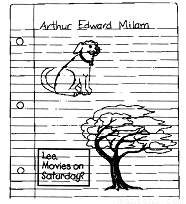
Arthur sat at the desk in his room, pencil in hand. He had to write a story for his English class by Friday. “I don’t know what to write about,” he complained to his dog Toby, who was asleep at his feet. Arthur was talkative when speaking to his friends, yet he had trouble finding words when he had to write.
By bedtime Arthur had drawn a picture of Toby smiling. He had drawn a tree with its branches blowing in the strong wind. He had also written a note asking his friend Lee to go to the movies on Saturday. But he had not written a single word of his story.
On Wednesday, Mrs. Solomon, Arthur’s English teacher, asked the class to turn in the first draft of their stories. His heart sinking, Arthur turned in the only work he had—the page with his name, the drawings and the note.
Arthur wasn’t surprised when Mrs. Solomon asked him to stay after class the next day. But he was surprised by what she said to him. “This is an attractive story, Arthur. The dog, the movie, the tree in the wind—I can’t wait to find out how they all fit together.”
“That isn’t my story, Mrs. Solomon,” Arthur admitted. “I haven’t been able to think of one yet.”
“Oh, I think you have the seed(种子of a story there,” Mrs. Solomon replied, “Look at your note and the pictures and see if a story comes to you.”
That night Arthur sat at his desk, and this is what he wrote: “One Saturday Mike went downstairs to meet his friend Julio at the cinema. It looked as if it might rain, so Mike carried his umbrella. Suddenly a big storm blew in, bending the trees. The noise of the wind sounded like the barking of Mike’s dog Toby. Toby really hated storms and barked whenever he wanted to be let inside. Then Mike realized that it wasn’t the sound of the wind. It was Toby. The dog was running after him down the busy street, barking. The sound was filled with blame. Mike felt guilty because he had left Toby outside. He turned and headed home with Toby running beside him. Mike let Toby in the door just as the rain started to pour down.”
Arthur had a story in the end. The last thing he did was to write his name proudly at the top of the page.
1.Why did Arthur turn in the page with only his name, the drawings and the note at first?
A.Because he had no time to fit them together.
B.Because he had difficulty in writing a story.
C.Because he wasn’t willing to do his homework.
D.Because he wanted to show his talent for drawing.
2.What does the underlined sentence in Paragraph 6 probably mean?
A.Toby is an imaginative and lovely dog.
B.The small tree will grow into a big one.
C.His friend Lee can give him a lot of support.
D.He can develop his story based on the first draft.
3.What kind of teacher do you think Mrs. Solomon is ?
A. She is a strict teacher B. She is a wise teacher
C. She is an honest teacher D. She is an energetic teacher
4.What can we infer(推断from the story?
A. Arthur is a shy and quiet student
B. Arthur isn’t very satisfied with his story
C. There will be a storm on Saturday
D. Encouragement is important in teaching
阅读下面短文,根据所读内容,在文章后小题的空格里填入一个最恰当的单词。
注意:每个空格只填一个单词。
Improve Homework Habits
Do you want to make homework simpler? It can be done readily with a little guidance from specialists (专家) in this field. Oxford Learning founder and CEO Dr. Nick Whitehead, said that homework doesn’t always have to be a headache. “Homework might be an unavoidable (不可避免的) part of school, but it doesn’t have to be the boring part. With the right skills in place, students can turn homework from headache-including to trouble-free.” These steps will make an obvious difference.
Use your notebooks
The brain is able to finish great works, but it is not perfect. Students should never rely on (依赖) it to remember all school details. When a teacher assigns homework, students should write the details in their notebooks. Many schools provide notebooks because they are the best organizational tools available.
According to Whitehead, to make them effective, students need to remember to take the notebooks out of their school bags at night, open them up, and read over the night’s list.
Remove distractions (使注意力分散的事物)
Computers on, music on, text messages receiving … this is not multitasking, it’s distracting.
Whitehead says that unless students are doing research, they should turn off all electronics and focus on the task at hand for a set period of time. They’ll find that it is easier to concentrate (全神贯注) and that homework takes less time. He adds that this fact has been confirmed by studies.
Think actively
Getting homework done is the name of the game, but what happens if students are struggling with a question, or can’t work out an answer? When facing difficulties, it is wise for the student to take a small break then return to look at the problem again.
According to Whitehead, students should look up their textbooks and school notes, take a step back to ask what the particular unit is all about, and even move ahead a few questions and see if the next part can help explain a little better. If not, use the Internet.
“Don’t stare at (盯着) the question; ask how this question relates to what is being learned overall.” he says.
Get organized
Homework is as much a part of daily routine as waking up in the morning and going to bed at night, but it’s often the most disorganized part. Whitehead recommends streamlining (使合理化) the process.
“Students should keep all the homework-related things in a bin or a bucket so they don’t waste time searching for pens or rulers.” He also recommends picking the same place to do homework every night, and (when possible) completing homework at the same time each day.
|
Improve Homework Habits |
|
|
As students, homework is an unavoidable part in school, but many students feel 1. about homework. The following 2. can help students turn homework from headache-including to trouble-free. |
|
|
Step1: Use your notebooks |
Students shouldn’t use brains to remember all school things. 3. , they should use notebooks to write the details about 4. at school. At home they open them up, and read over the night’s list. |
|
Step2: Remove distractions |
Computers, music, text messages, etc. may distract you from your homework. 5. you are not doing research, turn off all of these. Then you may find you can concentrate on homework more 6. and it takes less time. |
|
Step3: Think actively |
When you have 7. in doing your homework, it’s not wise for you to stare at the question. You should take a small break then come 8. to look at it again. |
|
Step4: Get organized |
Students 9. to streamline the process, keep all the homework-related things organized, pick the same place to do homework, and 10. homework at the same time each day. |
湖北省互联网违法和不良信息举报平台 | 网上有害信息举报专区 | 电信诈骗举报专区 | 涉历史虚无主义有害信息举报专区 | 涉企侵权举报专区
违法和不良信息举报电话:027-86699610 举报邮箱:58377363@163.com