
题目列表(包括答案和解析)
When you are learning English, you find it not clever to put an English sentence, word for word, into your own language. Take the sentence “How do you do?” as an example. If you looked up each word in the dictionary, once at a time, what is your translation (翻译)? It must be a wrong sentence in your own language.
Languages do not just have different sounds; they are different in many ways. Its important to master(掌握)the rules for word order in the study of English, too. If the speaker puts words in a wrong order, the listener can’t understand his sentence easily. Sometimes when the order of words in an English sentence is changed, the meaning of the sentence changes. But sometimes the order is changed, but the meaning of the sentence doesn’t change. Let’s see the different between the two parts of sentences.
“She only likes apples.” “Only she likes apples.”
“I have seen the film already.” “I have already seen the film.”
When you are learning English, you must do your best to get the spirit(精神实质) of the language and use it as the English speaker does.
【小题1】From the passage we know that __________when we are learning English.
| A.we shouldn’t put every word into our own language |
| B.we should look up every word in the dictionary |
| C.we need to put every word into our own language |
| D.we must read word by word |
| A.difficult to understand different sounds |
| B.possible to remember the word order |
| C.important to master the rules in different ways |
| D.easy to master the rules for word order |
| A.the meaning of an English sentence always changes with the order of words |
| B.the order of words can never change the meaning of an English sentence |
| C.sometimes a different order of words has a different meaning |
| D.if the order of words is different, the meaning of the sentence must be different |
| A.is the same as “Only she likes apples.” |
| B.is different from “Only she likes apples.” |
| C.means “She likes fruit except apples.” |
| D.means “She doesn’t like apples.” |
| A.Different orders, different meanings. |
| B.How to speak English. |
| C.How to put English into our own language. |
| D.How to learn English. |
| A.we shouldn’t put every word into our own language |
| B.we should look up every word in the dictionary |
| C.we need to put every word into our own language |
| D.we must read word by word |
| A.difficult to understand different sounds |
| B.possible to remember the word order |
| C.important to master the rules in different ways |
| D.easy to master the rules for word order |
| A.the meaning of an English sentence always changes with the order of words |
| B.the order of words can never change the meaning of an English sentence |
| C.sometimes a different order of words has a different meaning |
| D.if the order of words is different, the meaning of the sentence must be different |
| A.is the same as “Only she likes apples.” |
| B.is different from “Only she likes apples.” |
| C.means “She likes fruit except apples.” |
| D.means “She doesn’t like apples.” |
| A.Different orders, different meanings. |
| B.How to speak English. |
| C.How to put English into our own language. |
| D.How to learn English. |
When you are learning English, you find it not clever to put an English sentence, word for word, into your own language. Take the sentence "How do you do?" as an example. If you look up each word in the dictionary, one at a time, what is your translation (翻译)? It must be a wrong sentence in your own language.
Languages do not just have different sounds, they are different in many ways. It's important to master(掌握) the rules(规则) for word order (顺序) in the study of English, too. If the speaker puts words in a wrong order, the listener can't understand the speaker's sentence easily.Sometimes when the order of words in an English sentence is changed, the meaning of the sentence changes. But sometimes the order is changed, the meaning of the sentence doesn't change.
Let's see the difference between the two sentences:"She only likes apples. " "Only she likes apples. "
When you are learning English, you must use it as the English speaker does.
1.From the passage we know that _______when we are learning English.
A. we shouldn't put every word into our own language
B. we should look up (查阅) every word in the dictionary
C. we need to put every word into our own language
D. we must read word by word
2. The writer thinks it is________in learning English.
A. difficult to understand different sounds
B. possible to remember the word order
C. important to master the rules in different ways
D. easy to master the rules for word order
3.We can learn from the passage that_______.
A. the meaning of an English sentence always changes with the order of the words
B. the order of words can never change the meaning of an English sentence
C. sometimes different order of words has a different meaning
D. if the order of words is different, the meaning of the sentence must be different
Two Chinese spacecrafts successfully completed China’s first space docking early November 3, 2011, which has taken the country a step closer to building its own space station.
Nearly two days after its launch, the unmanned spacecraft Shenzhou VIII docked with the space lab module Tiangong I more than 343 km above the earth surface. Shenzhou VIII and Tiangong I took apart after flying together for 12 days. On the 14th of November, the two spacecrafts finished the second docking. Then Shenzhou VIII parted from Tiangong I again and returned to the earth safely on the 17th. Tiangong I is still traveling around the earth in the space, waiting for the arrival of Shenzhou IX and X and so on in the near future.
That marked another great leap for China’s space program and made China the third country in the world, after the United States and Russia, to master the space docking technique (空间对接技术).
The world’s first space docking was achieved in 1966, when the manned U.S, spacecraft Gemini 8 (双子星8号) docked with an unmanned Agena Target Vehicle (阿金纳目标飞行器). Space docking is necessary to explore space beyond Earth’s orbit. “The capability increases China’s ability to act independently in space, as well as its ability to work together with others,” said Gregory Kulacki, a U.S. space scientist and senior analyst.
“With the success of its first space docking, China is now equipped with the basic technology and ability required for the construction of a space station,” said Zhou Jianping, chief designer of China’s manned space program.” The country is on its way to building a permanent manned space station around 2020.”
1.What did the success of the first space docking mean to China?
A. China has caught up with the United States in the space exploration field.
B. China took a step closer to building its own space station.
C. China became the first country to master the space docking technique.
D. China has the ability to build a permanent manned space station right now.
2.What does the underlined word “That” in the third paragraph refer to?
A. Shenzhou VIII.
B. Tiangong I
C. The Space Station
D. The success of China’s first space docking
3.What can we learn from the passage?
A. Tiangong I will fly in the space for 12 days.
B. The first space docking of the world was achieved in 1966, by Russians.
C. Without space docking technique people can’t explore space beyond Earth’s orbit.
D. The U.S.A helped China achieve the first space docking.
4.What’s the best title of this passage?
A. The first space docking of China.
B. The history of space docking.
C. The first space docking of the world.
D. The space docking technique
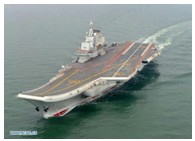
It’s a long-awaited day for China. The navy now has its first aircraft carrier(航空母舰), Liaoning.
It’s a unique experience to get to know the life in the carrier. The carrier is just like a small city on the sea. It has all the functions for daily life. There are 4 words to sum up its characters: big, small, much and high. The carrier Liaoning is such a huge one that the total length of the whole corridor(过道)could reach over 20 kilometers. But the living space for the sailors(水手)is quite small. That’s because the carrier is designed for researching purposes, rather than comfortable living. Over 1,000 sailors, both men and women, are living onboard. They are arranged among over 3,000 tiny rooms below the deck. For visitors, it’s so easy to get lost. So the first thing the new sailors have to learn is their way around. The number of female sailors is much less than that of the males, taking about 5 percent of the total. But they play a key role in carrying out some special missions.
Also, you will be surprised by the high level of education of today’s sailors. The captain said that over 90 percent of the sailors are college graduates. Six hold Doctor’s Degrees and 45 have a Master’s. The whole team is young but vigorous. The complex work on the carrier requires high management abilities for the commanders onboard(在船上).
1.Why do we visitors get lost easily inside the carrier?
A.Because they don’t have a map.
B.Because the living space is quite small.
C.Because there are too many corridors for rooms.
D.Because the corridor inside the carrier is too long.
2.What does the word “high” in Line 6 refer to(指代)?
A.The aircraft carrier is high since it is just like a small city.
B.Most of the soldiers received good education.
C.The expense(花费)to run a carrier is high.
D.The high-level of their training.
3.Which of the following is NOT TRUE according to the passage?
A.Liaoning is our country’s first aircraft carrier.
B.Most of the sailors on the carrier are college graduates.
C.There are far fewer women sailors than men sailors on the carrier.
D.It is comfortable for the sailors to live in the carrier.
湖北省互联网违法和不良信息举报平台 | 网上有害信息举报专区 | 电信诈骗举报专区 | 涉历史虚无主义有害信息举报专区 | 涉企侵权举报专区
违法和不良信息举报电话:027-86699610 举报邮箱:58377363@163.com