
A B C D E F G H 答案:A.drum B.violin C.trumpet D.piano E.swim F.dance G.sing H.chess 答案: 1. It’s a trumpet. 2. No, it’s a violin. 3. They can play chess.4. He can swim. 5. They often dance. 查看更多


题目列表(包括答案和解析)

听句子,选择与句子内容相符的图画(有一幅是多余的)。每个句子读两遍。

             A                 B            C                  D              E                        F    
1.______ 2.______ 3.______ 4.______ 5.______   

查看答案和解析>>

听句子,选择与句子内容相符的图画(有一幅是多余的)。每个句子读两遍。

          A                      B                C                   D    E                        F   
1._______2._______3._______4._______5._______  

查看答案和解析>>

阅读短文,选择正确答案。
    The Great Fire of London started in the very early hours of 2 September, 1666. In four days it destroyed
more than three-quarters of the old city, where most of the houses were wooden and close together. One
hundred thousand people became homeless, but only a few lost their lives.  
    The fire started on Sunday morning in the house of the King's baker (面包师) in Pudding Lane. The baker,
with his wife and family, was able to get out through a window in the roof. A strong wind blew the fire from
the bakery (面包房) into a small hotel next door. Then it spread quickly into Thames Street. That was the
beginning.
    By eight o'clock three hundred houses were on fire. On Monday nearly a kilometer of the city was burning
along the River Thames. Tuesday was the worst day. The fire destroyed many well-known buildings, old
St Paul's and the Guildhall among them.  
    Samuel Pepys, the famous writer, wrote about the fire. People threw their things into the river. Many poor
people stayed in their houses until the last moment. Birds fell out of the air because of the heat.  
    The fire stopped only when the King finally ordered people to destroy hundreds of buildings in the path of the
fire. With nothing left to burn, the fire became weak and finally died out.  
    After the fire, Christopher Wren, the architect (建筑师), wanted a city with wider streets and fine new
houses of stone. In fact, the streets are still narrow; but he did build more than fifty churches, among them new
St Paul's.  
    The fire caused great pain and loss, but after it London was a better place: a city for the future and not just of
the past.
1. The underlined word "family" in the second paragraph means _______.
[     ]
A. home         
B. children  
C. wife and husband   
D. wife and children
2. How was the fire put out according to the text?
[     ]
A. The king and his soldiers came to help.  
B. All the wooden houses in the city were destroyed.  
C. People managed to get enough water from the river.  
D. Houses standing in the direction of the fire were pulled down.
3. It seems that the writer of the text was most sorry for the fact that _______.
[     ]
A. some people lost their lives  
B. the birds in the sky were killed by the fire  
C. many famous buildings were destroyed  
D. the King's bakery was burned down
4. Why did the writer cite (引用) Samuel Pepys?
[     ]
A. Because Pepys was among those putting out the fire.  
B. Because Pepys also wrote about the fire.  
C. To show that poor people suffered most.  
D. To give the reader a clearer picture of the fire.
5. Which of the following were reasons for the rapid spread of the big fire?
(a) There was a strong wind.  
(b) The streets were very narrow.
(c) Many houses were made of wood.  
(d) There was not enough water in the city.  
(e) People did not discover the fire earlier.
[     ]
A. (a) and (b)
B. (a), (b) and (c)  
C. (a), (b), (c) and (d)
D. (a), (b), (c), (d) and (e)

查看答案和解析>>

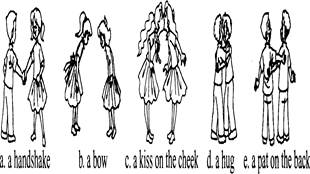
A greeting is a way of saying "Hello" to someone. People in different countries greet each other in different ways. Here are some.
World Greetings

Philippine
The everyday greeting for friends is a handshake for both men and women. Men some­times pat each other on the back.
Japan
When people meet for the first time, they usually bow. In business, people also shake hands.
In formal situations, people often exchange business cards. When you give a business card, give it with two hands. This is polite.
Special note: In Japan, a smile can have different meanings. It usually means that the person is happy, or that the person thinks something is funny. But it can also mean that the person is embarrassed.
New Zealand
Usually, both men and women shake hands when they meet someone for the first time.
Fun fact: If you see two people pressing their noses together, they are probably Maori. The Maori are the native people of New Zealand. This is their traditional greeting.
Brazil
Men often shake hands when they meet for the first time.
When women meet, they kiss each other on the cheek. Women also kiss male friends to say hello.
When you shake hands, look at the person in the eyes. This shows interest and friendliness.
【小题1】In this passage, which of the following is NOT mentioned?
A.Kisses.B.Hugs.C.Bows.D.Handshakes.
【小题2】Of the five pictures above (a, b, c, d and e), which is the same way to greet each other in the four countries?
A.aB.bC.cD.d
【小题3】Which of the following is TRUE according to the passage?
A.Both men and women shake hands in Brazil when they meet.
B.Japanese won't smile until they feel very happy.
C.The Maori often press their noses together to greet each other.
D.In Philippine, people shake hands only when they meet for the first time.

查看答案和解析>>

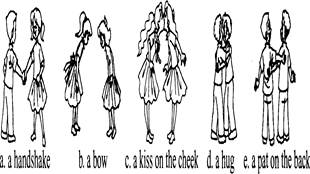
A greeting is a way of saying "Hello" to someone. People in different countries greet each other in different ways. Here are some.

World Greetings

Philippine

The everyday greeting for friends is a handshake for both men and women. Men some­times pat each other on the back.

Japan

When people meet for the first time, they usually bow. In business, people also shake hands.

In formal situations, people often exchange business cards. When you give a business card, give it with two hands. This is polite.

Special note: In Japan, a smile can have different meanings. It usually means that the person is happy, or that the person thinks something is funny. But it can also mean that the person is embarrassed.

New Zealand

Usually, both men and women shake hands when they meet someone for the first time.

Fun fact: If you see two people pressing their noses together, they are probably Maori. The Maori are the native people of New Zealand. This is their traditional greeting.

Brazil

Men often shake hands when they meet for the first time.

When women meet, they kiss each other on the cheek. Women also kiss male friends to say hello.

When you shake hands, look at the person in the eyes. This shows interest and friendliness.

1.In this passage, which of the following is NOT mentioned?

A.Kisses.            B.Hugs.             C.Bows.            D.Handshakes.

2.Of the five pictures above (a, b, c, d and e), which is the same way to greet each other in the four countries?

A.a                B.b                C.c                D.d

3.Which of the following is TRUE according to the passage?

A.Both men and women shake hands in Brazil when they meet.

B.Japanese won't smile until they feel very happy.

C.The Maori often press their noses together to greet each other.

D.In Philippine, people shake hands only when they meet for the first time.


查看答案和解析>>


同步练习册答案