
题目列表(包括答案和解析)
What do you do if you're stranded(处于困境的)on a lonely island? Surely you need to find a way to get in touch with the outside world. Your best chance of doing this is to draw the attention of a passing plane.
Body signals(信号)
Pilots from different countries understand body signals if they have the correct training. When you wave your arms up and down in a straight line, it means "yes". When you point downwards and swing your arm from side to side, it means "no". If you want the pilot to know that it's safe to land, push your hands out in front of you and bend(弯曲)your knees. If you want to say that it's not safe to land, put your arms in the air and move them to one side.
Smoke signals
The smoke from a fire can be seen from far away, so it's a good way to draw attention. If the weather is dry, it isn't hard to start a fire. Remember, however, that fires can be very dangerous if they get out of control. Never light a fire unless you're sure that it can't spread. If the ground is dark, light smoke can be seen more easily. Green grass and leaves produce light smoke.
Ground-to-air signals
It's a good idea to build some signals, too. Use large pieces of wood to make the symbols(标记). If you can't find any wood, use earth. Some useful symbols are:
F "I need food and water."
II "I need medicine."
I "I am badly hurt."
X" I am unable to move from here."
Pilots' replies
If the pilot lowers the plane's wings from side to side, this means "message received and understood". (At night, the pilot flashes the plane's green lights.) If the pilots flies the plane in a clockwise circle, this means "message received but not understood".(At night, the pilot flashes the plane's red lights.)
However, there is no signal which means "message not received". Why not?
【小题1】 Which picture means "it's not safe land"?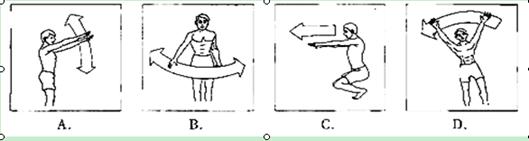
【小题2】 What can we learn from the passage?
| A.Swinging your arm from side to side means "yes". |
| B.If the ground is dark, light smoke can't be seen. |
| C.If you need some medicine, make a symbol "II". |
| D.The pilots make replies with a blue light at night. |
| A.The explanation of building signals on an island. |
| B.The importance of making signals on an island. |
| C.Ways of sending out signals on a lonely island. |
| D.Ways of receiving signals from a lonely island |
There was a little boy who got angry easily. His father gave him a bag of nails(钉子) and told him that every 16 he got angry, to drive a nail into the back wall. The first day the boy had 17 37 nails into the wall. Then he put fewer and fewer nails. He found it was 18 to be not angry than to drive those 19 into the wall. Finally the day came when the boy didn't get 20 at all. He told his father about it and the father suggested that the boy now pull out one nail for each day that he was able to be not angry. The days 21 and the young boy was finally able to tell his father that 22 nails were gone. The father took his son by the hand and led him to the 23 . He said, "You have done 24 , my son, but look at the holes in the wall. The wall will 25 be the same. When you say things 26 , they leave a scar(伤疤) just like this one. You 27 put a knife in a man and draw it out. It won't matter 28 you say I'm sorry, the wound(伤口) is still there. A mental hurt is as bad as a physical one. Friends are a very rare jewel, indeed. They make you 29 and encourage you to succeed. They lend an ear, they share a word of praise, and they always 30 to open their hearts to us.
1.A. time B. day C. week D. year
2.A. turned B. driven C. pulled D. threw
3.A. harder B. tougher C. easier D. worse
4.A. sticks B. knives C. nails D. forks
5.A. happy B. sad C. excited D. angry
6.A passed B. came C. returned D. happened
7.A. some B. many C. all D. most
8.A. house B. nails C. room D. wall
9.A. badly B. well C. sadly D. kindly
10.A. never B. sometimes C. often D. always
11.A. politely B. carefully C. happily D. angrily
12.A. must B. need C. can D. should
13.A. how much B. how long C. how many times D. how far
14.A. cry B. jump C. lose D. smile
15.A. refuse B. want C. fail D. learn
Just a Quick Nap(打个盹儿)
Do you feel a little sleepy after lunch? Well, that’s normal. Your body naturally slows down then. What should you do about it? Don’t reach for a coffee! Instead, take a nap.
It’s good to have a daily nap. First of all , you are more efficient(有效的) after napping. You remember things better and make fewer mistakes. Also, you can learn things more easily after taking a nap. A nap may increase your self-confidence and make you more active. It may even cheer you up. But, there are some simple rules you should follow about taking a nap. First, take a nap in the middle of day, about eight hours after you wake up. Next, a 20-minute nap is best. If you sleep longer, you may fall into a deep sleep. After waking from a deep sleep, you will feel worse. Also, you should set an alarm clock. That way, you can fully relax during your nap. You won’t have to keep looking at the clock, so you don’t oversleep.
Now, the next time you feel sleepy after lunch, don’t get stressed. Put your head down, close your eyes, and catch forty winks.
1. After taking a nap, you may feel more .
A.tired B.confident
C.sleepy D.excited
2.The proper period of time for taking a nap is .
A.the shorter the better
B.as long as you like
C.the longer the better
D.about twenty minutes
Mrs. Ball had a son. His name was Mick. She 26 him very much and as(因为)he was not a 27 child, she was always afraid that he might 28 ill. 29 she usually took him to see the best 30 in the town four times a year and asked the doctor to look 31 the son.
During one of these 32 , the doctor gave Mick all kinds of tests(检查) and then said to him, “Do you have any trouble with your nose or ears ?” Mick 33 for a second and then answered, “Yes, I 34 _.”
Mrs. Ball was very 35 . “But I’m sure you have 36 told me that, Mick!” she said worriedly. “Oh, really?” said the doctor 37 . “And what trouble do you have 38 your nose and ears, my boy?” “Well,” answered Mick. “I always have trouble with them when I’m 39 my sweater off, 40 the collar (领子) is very tight (紧的).”
| 【小题1】 |
|
| 【小题2】 |
|
| 【小题3】 |
|
| 【小题4】 |
|
| 【小题5】 |
|
| 【小题6】 |
|
| 【小题7】 |
|
| 【小题8】 |
|
| 【小题9】 |
|
| 【小题10】 |
|
| 【小题11】 |
|
| 【小题12】 |
|
| 【小题13】 |
|
| 【小题14】 |
|
| 【小题15】 |
|
The word“day” has two meanings. When we talk about the number of days in a year, we are using “day” to mean 24 hours. But when we talk about day and night, we are using“day” to mean the time between sunrise and sunset. Since the earth looks like a ball, the sun can shine on only half of it at a time. Always one half of the earth is having day and the other half night. A place is moved from day into night and from night into day over and over by the spinning(旋转)of the earth. At the equator(赤道)day and night are sometimes the same length(长度). They are each twelve hours long. The sun rises at 6 o’clock in the morning and sets at 6 o’clock in the evening. For six months the North Pole is tilted(倾斜)toward the sun. In those months the Northern Hemisphere(半球)gets more hours of sunlight than the Southern Hemisphere. Days are longer than nights. South of the equator nights are longer than days. For the other six months the North Pole is tilted away from the sun. Then the Southern Hemisphere gets more sunlight. Days are longer than nights. North of the equator nights are longer than days. Winter is the season of long nights. Summer is the season of long days.
1.When the Western Hemisphere is having day, the Eastern Hemisphere is having ________.
A. both day and night B. day
C. neither day nor night D. night
2.A place is moved from day into night and from night into day over and over by ________ of the earth.
A. the pushing B. the pulling C. the spinning D. the passing
3..At the equator day is as long as night ________.
A. sometimes B. never C. usually D. always
4.When the North Pole is tilted toward the sun, the Northern Hemisphere gets ________ sunlight.
A. less B. more C. all D. no
5..When it is winter in China, ________.
A. the USA is tilted toward the sun
B. the South Pole is tilted away from the sun
C. the North Pole is tilted toward the sun
D. the North Pole is tilted away from the sun
湖北省互联网违法和不良信息举报平台 | 网上有害信息举报专区 | 电信诈骗举报专区 | 涉历史虚无主义有害信息举报专区 | 涉企侵权举报专区
违法和不良信息举报电话:027-86699610 举报邮箱:58377363@163.com