
题目列表(包括答案和解析)
小题1:___”However, it is not polite to say “No, we wouldn't!”小题2:___” These are usually just polite ways of ending a talk. They are not real invitations because they don't mention an exact time or day. They just show that the person is trying to be friendly and the answers are “Yes, that would be nice.” or “___小题3:___”.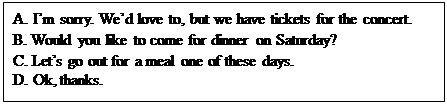
小题4:What is the article mainly about?| A.Britain. | B.A letter to friends. | C.Invitations. | D.A talk with friends. |
In Canada and the United States, people enjoy entertaining(请客)at home. They often invite friends over for a meal, a party, or just for coffee and conversation.
Here are the kinds of things people say when they invite someone to their home:
" Would you like to come over for dinner on Saturday night? "
" Hey, we're having a party on Friday. Can you come'? "
To reply to an invitation, either say thank you and accept(接受), or say you're sorry and give an excuse(借口):
" Thanks, I'd love to. What time would you like me to come?" or " Oh, sorry. I've tickets for a movie." Sometimes, however, people use expressions(措辞)that sound like invitations, but which are not real invitations(邀请). For example:
" Please come over for a drink sometime? "
" Why not get together for a party sometime? "
"Why don't you come over and see us sometime soon?"
They are really just polite ways of ending a conversation. They are not real invitations because they don't tell time or date. They just show that the person is trying to be friendly. To reply to expressions like these, people just say: "Sure, that would be nice!" or "OK. Yes, thanks."
So next time when you hear what sounds like an invitation. Is it a real invitation or is the person just being friendly?
【小题1】 Why do Canadians and Americans often invite friends for meals at home?
| A.Because they have no time. |
| B.Because they can spend less money |
| C.Because they enjoy entertaining at home |
| D.Because they have modern and beautiful houses |
| A."If you're free, let's go for a drink sometime." |
| B."Please go to the cinema with me some day." |
| C."Would you like to have a cup of tea with us sometime?" |
| D."I've two tickets here. Can you go to the concert with me?" |
| A.they're trying to be friendly |
| B.they're trying to be helpful |
| C.they're trying to make friends with others |
| D.they haven't got ready for a party yet |
| |||||||||||||||||||||||||||||||||||||||||||||||||||||||||||
In Britain ,people often invite friends for a meal , a party or just coffee. People who know each other very well may visit each other’s houses without an invitation(邀请),but if we invite new friends, usually an invitation is needed. When people invite someone to their homes , they often say ,“Would you like to come for dinner on Saturday ?” Answers are, “Thanks, we’d love to. What time?” or “I’m sorry, We’d love to ,but we have tickets for the concert.” However, it is not polite to say,“No, we wouldn’t.”
Sometimes, the British use expressions that sound like invitations but which are not invitations. For example. “You must come over for a drink sometime .” or “Let’s go out for a meal one of these days.” These are usually just polite ways of ending a talk . They are not real invitations because they don’t mention an exact time or day. They just show that the person is trying to be friendly and the answers are ,“Yes , that would be nice .” or “OK, yes ,thanks.”
So next time you hear what sounds like an invitation, listen carefully. Is it a real invitation or is the person just being friendly?
【小题1】It’s always necessary for to visit each other’s houses with an invitation.
| A.close friends | B.family members |
| C.neighbours | D.new friends |
| A.Sorry. We’d love to, but we have tickets for the concert . |
| B.Thanks. We’d love to, what time? |
| C.Sure. We’d like to. Thanks a lot. |
| D.No, we wouldn’t! |
| A.Would you like to come for dinner on Saturday? |
| B.Let’s go out for a meal one of these days. |
| C.Let’s go out for a meal on Saturday. |
| D.Shall we go for a drink this afternoon . |
| A.Yes , what time ? |
| B.No, that’s not a real invitation. |
| C.OK, yes , thanks. |
| D.No, you just want to be friendly. |
| A.Britain. |
| B.Invitation. |
| C.A Talk with Friends. |
| D.A Letter to Friends. |
In Britain ,people often invite friends for a meal , a party or just coffee. People who know each other very well may visit each other’s houses without an invitation(邀请),but if we invite new friends, usually an invitation is needed. When people invite someone to their homes , they often say ,“Would you like to come for dinner on Saturday ?” Answers are, “Thanks, we’d love to. What time?” or “I’m sorry, We’d love to ,but we have tickets for the concert.” However, it is not polite to say,“No, we wouldn’t.”
Sometimes, the British use expressions that sound like invitations but which are not invitations. For example. “You must come over for a drink sometime .” or “Let’s go out for a meal one of these days.” These are usually just polite ways of ending a talk . They are not real invitations because they don’t mention an exact time or day. They just show that the person is trying to be friendly and the answers are ,“Yes , that would be nice .” or “OK, yes ,thanks.”
So next time you hear what sounds like an invitation, listen carefully. Is it a real invitation or is the person just being friendly?
1.It’s always necessary for to visit each other’s houses with an invitation.
A.close friends B.family members
C.neighbours D.new friends
2.It is not polite to answer the real invitation by saying “ “
A.Sorry. We’d love to, but we have tickets for the concert .
B.Thanks. We’d love to, what time?
C.Sure. We’d like to. Thanks a lot.
D.No, we wouldn’t!
3.If the British just want to end a talk politely, they may say,” ”
A.Would you like to come for dinner on Saturday?
B.Let’s go out for a meal one of these days.
C.Let’s go out for a meal on Saturday.
D.Shall we go for a drink this afternoon .
4.The British often use “ ”to answer the invitations that are not real.
A.Yes , what time ?
B.No, that’s not a real invitation.
C.OK, yes , thanks.
D.No, you just want to be friendly.
5.Which is the best title for the passage?
A.Britain.
B.Invitation.
C.A Talk with Friends.
D.A Letter to Friends.
湖北省互联网违法和不良信息举报平台 | 网上有害信息举报专区 | 电信诈骗举报专区 | 涉历史虚无主义有害信息举报专区 | 涉企侵权举报专区
违法和不良信息举报电话:027-86699610 举报邮箱:58377363@163.com