
题目列表(包括答案和解析)
| 完型填空 | ||||
| Don't break kid's heart I ran into a stranger as he passed by. "Oh, excuse me please" was my reply. He said," Please excuse me too.I wasn't even watching for you." We were very 1 , this stranger and I. We went on our way and said goodbye. But at home 2 story is told-how we treat our loved ones, young and old. Later that day, cooking the evening meal, my daughter stood beside me very still. When I turned, I nearly knocked her down. "Move out of the way," I shouted at her. My daughter walked away, her little heart broken. I didn't realize how rudely I had spoken. While l was 3_ in bed. God's small voice came to me and said, "When dealing with a 4 ,common manners you use, but the children you love, you seem to be rude. Look on the kitchen floor, and you will find some 5 there by the door. Those are the flowers your daughter brought for you. She picked them herself, pink, yellow and blue. Your daughter stood _6 not to spoil(毁坏)the surprise, and you never saw the tears in her eyes." By this time, I felt very small, and now my 7 began to fall. I quietly went and knelt(跪下) by her bed, "Wake up, my little baby, wake up," I said. "Are these the flowers you 8 for me?" My daughter smiled, "I found them out by the tree. I picked them 9 they are pretty like you. I knew you would like them, especially the blue." I said, "Daughter, I am sorry for the way I acted today: I should not have shouted at you that way."My daughter said, "Oh, Mom, that's okay. I love you anyway." I said, "Daughter, I love you too, and I do like the flowers, especially the 10 ." | ||||
|
根据所给的词、汉语提示、词语释义或首字母写出单词,使句子意思完整正确。
1. All th e tourists shouted “__________” when they saw pyramids, one of the seven __________ in the world. (wonder)
2.If the doctor does a small_______ (operate) on him, he will be all right soon.
3.My cousin will go to the USA for_______(far) study with his classmates next year.
4. Everyone should help those _______(home) people after the earthquake.
5. It is well-known that smoking can be ________ (harm) to our health.
6. I am sorry. You pronounced this word ________ (correct).
7. There’r e so many people in the room. It’s _____ (hope) for us to get inside.
8. When I passed the driving test, I thought I was the_______(luck) person in the world.
9. Do you know how long the new airport has been in ________(serve)?
10.The course covers many topics, ___________(include) travel and hotels.
11. The team’s (finish) time will be recorded.
12. The text _________(it) is not easy, but it is interesting and educational
13. The question is too hard. He is (able) to work it out.
14.My brother ____________ (be) to England twice.
15.The curtains ____________ (rise) just now and the host came on stage.
16.A charity show ____________ (hold) in the school hall next week.
17.I’m happy ____________ (invite) to your birthday party by you.
18.Ways ____ ________ (find) to make waste water clean since two years ago.
19.These magazines mustn’t ___________ (take) out of the reading room.
20.The printers _____________ (use) to put the word s and pictures onto paper.
21.Computers are useful to us. But some students only use them________(play) games.
22.He ______(teach) in the school in the pa st.
st.
But over the past four years he__________(work) on the farm.
23.I will tell you as soon as he________(get) to Beijing.
24.We_______(visit) the Olympic Centre at 9 p.m. yesterday evening.
25. The books _______ (sell)well . They ______________(sell) out already.
26.Neither of the twins___________(ride) a horse in the past ten years.
27.Yang Liping ___________ (know) to everyone as an excellent dancer.
28.We shouldn’t drive at high __________ (速度). It’s too dangerous.
29.I was once c__________to be a host of a charity show.
30.Millie is a shy girl. She doesn’t like to speak loudly in p__________.
31.Class is over. Let’s have a b__________, boys and girls.
32.He took out the c__________ and took some photos of the sunset.
33.—Where’s Mr. Green? —He has gone to attend an____________(国际) meeting.
34. The heavy snow ____________(影响) many southern parts of China last year.
35. It’s important to_____________(教育) the young students.
36.Some scientists are doing lots of ____________ (研究) on the problem.
37. After the ___ (治疗), the old man could see again.
38. —Shall we go to London for a holiday?
— Oh. I think it’s a good c for her to practise her spoken English.
39. Please speak loudly, the old man is a bit d ___________ .
40.Our monitor has been asked to g_______us into a team of eleven to play football against Class Seven.
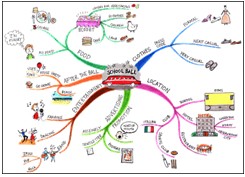
Tony Buzan’s grades were going down at university. Disappointed with his low marks, he went to the library to find a book on how to use his brain. He was directed to the medical section. Confused, he said to the librarian, “I don’t want to take my brain out, I just want to learn how to use it.” Her reply was simple: “There’s no book on that.”
“I thought to myself,” says Buzan, “if I buy a little radio, I get an instruction manual (说明书). If I buy a microwave, I get an instruction manual. But for the most important machine in the world, no instruction manual?”
Fifty years later, Buzan has become the world’s leading speaker on the brain and learning. In the late 1960s, he invented the mind map, a visual representation of thought processes.
This kind of thinking has become a popular tool for planning, organizing, problem solving, and communicating across the world. He has since authored and co-authored over 100 books that have appeared in more than 30 languages.
“I think in most cases, people use less than 1 percent of their brains,” he says.
But how do you expand this 1 percent? How do you become the best student you can be?
According to Buzan, the answer is simple. You take a section of whatever it is that you are trying to learn, he says, and you read it for its essence (精髓、要素). Then you make a mind map of all the important details. For a truly effective mind map, you start with a colored image in the center of your page. Draw the first image that comes to mind on the topic you are mind mapping. Branch off from your central image and create one of your main ideas. From your main branches draw some sub-branches and from those sub-branches you can draw even more branches. He emphasizes that you should use plenty of images and colors as these help with memory recall and encourage creativity.
By using this visual format (形式), according to Buzan, your mind will begin to make associations that will help you remember more information for longer periods of time.
Buzan believes that traditional note-taking methods, such as lists and summaries, do not stimulate the brain’s recall capacity or ability in the same way. Because of this, students will often find themselves locked away in their rooms for hours, trying hard to memorize separate details. Buzan believes that for a more effective and lasting way of studying, you must first understand how your brain works.
“Everyone is born smart,” he says. “You just have to learn how to learn.”
【小题1】What is the main purpose of the first two paragraphs?
| A.To show that Tony Buzan was worried about his study. |
| B.To invite us to think about the importance of manuals. |
| C.To prove that the mind map is a useful tool for the brain. |
| D.To show why Tony Buzan studies the brain and learning. |
| A.Excite. | B.Improve. | C.Encourage. | D.Affect. |
| A.If we learn the mind map, we will become the best student. |
| B.The mind map will help your brain connect separate details. |
| C.The mind map will be more effective if we put more details in it. |
| D.We will solve the problem if we make connections between ideas. |
| A.How to make the mind map? |
| B.Is the mind map widely used? |
| C.Can your memory be mapped? |
| D.Is the mind map helpful in thinking? |
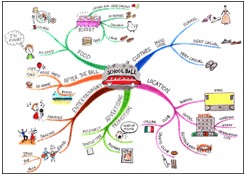
Tony Buzan’s grades were going down at university. Disappointed with his low marks, he went to the library to find a book on how to use his brain. He was directed to the medical section. Confused, he said to the librarian, “I don’t want to take my brain out, I just want to learn how to use it.” Her reply was simple: “There’s no book on that.”
“I thought to myself,” says Buzan, “if I buy a little radio, I get an instruction manual (说明书). If I buy a microwave, I get an instruction manual. But for the most important machine in the world, no instruction manual?”
Fifty years later, Buzan has become the world’s leading speaker on the brain and learning. In the late 1960s, he invented the mind map, a visual representation of thought processes.
This kind of thinking has become a popular tool for planning, organizing, problem solving, and communicating across the world. He has since authored and co-authored over 100 books that have appeared in more than 30 languages.
“I think in most cases, people use less than 1 percent of their brains,” he says.
But how do you expand this 1 percent? How do you become the best student you can be?
According to Buzan, the answer is simple. You take a section of whatever it is that you are trying to learn, he says, and you read it for its essence (精髓、要素). Then you make a mind map of all the important details. For a truly effective mind map, you start with a colored image in the center of your page. Draw the first image that comes to mind on the topic you are mind mapping. Branch off from your central image and create one of your main ideas. From your main branches draw some sub-branches and from those sub-branches you can draw even more branches. He emphasizes that you should use plenty of images and colors as these help with memory recall and encourage creativity.
By using this visual format (形式), according to Buzan, your mind will begin to make associations that will help you remember more information for longer periods of time.
Buzan believes that traditional note-taking methods, such as lists and summaries, do not stimulate the brain’s recall capacity or ability in the same way. Because of this, students will often find themselves locked away in their rooms for hours, trying hard to memorize separate details. Buzan believes that for a more effective and lasting way of studying, you must first understand how your brain works.
“Everyone is born smart,” he says. “You just have to learn how to learn.”
1.What is the main purpose of the first two paragraphs?
A.To show that Tony Buzan was worried about his study.
B.To invite us to think about the importance of manuals.
C.To prove that the mind map is a useful tool for the brain.
D.To show why Tony Buzan studies the brain and learning.
2.What does the word “stimulate” mean in the passage?
A.Excite. B.Improve. C.Encourage. D.Affect.
3.What can we infer from the passage?
A.If we learn the mind map, we will become the best student.
B.The mind map will help your brain connect separate details.
C.The mind map will be more effective if we put more details in it.
D.We will solve the problem if we make connections between ideas.
4.What is the best title for the passage?
A.How to make the mind map?
B.Is the mind map widely used?
C.Can your memory be mapped?
D.Is the mind map helpful in thinking?
| A.To show that Tony Buzan was worried about his study. |
| B.To invite us to think about the importance of manuals. |
| C.To prove that the mind map is a useful tool for the brain. |
| D.To show why Tony Buzan studies the brain and learning. |
| A.Excite. | B.Improve. | C.Encourage. | D.Affect. |
| A.If we learn the mind map, we will become the best student. |
| B.The mind map will help your brain connect separate details. |
| C.The mind map will be more effective if we put more details in it. |
| D.We will solve the problem if we make connections between ideas. |
| A.How to make the mind map? |
| B.Is the mind map widely used? |
| C.Can your memory be mapped? |
| D.Is the mind map helpful in thinking? |
湖北省互联网违法和不良信息举报平台 | 网上有害信息举报专区 | 电信诈骗举报专区 | 涉历史虚无主义有害信息举报专区 | 涉企侵权举报专区
违法和不良信息举报电话:027-86699610 举报邮箱:58377363@163.com