
题目列表(包括答案和解析)
|
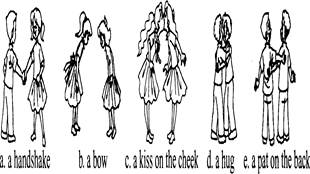
A greeting is a way of saying "Hello" to someone. People in different countries greet each other in different ways. Here are some.
World Greetings
|
Philippine |
The everyday greeting for friends is a handshake for both men and women. Men sometimes pat each other on the back. |
|
Japan |
When people meet for the first time, they usually bow. In business, people also shake hands. In formal situations, people often exchange business cards. When you give a business card, give it with two hands. This is polite. Special note: In Japan, a smile can have different meanings. It usually means that the person is happy, or that the person thinks something is funny. But it can also mean that the person is embarrassed. |
|
New Zealand |
Usually, both men and women shake hands when they meet someone for the first time. Fun fact: If you see two people pressing their noses together, they are probably Maori. The Maori are the native people of New Zealand. This is their traditional greeting. |
|
Brazil |
Men often shake hands when they meet for the first time. When women meet, they kiss each other on the cheek. Women also kiss male friends to say hello. When you shake hands, look at the person in the eyes. This shows interest and friendliness. |
1.In this passage, which of the following is NOT mentioned?
A.Kisses. B.Hugs. C.Bows. D.Handshakes.
2.Of the five pictures above (a, b, c, d and e), which is the same way to greet each other in the four countries?
A.a B.b C.c D.d
3.Which of the following is TRUE according to the passage?
A.Both men and women shake hands in Brazil when they meet.
B.Japanese won't smile until they feel very happy.
C.The Maori often press their noses together to greet each other.
D.In Philippine, people shake hands only when they meet for the first time.
(C)用所给词的适当形式填空,每空只填一词。
|
Being able to multitask—doing several things at the same time—is considered (考虑,认为) a welcome skill by most people. But if we consider the situation of the young people aged from eight to eighteen, we should think again.
What we often see nowadays is that young people juggle a larger number of electronic devices (电子产品) as they study. While working, they also surf on the Internet, send out emails, answer the telephone and listen to music on their iPods. In a sense, they are spending a large amount of time in fruitless efforts (努力) as they multitask.
Multitasking is even changing the relationship between family members. As young people give so much attention to their own worlds, they seem to have no time to spend with the other people around them. They can no longer greet family members when they enter the house, nor can they eat at the family table.
Multitasking also has an effect (影响) on young people’s performance at university and in the workplace. When asked about their opinions of the effects of modern gadgets (器具) on their performance of tasks, many young people gave a positive (肯定的) response (回应). However, the response from the worlds of education and business was not quite as positive. Educators feel that multitasking by children has a serious effect on later development of study skills. They believe that many college students now need help to improve their study skills. Similarly, employers (雇主) feel that young people entering the job market need to be taught all over again, as modern gadgets have made it unnecessary (没必要) for them to learn special skills to do their work.
1. What does the underlined word “juggle” most probably mean?
A. Want to buy. B. Use at the same time.
C. Take the place of. D. Search information from.
2.In Paragraph 3, the author points out that__________.
A. family members do not greet each other
B. family members do not eat at the family table
C. young people get on well with their families
D. young people hardly communicate with their family members
3.What’s the main idea of the last paragraph?
A. Young people must learn skills for future jobs.
B. Young people benefit (获益) a lot from modern gadgets.
C. Multitasking is an important skill to young people.
D. Multitasking influences young people’s development seriously.
4.Which of the following is TRUE according to the passage?
A. Young people think multitasking is good for their study and work.
B. Employers consider it unnecessary for young people to be taught all over again.
C. Educators feel that young people don’t need to improve their study skills.
D. People from the world of education believe multitasking has a good effect on children’s later study skills.
5. The author develops (阐述) the passage mainly by__________.
A. providing special examples
B. following the natural time order
C. giving out a cause and analyzing (分析) its effects
D. comparing opinions from different worlds
湖北省互联网违法和不良信息举报平台 | 网上有害信息举报专区 | 电信诈骗举报专区 | 涉历史虚无主义有害信息举报专区 | 涉企侵权举报专区
违法和不良信息举报电话:027-86699610 举报邮箱:58377363@163.com