
题目列表(包括答案和解析)
听力
Ⅰ.Listen and choose the right picture(根据你听到的内容,选出相应的图片):(共6分)
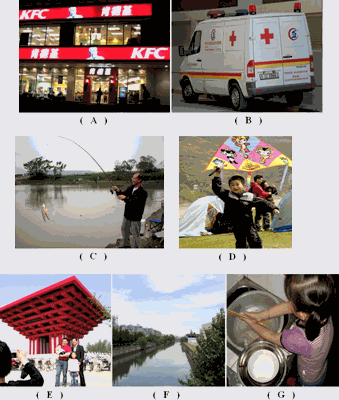
Ⅱ.Listen to the dialogue and choose the best answer to the question you hear(根据你听到的对话和问题,选出最恰当的答案):(共10分)
7.A.Mary
B.Jack.
C.Tom
D.Rose.
8.A.In the classroom.
B.In the office.
C.In the dinning hall.
D.In the playground.
9.A.Boring.
B.Difficult.
C.Exciting.
D.Interesting.
10.A.It's snowing.
B.It's raining.
C.It's fine.
D.It's cloudy.
11.A.Japanese.
B.French.
C.English.
D.Chinese.
12.A.By underground.
B.By car.
C.By bike.
D.By bus.
13.A.To visit Pudong.
B.To visit his grandparents.
C.To visit his aunt.
D.To visit his friends.
14.A.Tony was poor at math.
B.Tony likes to help others.
C.Ben failed to pass the math test.
D.Tony didn't like to study.
15.A.The woman can't return the skirt.
B.The shop hasn't got enough skirts.
C.The woman can have a change of the skirt.
D.The woman should pay more money.
16.A.Helen didn't ask for help.
B.Helen finished the work by herself.
C.Helen is hard-working and kind.
D.Someone helped Helen.
Ⅲ.Listen to the passage and tell whether the following statements are true or false(判断下列句子是否符合你听到的内容,符合的用“T”表示,不符合的用“F”表示):(共7分)
17.There was a big apple tree in front of Old John's house.
18.We know from the passage that the tree was there for more than fifty years.
19.John had a rich neighbour and the neighbour often gave him money.
20.The neighbour asked John to dig a hole to find some more money.
21.John dug a big hole for the neighbour to plant the young apple tree.
22.The neighbour gave John the young apple tree and John planted it himself.
23.After some years, the tree produced good apples and John sold them for money.
Ⅳ.Listen to the dialogue and fill in the blanks(根据你听到的内容,完成下列句子,每空格限填一词):(共7分)
24.There are about ________ hundred languages in the world.
25.English is not only used in England and the USA, but also in other ________ of the world.
26.It's hard to say how many people are learning English as a ________ language.
27.The only language that seems ________ to learn is the mother tongue.
28.We should ________ that we all learnt our mother language well when we were children.
29.We must do a lot of ________ when we want to learn English well.
30.Good teachers, records, tapes, books and dictionaries will be ________.
Have you ever noticed an advertisement which says " Learn a foreign
language in six weeks, or your money back! From the first day your
pronunciation will be excellent. Just send..." and so on?
Of course, it never happens quite like that. Anyone who learns a
foreign language would think that it is not true.
The only language that is easy to learn is the mother tongue. What is
the mother tongue? It is the first and main language that you learnt when
you were a child. And think how much practice that a child gets!
Before the Second World War, people usually learned a foreign
language in order to read the literary (文学的) works of the country.
Nowadays, speaking the foreign language is what most people want.
Every year many millions of people start learning one. How do they
do it?
Some people try at home , with books and tapes; some use radio
or television programs; others go to evening classes. If they use the
language only two or three times a week, learning it will take a long
time, like language leaning at school. A few people try to lean a
language fast by studying for six or more hours a day. It is clearly
easier to learn the language in the country where it is spoken. However,
most people cannot afford this, and many language learners need the
language in order to do their work better. For example, scientists and
doctors mainly need to be able to read books and reports in the foreign
language. Machines and good books will help, but they cannot do the
student's work for him. Whether the language is learned quickly or
slowly, it is hard work with a lot of training in reading, listening,
speaking, and writing.
1. In the advertisement it is possible for a person to learn a foreign, language In fact, everyone
who learns English would think it is not true.
A. using the language six or more hours a day
B. learning the language at school
C. studying the language in the foreign country
D. reading the foreign stories as many as possible
| |||||||||||||||||||||||||||||||||
| A.spelling, listening, grammar and reading |
| B.listening, speaking, reading and writing |
| C.taking exams, pronunciation, reading and writing |
| D.pronunciation, reading, listening and writing |
| A.learn more dialogues | B.learn a poem or a song by heart |
| C.practice speaking with your friends as much as you can | D.all above |
| A.It’s better to listen to English for a long time every day. |
| B.At the beginning, you’d better choose the tapes on which the people speak quickly. |
| C.At first you should begin with simple tapes for listening. |
| D.Few people think it hard to listen to English. |
| A.Many people find it difficult to listen to English. |
| B.Sit down and listen for an hour at a time. |
| C.Learn a poem or a song by heart can improve your speaking. |
| D.To improve speaking, you can practice speaking with your friends as much as you can. |
湖北省互联网违法和不良信息举报平台 | 网上有害信息举报专区 | 电信诈骗举报专区 | 涉历史虚无主义有害信息举报专区 | 涉企侵权举报专区
违法和不良信息举报电话:027-86699610 举报邮箱:58377363@163.com