
题目列表(包括答案和解析)
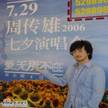
In his lowest days when few people bought his records, Taiwan singer Steve Chou lived alone in Canada and did little. One day, he passed by a local CD store and heard a song that greatly attracted him. “My heart tells me that music is the thing I truly want to do, not for fame(名誉)or money,” Chou said. That’s how we luckily have such a music genius(天才), who has since then composed(作曲)lots of hits for the pop music charts (排行榜).
“Sometimes we need to get close to nature to look deeply into our souls and see what we really want to follow,” he said.
Recently he has made public his latest work Lovers Genesis. In this album(集)he explores human relationships in the Internet age. “Technology itself is a good thing, but it depends on how you’re going to use it,” is Chou’s advice to teenagers.
Chou often gets his music ideas from trips. He has traveled to many places around the world and believes that learning a country’s language is the fastest way of experiencing the culture behind it.
Chou has worked hard on learning English to push forward his music career(事业). He has flown to the UK to attend months-long English training schools three times. There he lives with local families and practices daily conversations.
“So I could easily read the English instructions on recording machines and communicate with the local music producers,” said Chou, “The music reviews of the US or British singers that I appreciate(感激) could help me learn and grow with them.”
1.Which of the following about Steve Chou is the correct order?
①. He made public his work Lovers Genesis.
②. He passed by a local CD store and heard a song that greatly attracted him.
③. He composed lots of hits for the pop music charts.
④. Few people bought his records.
A. ①②③④ B. ④②③① C. ①③②④ D.④①③②
2.Why has Chou flown to the UK to learn English?
A. Because he wants to live in the UK.
B. Because his record company asks him to.
C. Because he wants to sell his album in the UK.
D. Because he thinks it will be helpful for his music career.
3.Steve Chou may agree with the following except that __________.
A. taking trips gives him some ideas of music
B. what we really want to follow is the most important
C. music is a thing that can bring him fame and money
D. in International age, technology itself is not a bad thing
4.What is Steve Chou like according to the passage?
A. Kind and helpful. B. Proud and confident.
C. Active and hard-working. D. Calm and disappointed.
School education is very important and useful. The students both learn knowledge and get educated. Yet, no one can learn everything from school. Scientists, such as Edison, Newton, Galileo and Einstein, didn't learn everything from school. They learnt a lot of knowledge outside school or practiced a lot themselves. A teacher, though he knows a lot, can't teach his students everything.
The teacher's job is to teach his students how to learn, how to read and how to think. A good teacher with rich experience in teaching can teach his students the methods (="ways)" of study. Through these methods students are able to learn and get a lot of things by themselves.
Usually it's very easy for students to memorize some knowledge, but it is difficult to use it to solve problems. If a teacher really teaches students the ability(能力) of how to use knowledge, it means the teacher has learned lots of knowledge by himself(or herself). The success in learning shows he or she knows how how how to study.
根据课文内容选择最佳答案(每题两分,共10分)
【小题1】From the passage we know ________.
| A.students are taught everything at school |
| B.a teacher can't teach his students everything |
| C.school is really not important and useful |
| D.Edison learned lots of knowledge at school |
| A.to help his students with their lessons |
| B.to teach his students everything |
| C.to show his students how how to study by themselves |
| D.to tell them how to study |
| A.c,a,b,d | B.b,c,a,d |
| C.c,b,d,a | D.c,d,a,b |
| A.If we know how to learn, we can get a lot of knowledge. |
| B.We can learn everything from our teachers. |
| C.The writer tells us that practice is more important for students than learning. |
| D.It is the only job for students to learn knowledge. |
| A.A real job for teachers |
| B.Study in and outside school |
| C.Practice-the only way of learning |
| D.How to learn language |
阅读下面短文,将短文中画线部分的句子翻译成中文,并将其答案写在答题卡的相应位置上。
We are all busy talking about and using the Internet. But how many of us know the history of the Internet?
At first the Internet was only used by the government . 112. But in the early 1970’s , universities, hospitals and banks are allowed to use it , too . However, computers were still very expensive and the Internet was difficult to use. By the start of the 1990’s, computers became cheaper and easier to use. Scientists had also developed software that made “surfing” the Internet more convenient.
113Today it is easy to use the Internet and sending e-mail is more and more popular among students.
|
1.__________________________________________________________
2.___________________________________________________________
Computers are very important to modern life. Many people think that in the future we will use computers in everyday life. It is thought that we won’t have to go shopping because we will be able to get most things which are sold in shops on the Internet. There will be no more books because we will be able to get all texts from computers. People will use the Internet to play games, see films and buy food. Also,we can use the Internet to make telephone calls.
Some people are glad about these new ways of shopping and communication (交际). Others do not think that computers will replace our old ways.
Let’s look at books, for example. Some people think that one day we will not read books made of paper. Instead, we will buy and read books using computers. We’ll read texts on small pocket computers. The computers will keep many different books in them at the same time. We won’t need to turn to lots of pages and we will save lots of paper. We will use more and more computerized (计算机化的) books
Is Internet shopping such a pleasure(愉快的事) as going to the shop? Many people say it is not. It is a pleasure to go into shops and look at things you want to buy. It is also unlikely (不大可能) that many people will want to read large texts on our computers, because paper books may be more friendly. Maybe computers won’t change these two habits .
【小题1】In the future , people will use computers for ___.
| A.playing games, shopping and making telephone calls |
| B.making telephone calls, having meals and seeing films |
| C.seeing films, buying food and going for holidays |
| D.playing games, making telephone calls and seeing the doctors |
| A.更新 | B.取代 | C.交换 | D.放弃 |
| A.Computerized books won’t be very expensive. |
| B.Computers can keep many different books in them. |
| C.We won’t have lots of pages. |
| D.We won’t need any paper. |
| A.about the old and new ways of shopping and communicating |
| B.if the Internet will change our habits |
| C.about computerized books |
| D.about future uses of computers |
| A.Computers will replace shops and books |
| B.Computers are the future |
| C.Computers will do everything for man |
| D.How computers change our life |
湖北省互联网违法和不良信息举报平台 | 网上有害信息举报专区 | 电信诈骗举报专区 | 涉历史虚无主义有害信息举报专区 | 涉企侵权举报专区
违法和不良信息举报电话:027-86699610 举报邮箱:58377363@163.com